
B.safe HPLC Solvent Bottle Sealing Cap System
| Brand | b.safe |
|---|---|
| Origin | Germany |
| Product Type | Imported HPLC Solvent Bottle Sealing System |
| Model | Solvent Bottle Sealing System |
| Material | PTFE/PPS, PTFE/PP, PTFE/PE |
| Temperature Resistance | –20 °C to +200 °C (PPS variants), 0 °C to +110 °C (PP variants), –50 °C to +80 °C (PE variants) |
| Chemical Resistance | +++ (Universal) / ++ (Very Good) |
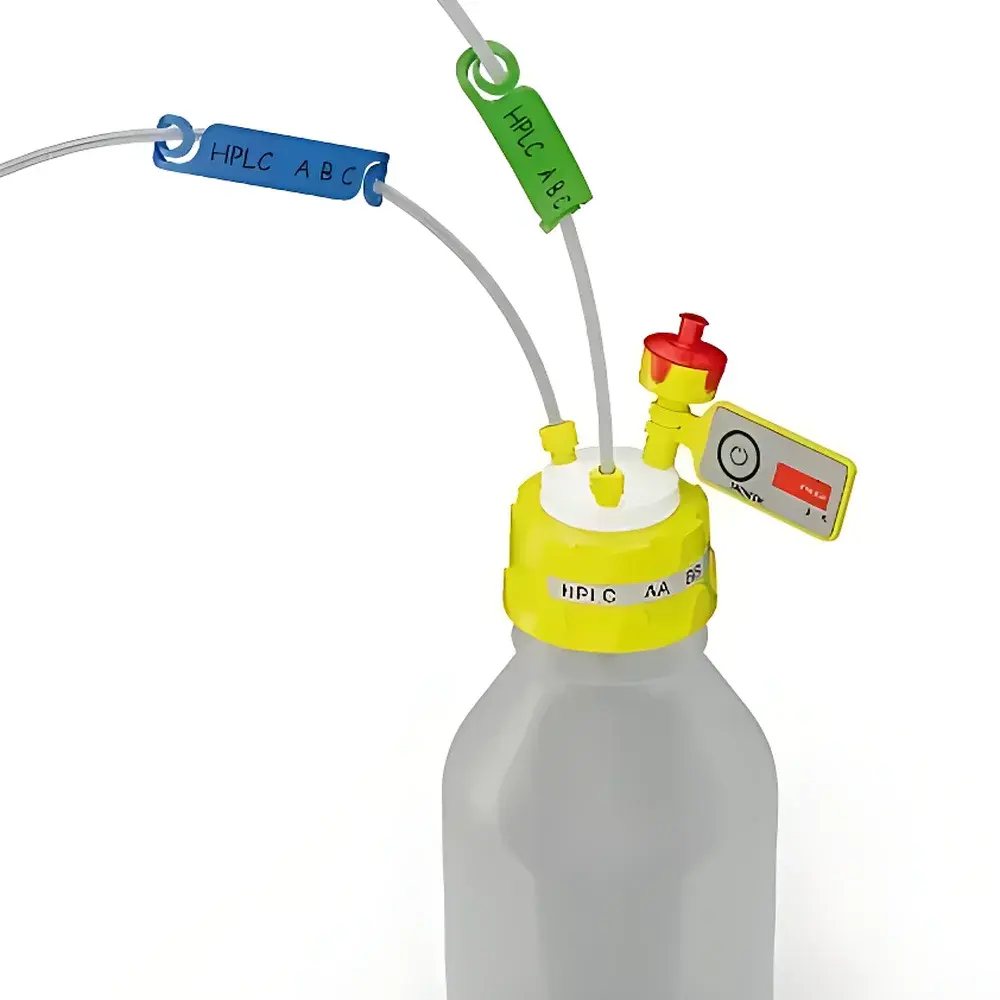
| Tube Configuration Options | 1–6 × Ø3.2 mm PFA-tube ports (yellow), 0–5 blind plugs (white), UNF 1/4″ thread interface |
| Sealing Element | Viton® flat gasket with PTFE sealing lip |
| Filtration | Hydrophobic porous PTFE membrane (6-month service life, color-indicating replacement window) |
| Sterilization | Autoclavable (121 °C, 20 min), dishwasher-safe |
| Compliance | Designed for GLP/GMP-compliant HPLC and UHPLC solvent delivery environments |
Overview
The b.safe HPLC Solvent Bottle Sealing Cap System is an engineered solution for maintaining solvent integrity, minimizing evaporation, and preventing particulate ingress in high-performance liquid chromatography (HPLC) and ultra-high-performance liquid chromatography (UHPLC) mobile phase reservoirs. Unlike conventional stoppers or generic caps, this system integrates fluid dynamics, chemical inertness, and process traceability into a single modular assembly. It operates on a pressure-balanced principle: an integrated air inlet valve—equipped with a hydrophobic, sintered PTFE membrane—allows ambient air to enter the solvent bottle only under vacuum conditions generated by the pump, while blocking solvent vapor escape and external contaminants. The cap’s mechanical architecture ensures leak-tight coupling between solvent tubing (via PFA fixed fittings), bottle neck, and atmospheric interface—critical for baseline stability, retention time reproducibility, and long-term system uptime in regulated analytical laboratories.
Key Features
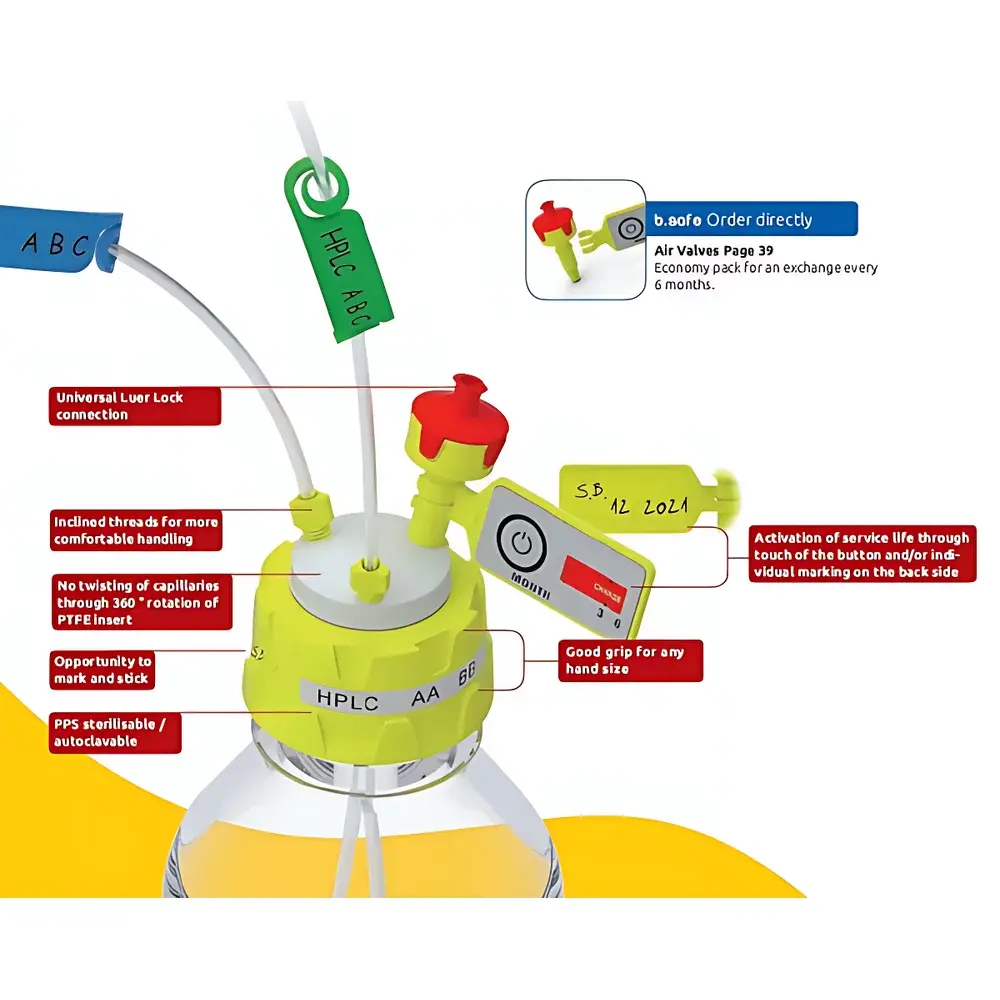
- Modular, chemically resistant construction: Outer housing in polyphenylsulfone (PPS) for autoclave compatibility (121 °C, 20 min) and mechanical robustness; inner core in virgin PTFE for universal chemical inertness across organic solvents, acids, and bases.
- Pressure-adaptive air inlet valve with integrated 0.2 µm hydrophobic PTFE membrane: Enables controlled air replenishment during solvent drawdown without introducing moisture or airborne particles; service life monitored via visual red-color indicator window (replacement recommended every 6 months).
- Ergonomic, glove-compatible design: Textured surface geometry and low-profile torque profile allow secure tightening—even with nitrile or latex gloves—without cross-threading or over-torquing.
- Rotatable PTFE inner core: Permits full cap engagement without disconnecting solvent lines, reducing downtime and contamination risk during routine maintenance.
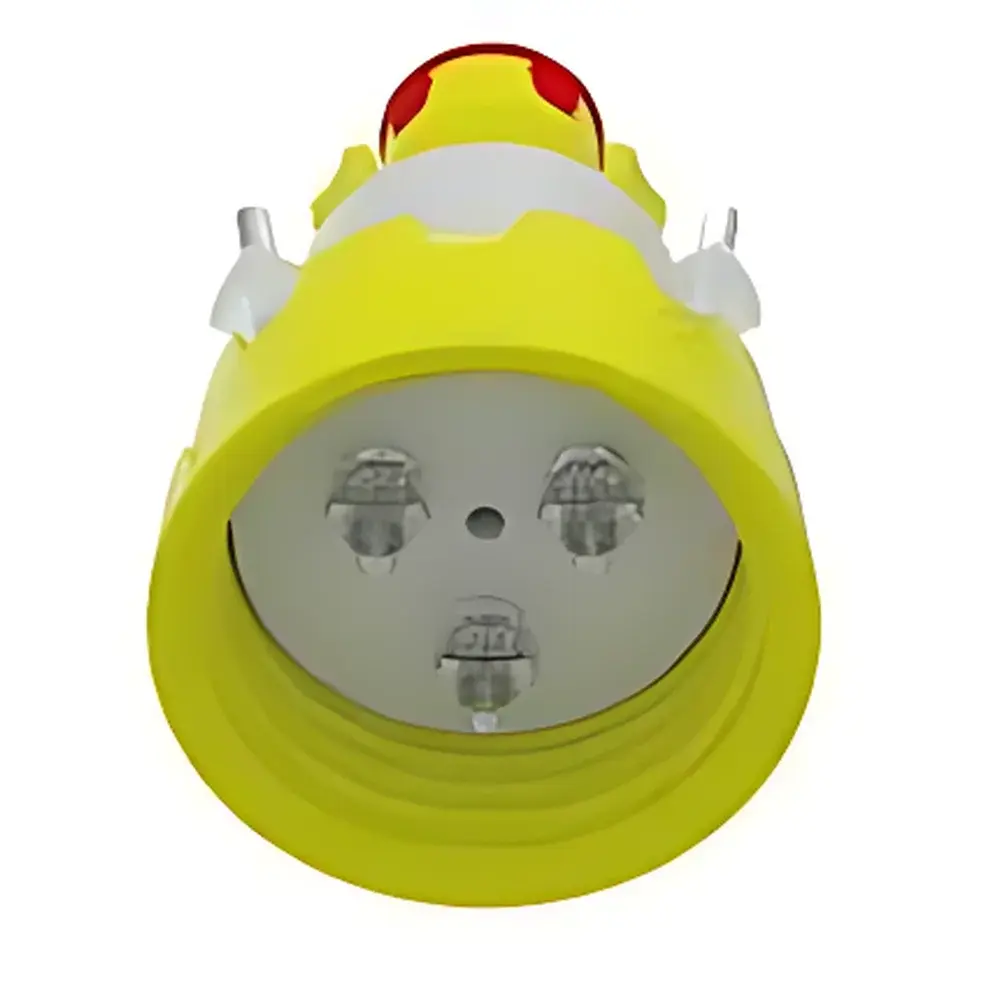
- UNF 1/4″ threaded interface with generous radial clearance: Accommodates standard PFA tubing (Ø3.2 mm) and air valves without kinking, ensuring laminar flow path integrity from reservoir to pump head.
- Viton® flat gasket with dual-seal geometry: Primary compression seal against bottle rim; secondary PTFE sealing lip isolates elastomer from solvent vapors—extending gasket life and eliminating extractables in sensitive LC-MS applications.
Sample Compatibility & Compliance
The b.safe sealing system is validated for use with standard 1–4 L glass or HDPE HPLC solvent bottles (e.g., Thermo Fisher, VWR, Fisherbrand). Its material set—PTFE, PPS, Viton®, and sintered PTFE—meets USP Class VI biocompatibility requirements and exhibits no detectable leachables under ICH Q5A/Q5D stress conditions. The system supports compliance with FDA 21 CFR Part 11 when used in conjunction with electronic logbook systems for filter change tracking. It is routinely deployed in laboratories operating under ISO/IEC 17025, ASTM D4291 (HPLC mobile phase handling), and EU GMP Annex 11 frameworks—particularly where solvent stability, batch-to-batch retention time consistency, and audit-ready maintenance records are mandatory.
Software & Data Management
While the cap itself is a passive hardware component, its integrated filter lifetime indicator enables structured manual documentation per GLP Annex 15. Each unit includes a dedicated log field on the cap body for recording replacement date and operator ID. For digital integration, laboratories may map cap installation and filter change events into LIMS or ELN platforms (e.g., LabWare, Benchling, Veeva Vault) using standardized SOP templates. No proprietary software or firmware is required—design prioritizes interoperability with existing quality management infrastructure.
Applications
- Long-term storage and dispensing of acetonitrile, methanol, water, THF, and aggressive mobile phases (e.g., TFA, HFIP, chlorinated solvents) in HPLC/UHPLC systems.
- Method transfer environments requiring identical solvent headspace conditions across instruments and sites.
- Regulated QC/QA labs performing pharmacopeial assays (USP , EP 2.2.46) where solvent evaporation-induced concentration drift must be eliminated.
- LC-MS workflows demanding ultra-low background and minimal ion suppression from volatile organics or silicone-based contaminants.
- Automated sample preparation systems integrating solvent reservoirs with robotic liquid handlers (e.g., Hamilton STAR, Tecan Freedom EVO).
FAQ
Is the b.safe cap compatible with all standard HPLC solvent bottles?
Yes—designed for universal fit on bottles with standard GL45 or GL32 neck threads (ISO 2858/ISO 4796). Adapter sleeves are available for non-standard geometries.
Can the cap withstand repeated autoclaving cycles?
PPS/PTFE variants are rated for ≥50 autoclave cycles at 121 °C, 20 min, 1 bar saturated steam. PP and PE versions are not autoclavable but are dishwasher-safe (≤75 °C).
How is filter replacement verified and documented?
The integrated PTFE membrane disc transitions from white to uniform red when exhausted. Users record replacement date, lot number, and initials directly on the cap’s engraved log field—fulfilling ALCOA+ data integrity principles.
Does the air inlet introduce moisture into the solvent?
No—the hydrophobic PTFE membrane (contact angle >110°) blocks liquid water and aerosols while permitting dry air diffusion under vacuum. RH exposure remains below 5% at 25 °C.
Are custom configurations available for OEM integration?
Yes—b.safe offers OEM kits with laser-marked part numbers, bulk packaging, and material certification (EN 10204 3.1) upon request.



