
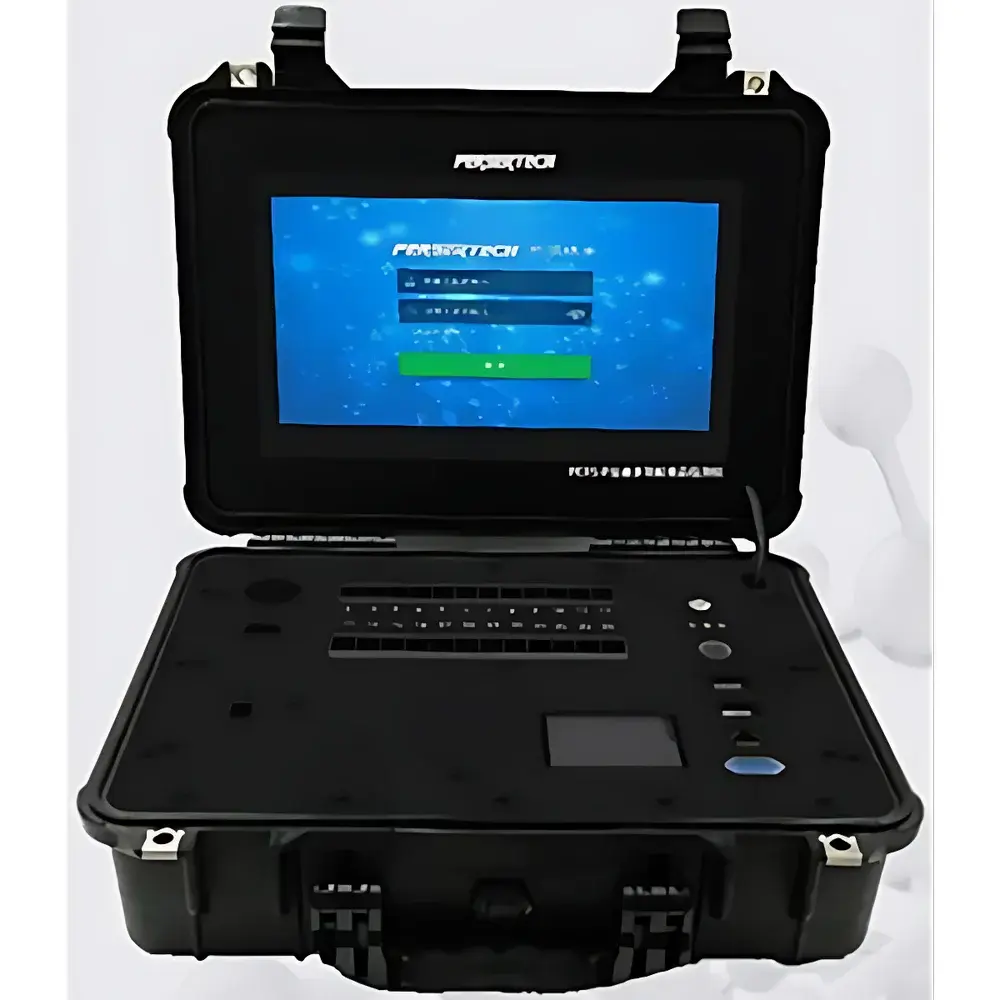
Safe AT-RS200 Portable Tri-Modal Raman Spectrometer with UV-Vis Absorption and Colloidal Gold Detection
| Brand | Safe |
|---|---|
| Origin | Beijing, China |
| Manufacturer Type | OEM/ODM Manufacturer |
| Instrument Type | Portable Handheld Raman Spectrometer |
| Model | AT-RS200 |
| Spectral Range | 200–3200 cm⁻¹ (Raman), 190–1100 nm (UV-Vis) |
| Spectral Resolution | ≤1 cm⁻¹ (Visible Raman), ≤2 cm⁻¹ (UV Raman) |
| Minimum Wavenumber | 200 cm⁻¹ |
| Spectral Repeatability | ≤±0.15 cm⁻¹ |
| Detection Modalities | Surface-Enhanced Raman Scattering (SERS), UV-Vis Absorption Spectrophotometry, Colloidal Gold Immunochromatographic Assay (CGIA) |
| Total Assay Coverage | ~600 analytes across food safety, environmental monitoring, and veterinary medicine |
Overview
The Safe AT-RS200 is an engineered tri-modal field-deployable analytical platform integrating three complementary optical detection technologies—Surface-Enhanced Raman Spectroscopy (SERS), UV-Vis absorption spectrophotometry, and colloidal gold immunochromatographic assay (CGIA)—within a single, ruggedized handheld enclosure. Unlike conventional single-principle instruments, the AT-RS200 leverages orthogonal signal transduction mechanisms to mitigate matrix interference, cross-reactivity, and false-negative rates inherent in monomodal rapid screening. Its core Raman module operates on the principle of inelastic light scattering: when monochromatic laser excitation (typically 785 nm or 532 nm) interacts with molecular vibrational modes, frequency-shifted Stokes and anti-Stokes photons are collected and dispersed via a high-efficiency holographic grating and thermoelectrically cooled CCD detector. This enables label-free, non-destructive identification of molecular fingerprints with high chemical specificity—particularly valuable for detecting trace adulterants, banned pharmaceuticals, and toxic small molecules in complex biological and environmental matrices.
Key Features
- Tri-modal architecture: Simultaneous hardware-level integration of SERS, UV-Vis photometry, and CGIA reflection photometry—no external modules or manual reconfiguration required.
- Field-optimized optical design: Dual-laser excitation capability (785 nm standard; optional 532 nm), optimized for both fluorescence suppression and resonance enhancement across diverse analyte classes.
- High spectral fidelity: ≤1 cm⁻¹ resolution in visible Raman range ensures baseline separation of closely spaced vibrational bands (e.g., carbonyl stretch vs. C–N bend in β-lactam antibiotics).
- Ruggedized portable form factor: IP54-rated enclosure, integrated Li-ion battery (≥8 h operation), and shock-absorbing chassis validated per MIL-STD-810G for transport and field use.
- SHINERS-compatible substrate interface: Supports proprietary silica-hybridized nanostructured substrates enabling >10⁶-fold SERS enhancement and ≥12-month shelf-stable reagent kits under ambient storage conditions.
- Onboard calibration traceability: Embedded NIST-traceable Raman shift standards (e.g., silicon at 520.7 cm⁻¹, cyclohexane at 802 cm⁻¹) enable daily instrument performance verification without external reference materials.
Sample Compatibility & Compliance
The AT-RS200 accepts liquid, semi-solid, and surface-swab samples directly—no solvent extraction or derivatization required for most targeted assays. Sample introduction supports disposable SERS substrates, cuvette-based UV-Vis measurement (10 mm pathlength), and lateral-flow strips for CGIA. All detection modules comply with internationally recognized validation frameworks: Raman quantification adheres to ASTM E1840-22 (Standard Practice for Calibration of Raman Spectrometers); UV-Vis absorbance measurements follow ISO 6425:2019 (spectrophotometer performance criteria); and CGIA interpretation meets CLSI EP12-A2 guidelines for qualitative immunoassay evaluation. The system architecture supports audit-ready data integrity per FDA 21 CFR Part 11 when deployed with optional secure firmware (including electronic signatures, user role management, and immutable audit trails).
Software & Data Management
Pre-installed SafeScan v4.2 firmware provides intuitive touchscreen-driven workflow navigation, with embedded method libraries for all 600+ validated assays—including dynamic spectral matching against curated reference libraries (SafeSpectra DB v3.1, containing >12,000 high-SNR Raman spectra of food contaminants, mycotoxins, antibiotics, and heavy metal chelates). Quantitative results are generated using multivariate calibration models (PLS-R, PCA-LDA) trained on reference-standard-spiked real-world matrices. Data export supports CSV, PDF report generation, and HL7-compliant XML for LIMS integration. Optional cloud synchronization enables centralized fleet monitoring, remote method updates, and anonymized aggregate trend analysis across multi-site deployments—fully compliant with GDPR and HIPAA data handling requirements.
Applications
The AT-RS200 delivers actionable analytical intelligence across regulated and resource-constrained environments: rapid on-site screening of pesticide residues (e.g., chlorpyrifos, thiamethoxam) and veterinary drug markers (e.g., enrofloxacin, ractopamine) in produce and meat; detection of illegal food additives (e.g., melamine, Sudan dyes, formaldehyde) in processed foods; quantification of heavy metals (Pb²⁺, Cd²⁺, As³⁺) via SERS-active chelation complexes; real-time water quality assessment (nitrate, phosphate, total organic carbon surrogates); and point-of-care verification of counterfeit pharmaceuticals through polymorph-specific Raman signatures. It is routinely deployed by national food safety inspection agencies, third-party certification laboratories, and agricultural cooperatives requiring GLP-aligned field data collection without laboratory dependency.
FAQ
What regulatory standards does the AT-RS200 support for method validation?
It supports ASTM E1840-22, ISO 6425:2019, CLSI EP12-A2, and FDA 21 CFR Part 11 when configured with secure firmware.
Can the instrument perform quantitative analysis without external calibration standards?
Yes—pre-loaded PLS-R models enable semi-quantitative reporting (ppb–ppm range) for >95% of listed assays; absolute quantification requires optional on-site standard addition for matrix-matched calibration.
Is spectral library customization available for proprietary analytes?
Yes—Safe offers contract spectral acquisition and model development services, including GMP-compliant reference material characterization and ICH Q5C stability testing of spectral signatures.
How is instrument performance verified in the field?
Built-in NIST-traceable Raman standards and automated daily self-diagnostic routines validate wavelength accuracy, intensity linearity, and detector dark-current stability before each analysis session.
Does the system support multi-user environments with role-based access control?
Yes—administrator, operator, and reviewer roles can be defined with configurable permissions for method editing, result approval, and audit log access.





