
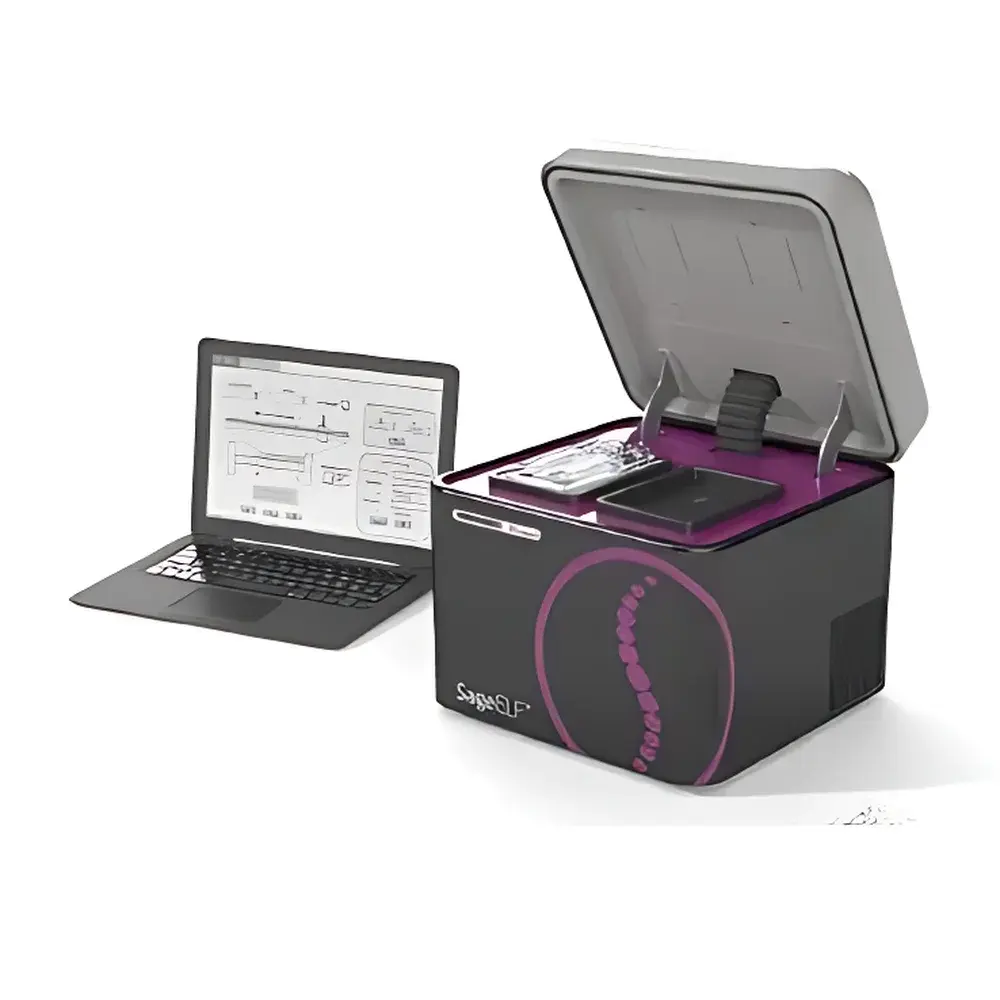
Sage Science ELF Automated DNA Fragment Recovery System
| Brand | Sage Science |
|---|---|
| Origin | USA |
| Manufacturer Type | Authorized Distributor |
| Product Origin | Imported |
| Model | ELF |
| Instrument Type | Magnetic Bead-Based Purification |
| Automation Level | Dedicated Fully Automatic |
| Throughput | 24 Samples per Run |
| Sample Volume Range | 24 µL (standard input volume) |
| Fragment Size Resolution | Continuous Fractionation into 12 Discrete Size Ranges |
| Maximum Recoverable DNA Size | Up to 18 kb (with Pulsed-Field Module) |
| Compatible Library Prep | Illumina, Ion Torrent, PacBio SMRT, Oxford Nanopore, Mate-Pair |
Overview
The Sage Science ELF Automated DNA Fragment Recovery System is an electrophoretically driven, high-resolution nucleic acid purification platform engineered for reproducible, size-selective recovery of DNA fragments from complex or low-input samples. Unlike conventional gel-based excision or bead-based size selection methods, the ELF system employs proprietary pulsed-field and constant-field electrophoresis within a microfluidic cassette to achieve continuous, programmable elution of DNA across 12 precisely defined size windows—ranging from sub-100 bp to >18 kb—without manual band cutting, UV exposure, or enzymatic shearing artifacts. This principle enables quantitative recovery of intact, high-fidelity DNA suitable for demanding downstream applications including long-read library construction, mate-pair sequencing, and archival sample rescue.
Key Features
- Electrophoretic size fractionation with real-time UV monitoring and automated fraction collection across 12 user-defined size bins
- Dedicated fully automatic operation: integrated liquid handling, electrophoresis control, fraction transfer, and magnetic bead-based binding/wash/elution in a single unattended workflow
- Optimized for low-input and degraded samples—including ancient DNA, forensic extracts, and FFPE-derived material—via enhanced capture efficiency and minimized loss during transfer steps
- Modular pulsed-field electrophoresis capability for separation and recovery of ultra-high-molecular-weight (UHMW) DNA up to 18 kb, critical for PacBio HiFi and Oxford Nanopore ultra-long read library preparation
- Pre-validated, application-specific protocols for Illumina TruSeq, Nextera Mate-Pair, PacBio SMRTbell, and ONT Ligation Sequencing kits
- On-board barcode scanning and audit-trail logging compliant with GLP and ISO 17025 documentation requirements
Sample Compatibility & Compliance
The ELF system accepts input DNA from diverse extraction chemistries—including silica-column, phenol-chloroform, and magnetic bead purifications—and accommodates variable purity profiles typical of clinical, forensic, and paleogenomic samples. Input volumes are standardized at 24 µL (range: 15–30 µL), compatible with post-PCR cleanup, sheared libraries, and enzymatically digested genomic DNA. All consumables—including electrophoresis cassettes, collection plates, and magnetic bead reagents—are manufactured under ISO 13485-certified conditions and supplied sterile-filtered and DNase/RNase-free. The system supports 21 CFR Part 11-compliant electronic signatures and full audit trail generation when paired with Sage Science’s ELFTM Software v4.2 or later.
Software & Data Management
ELF Control Software provides intuitive, wizard-driven method setup with preloaded electrophoresis profiles (e.g., “HiFi Long-Read”, “Mate-Pair 2–10 kb”, “Ancient DNA <500 bp”). Each run generates a complete metadata package—including voltage/time logs, UV intensity traces, fraction elution timestamps, and QC metrics (recovery yield, size distribution skew)—exportable as CSV, PDF, or LIMS-integrated XML. Raw electropherograms and fraction maps are stored with SHA-256 checksums to ensure data integrity. Software validation packages—including IQ/OQ documentation and protocol verification reports—are available for regulated environments requiring GMP or CLIA compliance.
Applications
- Size-selection for PacBio circular consensus sequencing (CCS) libraries requiring narrow insert distributions (e.g., 8–12 kb)
- Mate-pair library construction where precise 2–5 kb fragment recovery minimizes chimeric junctions
- Rescue and size-refinement of fragmented DNA from formalin-fixed paraffin-embedded (FFPE) tissue or ancient specimens prior to hybridization capture
- Preparation of asymmetric shearing controls for ATAC-seq and CUT&RUN assays
- Quality control and normalization of cfDNA libraries prior to targeted panel sequencing
- Fragment size standardization across multi-site clinical trial cohorts to reduce batch effects in variant calling
FAQ
Does the ELF system require gel casting or staining reagents?
No. The system uses disposable, pre-filled electrophoresis cassettes containing proprietary polymer matrix and embedded UV-transparent electrodes—eliminating acrylamide handling, ethidium bromide, or SYBR Safe.
Can I recover DNA fragments outside the standard 12-bin configuration?
Yes. Custom fractionation schemes (e.g., 8 bins with extended high-MW range or 16 bins for fine-resolution exome capture) can be programmed via advanced method editor; cassette compatibility must be verified with Sage Science Technical Support.
Is the ELF validated for clinical diagnostic use?
The ELF platform is CE-IVDR registered (Class B) and FDA-listed as a Class I exempt device for research use only (RUO); clinical validation studies are ongoing per ISO 15189 requirements in collaboration with CAP-accredited laboratories.
What maintenance is required beyond routine cleaning?
Annual calibration of UV detector linearity and electrophoresis current output is recommended; Sage Science offers certified field service engineers for on-site performance qualification (PQ) and preventive maintenance.
How does the ELF compare to manual gel excision in terms of DNA recovery yield?
Published comparative studies (J. Mol. Diagn. 2023;25:412–421) report median recovery of 68% for 3–8 kb fragments versus 22–35% with optimized gel extraction—attributed to absence of diffusion loss, UV damage, and incomplete elution.



