
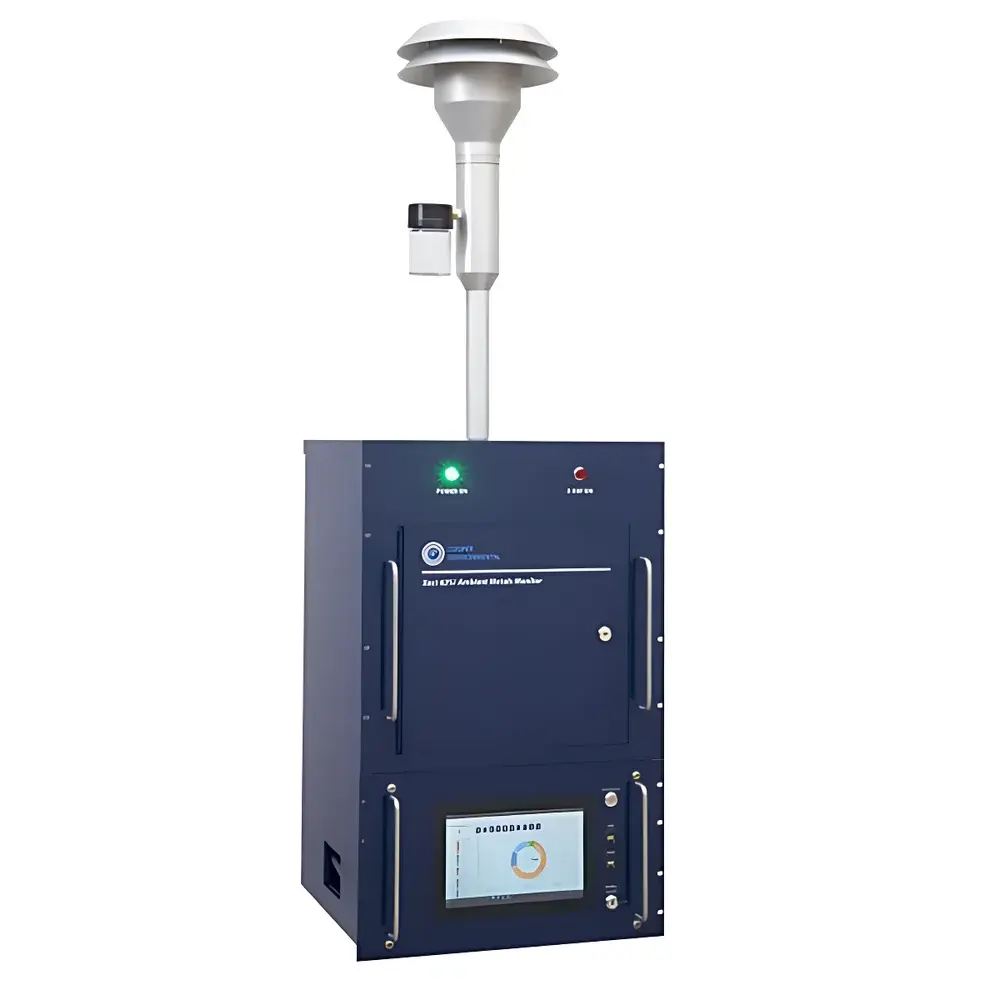
SAIL HERO CES Xact 625 Atmospheric Heavy Metal Online Analyzer
| Brand | SAIL HERO |
|---|---|
| Origin | Hebei, China |
| Manufacturer Type | OEM Manufacturer |
| Country of Origin | China |
| Model | CES Xact 625 |
| Product Category | Atmospheric Heavy Metal Analyzer |
| Measurement Principle | Energy-Dispersive X-Ray Fluorescence (EDXRF) |
| Sample Collection Method | Rotating Filter Tape with PM Size-Cut Inlet |
| Certification | EPA Environmental Technology Verification (ETV) Approved |
| Data Output | Real-Time Elemental Concentration (ng/m³), Time-Resolved Profiles (1–24 hr resolution) |
| Software | ADAPT Analytical Data Processing Toolkit |
| QA/QC Features | On-Board Internal Standard Source, Daily Automated XRF Calibration, Real-Time System Health Monitoring |
Overview
The SAIL HERO CES Xact 625 Atmospheric Heavy Metal Online Analyzer is an industrial-grade, continuous ambient air monitoring system engineered for high-temporal-resolution quantification of trace-level toxic metals in airborne particulate matter (PM2.5 and PM10). It operates on the principle of energy-dispersive X-ray fluorescence (EDXRF), a non-destructive, element-specific analytical technique that enables simultaneous multi-element detection without chemical digestion or reagent consumption. Airborne particles are size-selectively collected onto a rotating filter tape via a certified PM inlet (e.g., PM2.5 cyclone or TEOM-compatible impactor), followed by automated tape advancement to the measurement position. At this station, a low-power X-ray source excites characteristic fluorescent emissions from target elements—including Pb, As, Cd, Cr, Ni, Mn, Zn, Cu, Fe, and V—whose intensities are converted into mass concentrations (ng/m³) using factory-calibrated fundamental parameter algorithms. The system achieves laboratory-equivalent detection limits (sub-ng/m³ range for key toxics) while maintaining unattended operation over extended deployment cycles.
Key Features
- Continuous, real-time elemental analysis with configurable time resolution (1-hour to 24-hour averaging intervals)
- Rotating filter tape mechanism enabling sequential sampling and analysis—no downtime between acquisition and measurement
- Integrated meteorological sensor suite (wind speed/direction, temperature, relative humidity, pressure) co-located with sampling inlet for source apportionment modeling
- EPA ETV-verified methodology compliant with U.S. EPA Methods IO-3.3 and IO-4.3 for ambient metal monitoring
- On-board internal radioactive calibration source (e.g., 109Cd or 55Fe) for continuous spectral drift correction and precision validation
- Daily automated XRF system calibration with reference standards traceable to NIST SRMs
- Embedded diagnostics and fault logging supporting remote maintenance and GLP-compliant audit trails
Sample Compatibility & Compliance
The CES Xact 625 is validated for use with Teflon®-coated glass fiber or quartz fiber filter tapes compatible with EPA-recommended substrates. It meets performance criteria outlined in ISO 14707:2022 (ambient air—determination of metals in suspended particulate matter) and supports regulatory reporting frameworks including EU Directive 2004/107/EC (arsenic, cadmium, lead, nickel) and China’s HJ 93-2013 and HJ 657-2013 standards. All data outputs conform to EPA Data Quality Objectives (DQOs) for precision (RSD ≤15% at 3×MDL), accuracy (±25% recovery across matrix spikes), and completeness (>90% operational uptime). System firmware and data handling protocols are designed to support 21 CFR Part 11 compliance when deployed in regulated environmental laboratories or government air quality networks.
Software & Data Management
The proprietary ADAPT (Analytical Data Processing Toolkit) software provides a secure, browser-based interface for instrument control, real-time visualization, and post-acquisition spectral deconvolution. It delivers time-series plots, stacked bar charts of elemental contributions, wind-rose–integrated concentration maps, and customizable alerting (e.g., threshold exceedance, calibration failure, tape exhaustion). Raw spectra, processed results, QA/QC logs, and metadata are stored in SQLite or PostgreSQL databases with optional integration into enterprise LIMS or SCADA platforms via OPC UA or MQTT. Audit trails record all user actions, parameter changes, and calibration events with timestamped digital signatures—essential for ISO/IEC 17025 accreditation and regulatory audits.
Applications
- Urban and industrial air quality monitoring networks requiring speciated heavy metal data for health risk assessment
- Source identification and receptor modeling (e.g., PMF, CMB) in proximity to smelters, waste incinerators, traffic corridors, and construction zones
- Long-term trend analysis aligned with WHO Air Quality Guidelines and national emission inventory reporting
- Compliance verification for stationary source permits and ambient air standards enforcement
- Research applications in atmospheric chemistry, aerosol aging studies, and transboundary pollution tracking
FAQ
What elements can the CES Xact 625 quantify simultaneously?
It routinely measures up to 20 elements—including Pb, As, Cd, Cr, Ni, Mn, Zn, Cu, Fe, V, Se, Co, Mo, Sb, Sn, Ba, Ti, Ca, K, and Cl—with detection limits ranging from 0.01 to 0.5 ng/m³ depending on element mass absorption coefficient and collection efficiency.
Is the system suitable for unattended field deployment?
Yes. Designed for outdoor cabinet or shelter installation, it features wide-temperature-range electronics (−30 °C to +50 °C), integrated desiccant drying, and power-fail recovery logic ensuring data continuity during grid fluctuations.
How is data integrity ensured during long-term operation?
Through dual-layer QA/QC: hardware-level internal standard normalization per spectrum, plus software-level statistical process control (SPC) charts tracking daily calibration residuals, background stability, and tape transport repeatability.
Can the system be integrated into existing air monitoring infrastructure?
Yes. It supports Modbus TCP, DNP3, and HTTP RESTful APIs for seamless interoperability with central data acquisition systems and national air quality portals.
Does the analyzer require hazardous radioactive sources for operation?
No. The internal check source is a sealed, exempt-quantity isotopic source compliant with IAEA RS-G-1.9 and national radiation safety regulations—no licensing required for routine operation.







