
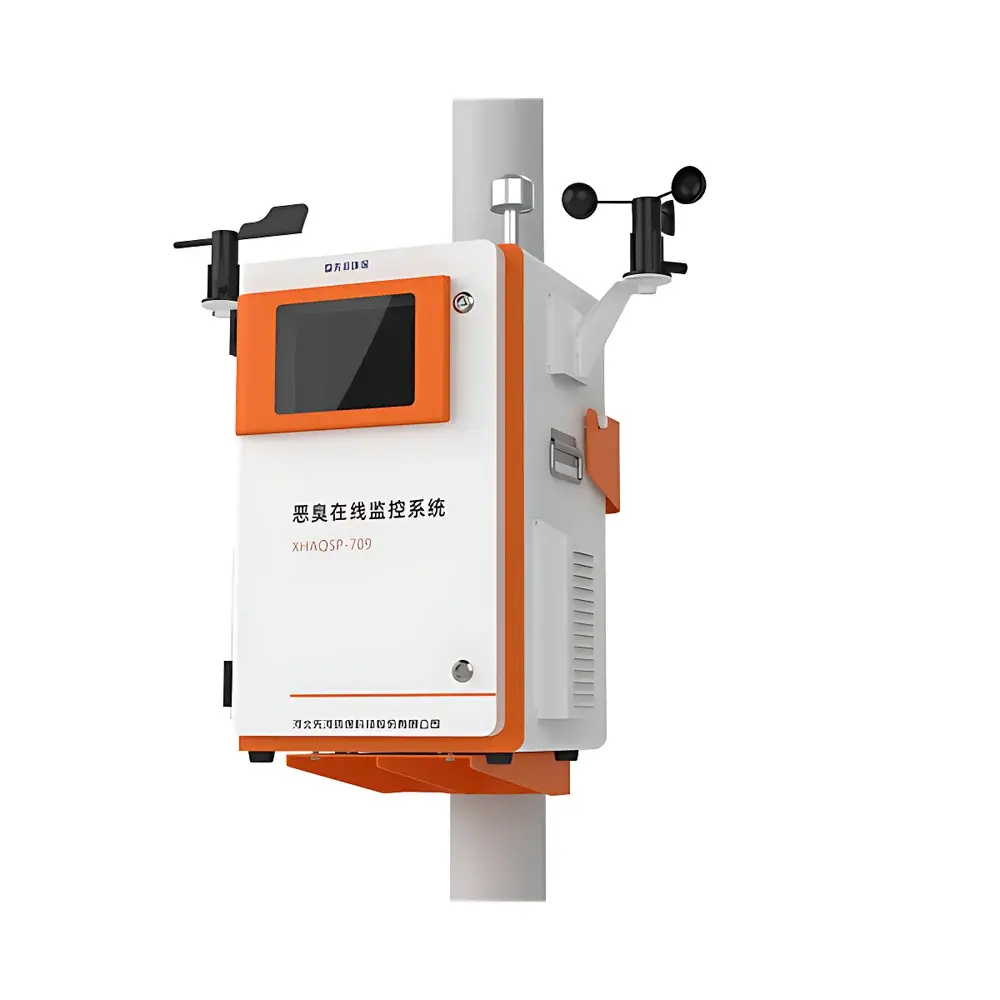
SAIL HERO XHAQSP-709B Fenceline Odor Monitoring System
| Brand | SAIL HERO |
|---|---|
| Origin | Hebei, China |
| Manufacturer Type | Direct Manufacturer |
| Product Origin | Domestic (China) |
| Model | XHAQSP-709B |
| Instrument Type | Online Monitoring System |
| Detection Principle | Multi-sensor Array (Electrochemical, Metal Oxide Semiconductor – MOS, Photoionization Detector – PID) |
| Target Analytes | NH₃, H₂S, Trimethylamine, Methanethiol, Dimethyl Sulfide, Dimethyl Disulfide, Carbon Disulfide, Styrene, Odor Intensity (OUₑ) |
| Optional | TVOC, Cl₂, HCl |
| Compliance | GB 14554–1993 “Emission Standard of Malodorous Pollutants” |
| Data Storage | ≥3 years |
| Operating Temperature Range for Sensors | −20 °C to +50 °C |
| Sampling Method | Constant-flow sampling |
| Humidity Mitigation | Deep condensation dew point control + multi-stage particulate filtration |
| Calibration | Automated zero/span calibration with standard gas |
| Connectivity | Dual-mode (wired Ethernet + wireless LTE/4G) |
| Display | Integrated capacitive touchscreen interface |
| Algorithm Engine | Cross-interference compensation model + neural network-based odor intensity quantification |
Overview
The SAIL HERO XHAQSP-709B Fenceline Odor Monitoring System is an industrial-grade, continuous emission monitoring solution engineered for real-time, on-site quantification of malodorous compounds at facility boundaries. Designed specifically for compliance-driven environmental management, the system implements a multi-modal sensing architecture grounded in three complementary detection principles: electrochemical (EC) cells for selective, low-concentration measurement of reactive gases such as H₂S and NH₃; metal oxide semiconductor (MOS) sensors for broad-spectrum volatile organic compound (VOC) response with thermal stability; and photoionization detectors (PID) for high-sensitivity, non-destructive detection of aromatic and unsaturated organics including styrene and trimethylamine. Unlike single-principle analyzers, the XHAQSP-709B integrates these transduction mechanisms into a synchronized sensor array, enabling simultaneous acquisition of concentration data across eight regulated odorants defined in China’s GB 14554–1993 standard — while also supporting configurable extension to additional regulatory targets such as chlorine (Cl₂), hydrogen chloride (HCl), and total VOCs (TVOC). The system operates under fenceline monitoring paradigms, where spatially distributed units provide time-resolved, location-tagged data streams essential for source attribution, dispersion modeling, and regulatory reporting.
Key Features
- Multi-sensor fusion architecture with real-time cross-interference compensation using empirically validated algorithmic models
- Neural network–based odor intensity (OUₑ) calculation compliant with GB/T 14675–1993 methodology
- Dual communication protocol support: industrial Ethernet (TCP/IP) and LTE/4G cellular for redundant remote telemetry
- Integrated thermoelectric cooling module enabling deep condensation dehumidification (dew point ≤ 5 °C), coupled with three-stage mechanical filtration to eliminate particulate and moisture artifacts
- Active sensor temperature stabilization across −20 °C to +50 °C ambient range, ensuring metrological consistency in outdoor deployments
- Constant-flow sampling pump with mass flow controller (MFC) feedback loop, maintaining ±1% volumetric accuracy over extended operational cycles
- Onboard 32 GB industrial-grade SSD supporting ≥3 years of second-resolution data logging (concentration, temperature, humidity, pressure, diagnostic flags)
- 7-inch capacitive touchscreen HMI with local visualization of real-time trends, alarm status, calibration history, and maintenance logs
- Automated calibration sequence with programmable schedules for zero-air and span-gas injection via integrated solenoid manifold
Sample Compatibility & Compliance
The XHAQSP-709B is validated for continuous sampling of ambient air, stack effluent, and ducted process exhaust streams. Its inlet conditioning system accommodates particulate loadings up to ISO 12103-1 A4 dust and relative humidity up to 95% RH (non-condensing). All measurement channels are traceable to national reference standards through factory calibration against NIM-certified gas standards. The system satisfies technical requirements outlined in GB 14554–1993 for fenceline odor concentration monitoring and aligns with the data integrity expectations of China’s Ministry of Ecology and Environment (MEE) Technical Guidelines for Online Monitoring of Malodorous Pollutants (HJ 1227–2021). While not certified to EU EN 13725 or US EPA Method TO-15, its modular design permits future adaptation to international odor assessment frameworks through firmware updates and sensor reconfiguration.
Software & Data Management
The embedded Linux-based firmware supports OPC UA server functionality for seamless integration into SCADA and DCS environments. Remote configuration, diagnostics, and firmware updates are managed via HTTPS-secured web interface or MQTT broker integration. All raw sensor outputs, processed concentrations, and derived odor intensity values are timestamped with GPS-synchronized UTC and stored with full audit trail: each calibration event, alarm trigger, and maintenance action is logged with user ID, timestamp, and contextual metadata. Data export conforms to CSV and NetCDF-4 formats, compatible with third-party analytics platforms. The system supports 21 CFR Part 11–compliant electronic signatures when deployed in GMP-aligned pharmaceutical or biotech manufacturing zones — provided supplementary validation documentation is executed per site-specific IQ/OQ protocols.
Applications
- Fenceline monitoring for wastewater treatment plants, composting facilities, and rendering operations
- Continuous compliance verification at chemical manufacturing, pharmaceutical synthesis, and food processing sites
- Odor impact assessment during environmental impact assessments (EIA) and post-permit operational reviews
- Source identification and plume tracking in conjunction with meteorological stations and Gaussian dispersion modeling tools
- Real-time public-facing odor advisory systems integrated with municipal air quality dashboards
- Research applications in atmospheric chemistry, microbial VOC emissions, and olfactometry correlation studies
FAQ
Does the XHAQSP-709B meet international odor standards such as EN 13725?
No — it is designed and validated for compliance with Chinese national standards (GB 14554–1993, HJ 1227–2021). Adaptation to EN 13725 requires additional olfactometric correlation and dynamic dilution validation.
Can the system operate reliably in sub-zero ambient temperatures?
Yes — its active sensor temperature control maintains operational stability between −20 °C and +50 °C, with cold-start capability verified down to −30 °C ambient when powered continuously.
Is raw sensor data accessible for custom algorithm development?
Yes — all unprocessed analog and digital sensor outputs (including baseline drift, response kinetics, and temperature-compensated signals) are exposed via Modbus TCP and RESTful API endpoints.
What maintenance intervals are recommended for long-term deployment?
Sensor modules require replacement every 12–18 months depending on exposure profile; filters should be inspected quarterly and replaced semiannually; annual full-system calibration and leak check are advised.
How is interference from ambient VOCs handled during H₂S or NH₃ measurement?
The system applies a dual-layer correction: first, hardware-level bandpass filtering and differential referencing; second, software-level multivariate regression trained on >20,000 field-collected spectra to suppress cross-sensitivity artifacts.







