
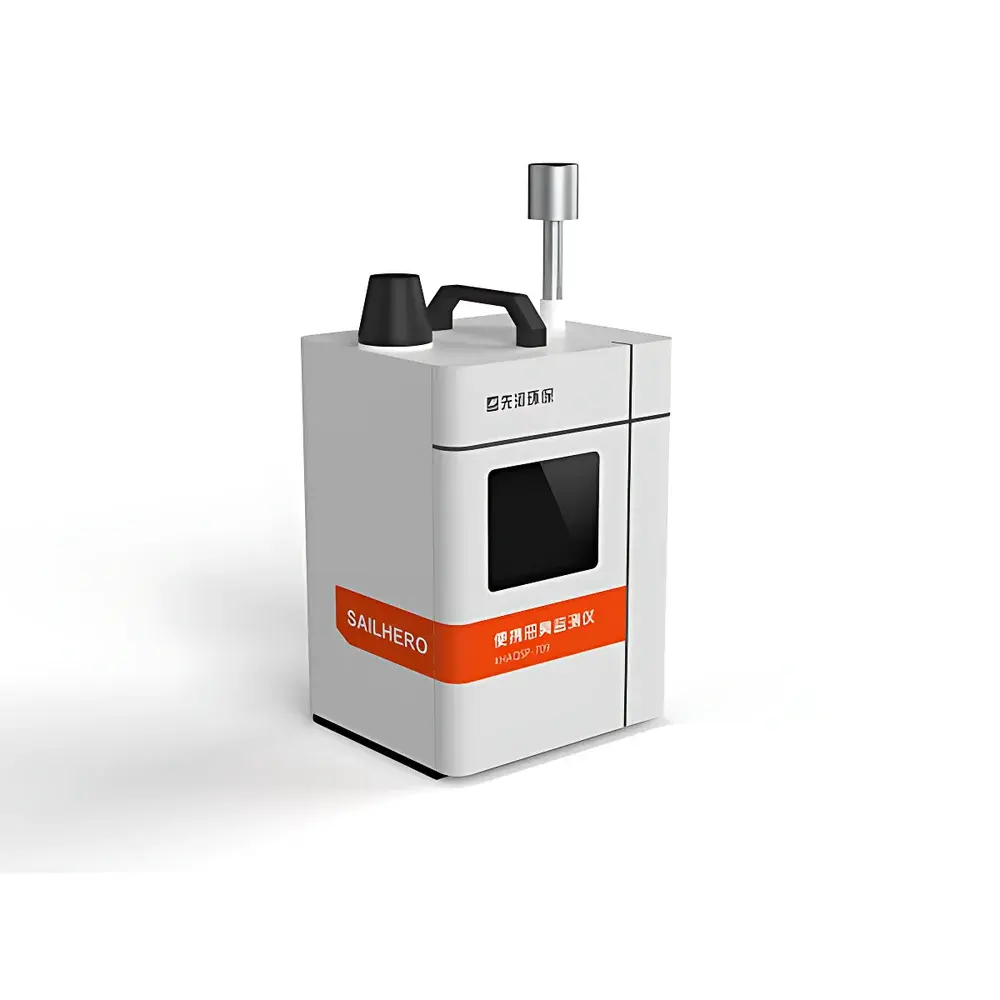
SAIL HERO XHAQSP-709D Portable Onsite Odor Monitoring System
| Brand | SAIL HERO |
|---|---|
| Origin | Hebei, China |
| Manufacturer Type | Original Equipment Manufacturer (OEM) |
| Country of Origin | China |
| Model | XHAQSP-709D |
| Instrument Type | Portable |
| Detection Principles | Electrochemical (EC), Metal Oxide Semiconductor (MOS), Photoionization Detection (PID) |
| Target Analytes | NH₃, H₂S, Trimethylamine, Methanethiol, Dimethyl Sulfide, Dimethyl Disulfide, Carbon Disulfide, Styrene, Odor Intensity (OUₑ), Optional: TVOC, Cl₂, HCl |
| Compliance | GB 14554–1993 “Emission Standard of Odorous Pollutants” |
| Data Connectivity | 4G + BeiDou/GPS Dual-Mode Positioning |
| Power Supply | Rechargeable Lithium Battery + AC Adapter |
| Operating Temperature Range | –20 °C to +50 °C with Sensor Thermostatic Control |
| User Interface | Industrial-Grade Capacitive Touchscreen |
| Calibration | Automated Zero Calibration |
| Software Integration | Cloud Platform & Mobile APP (iOS/Android) |
| Data Processing | Cross-Interference Compensation Algorithm, Artificial Neural Network (ANN) Modeling, Principal Component Analysis (PCA) |
Overview
The SAIL HERO XHAQSP-709D Portable Onsite Odor Monitoring System is a field-deployable, multi-sensor gas analyzer engineered for real-time quantification and odor intensity assessment of complex malodorous emissions. It operates on a hybrid detection architecture integrating electrochemical (EC), metal oxide semiconductor (MOS), and photoionization detection (PID) technologies—each sensor channel calibrated and temperature-stabilized to ensure metrological consistency under variable ambient conditions. Unlike fixed-station odor analyzers reliant on olfactometry or GC-MS, the XHAQSP-709D delivers rapid (<60 s response time), trace-level (ppb–ppm range) measurements of eight regulated odorants defined in China’s GB 14554–1993, including ammonia (NH₃), hydrogen sulfide (H₂S), trimethylamine, methanethiol, dimethyl sulfide, dimethyl disulfide, carbon disulfide, and styrene. Its odor intensity output (expressed in European Odor Units, OUₑ) is derived from a weighted sum algorithm incorporating sensor response profiles, cross-interference correction matrices, and ANN-based pattern recognition trained on reference odorant mixtures.
Key Features
- Thermostatically controlled sensor module maintains stable operating temperature (±0.5 °C) across –20 °C to +50 °C ambient range—mitigating thermal drift and enhancing long-term signal reproducibility.
- Integrated dual-mode positioning system combining 4G cellular data transmission with BeiDou and GPS satellite navigation enables georeferenced emission mapping and mobile deployment tracking.
- Industrial-grade 7-inch capacitive touchscreen with glove-compatible operation supports offline data visualization, parameter configuration, and real-time trend analysis without external devices.
- Rechargeable lithium-ion battery (≥12 h continuous operation at 25 °C) with smart charge management and AC adapter compatibility ensures uninterrupted field use in remote or infrastructure-limited locations.
- Automated zero calibration sequence reduces manual maintenance frequency and minimizes downtime—calibration status and drift logs are timestamped and stored with audit-trail capability.
- Modular sensor architecture allows optional expansion for chlorine (Cl₂), hydrogen chloride (HCl), or total volatile organic compounds (TVOC), supporting site-specific regulatory requirements beyond standard odorant panels.
Sample Compatibility & Compliance
The XHAQSP-709D is validated for direct sampling of ambient air, stack effluents, landfill boundary air, wastewater treatment headspaces, and composting facility exhaust streams. All sensor modules comply with IEC 60079-0 (Explosive Atmospheres – General Requirements) for non-intrinsically safe zone deployment when used with appropriate enclosure ratings (IP65). Data reporting conforms to GB 14554–1993 Annex A and B protocols for odor concentration calculation and emission rate derivation. While not certified to ISO 16000-29 (Indoor Air – Odor Assessment) or EN 13725 (Ambient Air – Dynamic Olfactometry), its algorithmic odor intensity estimation provides a technically defensible screening tool aligned with national enforcement frameworks and pre-compliance verification workflows. Raw sensor outputs and processed OUₑ values are exportable in CSV/JSON formats compatible with GLP-aligned laboratory information management systems (LIMS).
Software & Data Management
Data acquisition, visualization, and remote control are managed via the proprietary SAIL HERO Cloud Platform—a secure, role-based web interface supporting TLS 1.2 encryption and OAuth 2.0 authentication. The platform stores time-synchronized sensor readings, GPS coordinates, calibration events, and algorithm version metadata with configurable retention policies (default: 180 days). An iOS and Android mobile application enables live telemetry viewing, alarm notification (SMS/email push), instrument reconfiguration (e.g., sampling interval, alarm thresholds), and offline log download. All data transactions comply with GDPR-compliant anonymization practices where applicable; audit trails record user actions, timestamps, and IP addresses per 21 CFR Part 11 principles for electronic records integrity. PCA-based source apportionment reports can be generated on-demand using historical datasets uploaded to the cloud analytics engine.
Applications
- Regulatory compliance monitoring at municipal wastewater treatment plants, rendering facilities, and food processing sites subject to GB 14554–1993 emission limits.
- Rapid odor source identification during community complaint investigations—geotagged measurements support spatial interpolation and plume dispersion modeling.
- Pre-commissioning verification of odor control systems (e.g., biofilters, activated carbon units) by establishing baseline emission profiles before and after mitigation installation.
- Research-grade field studies assessing seasonal variation in biogenic odorant emissions from agricultural operations or anaerobic digesters.
- Mobile monitoring campaigns along industrial park perimeters or urban-rural interfaces where fixed monitoring stations lack spatial resolution.
FAQ
Does the XHAQSP-709D meet international odor standards such as EN 13725 or ISO 16000-29?
No—the instrument is designed and validated specifically against GB 14554–1993. It serves as a high-resolution screening tool, not a replacement for dynamic olfactometry or certified reference methods.
Can sensor modules be replaced or recalibrated in the field without returning to the manufacturer?
Yes—field-swappable sensor cartridges with embedded calibration coefficients enable on-site replacement; full recalibration requires connection to the SAIL HERO Calibration Station (sold separately) and certified span gases.
How does the neural network algorithm handle unknown or untrained odorant mixtures?
The ANN model operates within a bounded chemical space defined by its training dataset (eight primary odorants + common interferents); extrapolation beyond this domain triggers an uncertainty flag in the output report.
Is raw sensor data accessible for third-party analysis?
Yes—CSV exports include timestamped analog/digital sensor outputs, temperature/humidity compensation values, and algorithm-derived odor intensity indices, all with SI-unit annotations.
What cybersecurity measures protect data transmitted over 4G networks?
All telemetry uses AES-256 encryption in transit; device authentication employs certificate-based mutual TLS, and firmware updates require signed digital signatures verified prior to installation.
Related Products







