
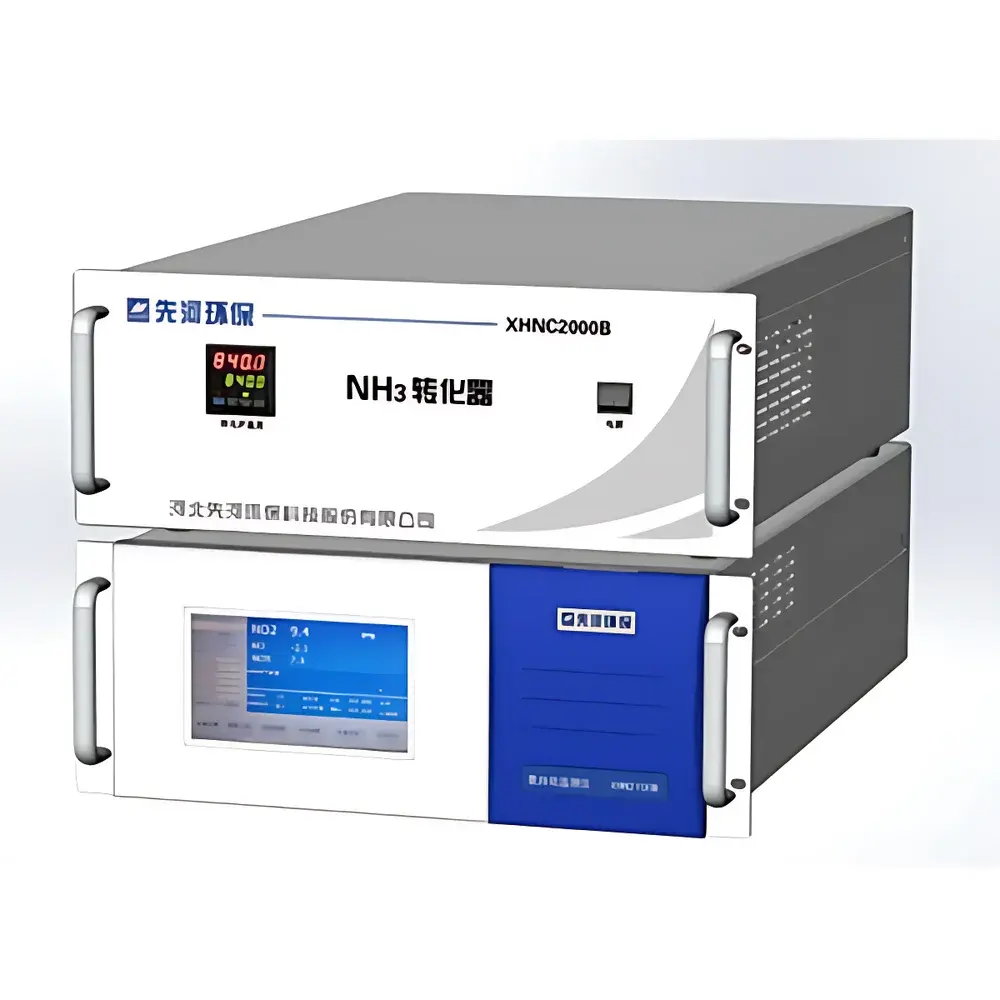
SAIL HERO XHN2100B Ammonia (NH₃) Analyzer for Ambient Air Monitoring
| Brand | SAIL HERO |
|---|---|
| Model | XHN2100B |
| Measurement Principle | Chemiluminescence Detection (CLD) with NO–O₃ Reaction |
| Target Analyte | NH₃ (derived via TNₓ–NOₓ differential) |
| Compliance | Designed for continuous ambient air quality monitoring per China’s HJ 654-2013 and compatible with EPA Method 7010 / ISO 11088:2021 frameworks |
| Output Options | RS232, RS485, 0–5 V analog, 4–20 mA current loop (optional) |
| Environmental Compensation | Integrated temperature & pressure sensors with real-time correction |
| Calibration | Manual or remote zero/span calibration capability |
| Display & Interface | Touchscreen GUI with multilingual support (default Chinese, English firmware-ready) |
| Power Supply | 220 VAC ±10%, 50 Hz |
| Operating Temperature | 0–40 °C |
| Enclosure Rating | IP54 |
Overview
The SAIL HERO XHN2100B Ammonia (NH₃) Analyzer is a fixed-site, continuous ambient air quality monitoring instrument engineered for high-reliability quantification of gaseous ammonia in outdoor and indoor environmental applications. It employs a dual-channel chemiluminescence detection (CLD) methodology based on the well-established NO–O₃ reaction kinetics. In this process, ambient NO is reacted with ozone (O₃) to generate excited-state nitrogen dioxide (NO₂*), which emits photons at ~600–3000 nm upon relaxation. The emitted light intensity—measured by a low-noise photomultiplier tube (PMT)—is linearly proportional to the NO concentration. To determine NH₃, the instrument first measures total reactive nitrogen oxides (TNₓ) after catalytic conversion of NH₃ to NO at >650 °C in a molybdenum or stainless-steel converter, then separately measures NOₓ (NO + NO₂) without conversion. The difference (TNₓ – NOₓ) yields the equivalent NH₃ concentration. This indirect but metrologically traceable approach ensures robustness against interferences from common atmospheric species such as SO₂, VOCs, and particulate matter—provided converter efficiency and ozone purity are maintained per CLD best practices.
Key Features
- Chemiluminescence-based NH₃ quantification via TNₓ–NOₓ differential measurement, compliant with internationally recognized CLD principles for reactive nitrogen speciation
- Integrated thermal converter with precise temperature control (>650 °C) ensuring ≥95% NH₃-to-NO conversion efficiency under field conditions
- Onboard ozone generator with real-time O₃ concentration monitoring and feedback regulation to maintain stoichiometric excess
- Automatic temperature and barometric pressure compensation algorithms aligned with ISO 4222 and EPA 40 CFR Part 53 requirements for ambient gas analyzers
- Touchscreen human-machine interface (HMI) supporting configurable data logging intervals, alarm thresholds, and unit selection (ppb, µg/m³, nmol/mol)
- Embedded self-diagnostic system with fault logging, sensor health monitoring, and visual/audible alerts for low O₃, converter failure, or PMT signal drift
- Modular I/O architecture supporting RS232/RS485 serial communication, 0–5 V analog output, and 4–20 mA current loop (field-selectable via configuration menu)
Sample Compatibility & Compliance
The XHN2100B is validated for use with ambient air samples across urban, rural, agricultural, and industrial boundary layer environments. It meets the performance specifications outlined in China’s HJ 654-2013 Technical Specification for Ambient Air Quality Continuous Automatic Monitoring Systems (Gaseous Pollutants), including linearity (R² ≥ 0.999), zero drift (<±1 ppb/24 h), span drift (<±2% full scale/24 h), and response time (T₉₀ < 120 s). Its design incorporates materials and seals compatible with typical ambient humidity (10–90% RH non-condensing) and particulate loading (≤100 µg/m³ PM₁₀). While not certified to EU EN 14625 or US EPA EQOA equivalency protocols, its core CLD architecture aligns with the measurement science underpinning those standards. Data integrity supports GLP-compliant workflows through timestamped event logs and audit-trail-capable firmware (optional upgrade available).
Software & Data Management
The analyzer runs embedded Linux-based firmware with secure web-enabled configuration (HTTPS) and local SD-card data storage (up to 12 months at 1-minute resolution). Raw signals (PMT voltage, converter temperature, O₃ output, ambient T/P) are recorded alongside calculated NH₃, NO, NO₂, and NOₓ concentrations. Export formats include CSV and XML, compatible with national air quality data platforms (e.g., CNEMC AQS) and third-party SCADA systems. Remote firmware updates and diagnostic telemetry are supported via Ethernet or optional 4G LTE module. All calibration events, maintenance logs, and alarm triggers are stored with UTC timestamps and user-accessible identifiers—enabling traceability required under ISO/IEC 17025 and laboratory QA/QC programs.
Applications
- Continuous monitoring of NH₃ emissions near livestock facilities, fertilizer application zones, and wastewater treatment plants
- Urban and regional air quality networks tracking secondary inorganic aerosol (SIA) precursors
- Research-grade studies on atmospheric nitrogen cycling, dry deposition modeling, and ammonia–PM₂.₅ formation pathways
- Compliance verification for industrial stack emissions where NH₃ is a regulated parameter (e.g., SCR de-NOₓ systems)
- Indoor air quality assessment in agricultural laboratories, animal housing, and food processing environments
FAQ
How does the XHN2100B distinguish NH₃ from other nitrogen-containing compounds?
It relies on selective catalytic conversion: only NH₃ (and some organic amines) convert quantitatively to NO at elevated temperatures in the converter; NO₂, HONO, and PAN do not contribute significantly under optimized conditions.
Is ozone purity critical to measurement accuracy?
Yes—impurities (e.g., NOₓ, hydrocarbons) in the O₃ stream cause background luminescence. The instrument includes an O₃ scrubber and real-time UV absorbance monitoring to ensure ≥99.5% O₃ purity.
Can the analyzer operate unattended for extended periods?
Yes—designed for 7×24 operation with automatic zero/span scheduling, power-failure recovery, and low-maintenance consumables (O₃ generator cell life ≥12 months at 25 °C).
What calibration gases are required for routine maintenance?
Certified NO-in-N₂ standard (e.g., 100 ppb) for NOₓ channel validation; NH₃-in-air permeation tube or dynamic dilution source for TNₓ channel verification; zero air (hydrocarbon-free, <1 ppb NOₓ) for baseline checks.
Does the XHN2100B support FDA 21 CFR Part 11 compliance?
Out-of-the-box functionality includes electronic signatures, audit trails, and role-based access control—configurable to meet Part 11 requirements when deployed in regulated pharmaceutical or environmental testing labs.







