
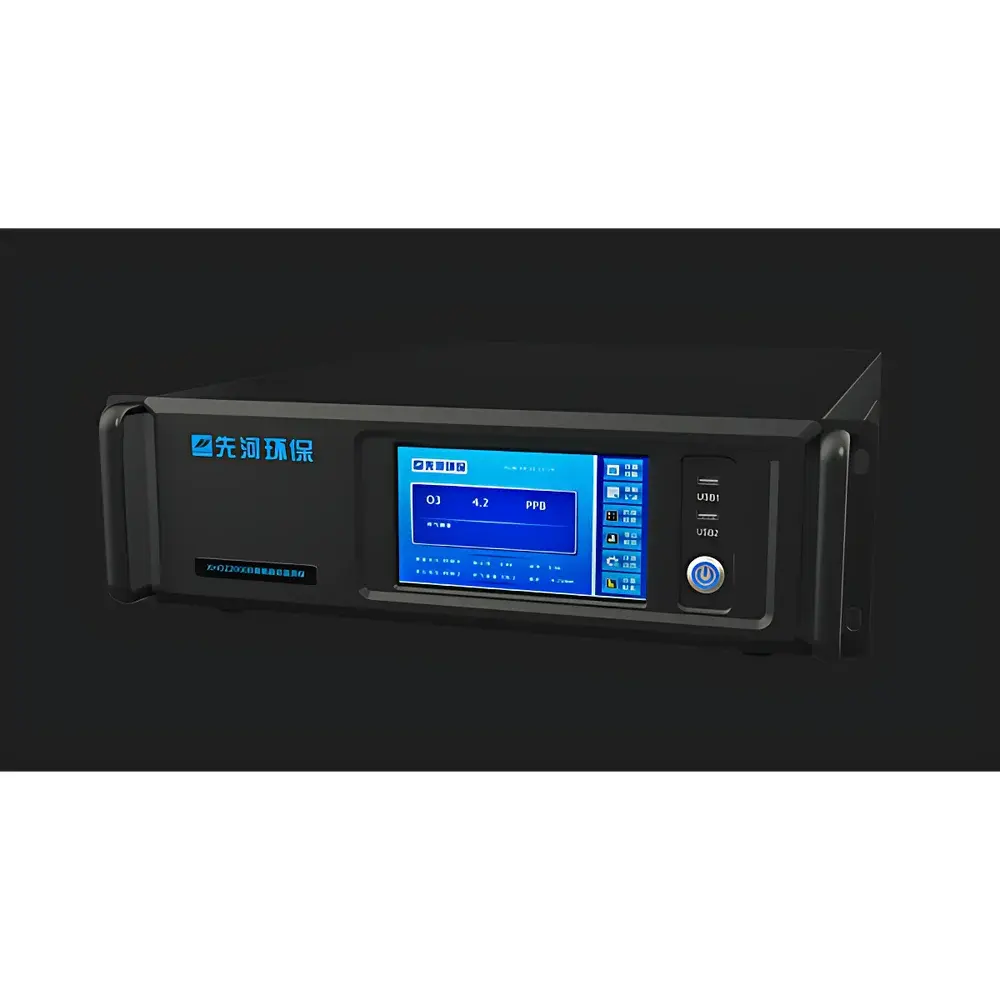
SAIL HERO XHOZ2000B Ozone Analyzer
| Brand | SAIL HERO |
|---|---|
| Origin | Hebei, China |
| Manufacturer Type | Manufacturer |
| Origin Category | Domestic |
| Model | XHOZ2000B |
| Pollutant Measured | O₃ |
| Measurement Principle | UV Absorption at 254 nm |
| Calibration | Manual and Remote Zero/Span Calibration |
| Optical Path Material | PTFE (Teflon) |
| Certification | CEPAA Environmental Product Certification |
| Verification | CMA-Accredited Testing Report from Ministry of Ecology and Environment Environmental Monitoring Instrument Quality Supervision & Inspection Center |
| Temperature Control | Closed-Loop Thermostatic Regulation of UV Lamp |
| Detection Technology | Dual-Beam Ratio Measurement |
Overview
The SAIL HERO XHOZ2000B Ozone Analyzer is a fixed-site, continuous ambient air monitoring instrument engineered for high-stability, trace-level ozone (O₃) quantification in regulatory-grade air quality networks. It operates on the well-established principle of ultraviolet (UV) absorption spectroscopy at the characteristic wavelength of 254 nm—where ozone exhibits strong and selective molar absorptivity. The analyzer employs a dual-beam optical architecture to measure the differential attenuation of UV light across a precisely defined absorption path, enabling direct calculation of ozone concentration via the Beer–Lambert law. Designed for unattended operation in national and municipal automatic air quality monitoring stations (AQMS), the XHOZ2000B complies with technical specifications outlined in HJ 654–2013 (Standard Method for Performance Testing of Ambient Air Quality Monitoring Instruments) and aligns with the measurement performance requirements of ISO 13964:2022 (Ambient air—Determination of ozone—Ultraviolet photometric method). Its robust mechanical design, stable optical subsystem, and integrated environmental compensation support long-term data integrity under variable ambient conditions.
Key Features
- Dual-beam ratio measurement technique eliminates drift caused by UV lamp intensity decay and optical window fouling—ensuring measurement continuity without frequent maintenance.
- Closed-loop thermostatic control of the low-pressure mercury UV lamp maintains spectral output stability within ±0.2 °C, minimizing wavelength-dependent sensitivity variation over time.
- Entire gas-handling wetted path constructed from inert PTFE (Teflon®), including sample inlet, absorption cell, and exhaust fittings—preventing catalytic decomposition or adsorption of ozone during transit.
- Intuitive touchscreen interface with multilingual support (default Chinese, configurable firmware options available); menu-driven navigation enables rapid configuration of units (ppb, µg/m³, nmol/mol), range switching, and diagnostic access.
- Supports both manual and automated zero/span calibration protocols via built-in solenoid valves and external calibration gas ports; compatible with remote command execution via RS-232/RS-485 or Modbus TCP.
- Integrated temperature, pressure, and humidity sensors provide real-time environmental compensation for standardized reporting at reference conditions (25 °C, 101.325 kPa).
Sample Compatibility & Compliance
The XHOZ2000B is validated for continuous sampling of ambient outdoor air, urban background air, and roadside air matrices. It meets the interference rejection criteria specified in EN 14625:2012 (Ambient air quality—Standard method for the measurement of ozone using UV photometry), demonstrating negligible cross-sensitivity to NO₂ (<0.5% response at 200 ppb), SO₂ (<0.3%), and water vapor (<1% at RH 80%). All electrical and electromagnetic compatibility designs conform to IEC 61326-1:2020 (EMC requirements for laboratory equipment). The instrument has received formal verification from the Ministry of Ecology and Environment’s Environmental Monitoring Instrument Quality Supervision & Inspection Center (CMA-accredited lab) and holds the China Environmental Protection Industry Association (CEPAA) Environmental Product Certification—both required for inclusion in China’s National Urban Air Quality Monitoring Network.
Software & Data Management
Data output follows standard AQMS communication protocols: analog outputs (0–10 V / 4–20 mA) for legacy SCADA integration, plus digital interfaces supporting Modbus RTU (RS-485), Modbus TCP (Ethernet), and optional MQTT for cloud-based telemetry. Internal data logging stores second-by-second raw absorbance values, compensated concentration readings, and system diagnostics (lamp voltage, cell temperature, flow rate) with timestamping compliant with ISO/IEC 17025 audit requirements. Firmware supports GLP-compliant audit trails—including user login history, calibration event logs with operator ID and gas certificate references, and parameter change records—with exportable CSV reports for regulatory submission.
Applications
- Continuous ozone monitoring in national and provincial ambient air quality monitoring stations (AQS) per China’s “Environmental Air Quality Standards” (GB 3095–2012).
- Photochemical smog research campaigns requiring high-temporal-resolution O₃ time-series data alongside co-located NOₓ, VOC, and meteorological measurements.
- Validation and intercomparison studies involving reference-grade transfer standards and mobile laboratories.
- Indoor air quality assessment in controlled environments such as cleanrooms and environmental test chambers where low-level ozone generation must be verified.
- Compliance monitoring for industrial facilities subject to local ozone precursor emission controls under regional air pollution prevention plans.
FAQ
What is the minimum detectable concentration (MDL) of the XHOZ2000B?
The instrument achieves an MDL of ≤0.5 ppb (1σ, 60-second averaging) under typical operating conditions, consistent with Class I performance criteria in HJ 654–2013.
Does the analyzer require periodic lamp replacement?
The UV lamp is rated for ≥12,000 hours of continuous operation; replacement intervals are tracked automatically and reported via system diagnostics.
Can the XHOZ2000B be integrated into non-Chinese AQMS platforms?
Yes—its Modbus TCP and analog I/O interfaces enable interoperability with international data acquisition systems including Thermo Fisher TEOM, Horiba APNA, and third-party SCADA or EPA AirNow-compatible gateways.
Is ozone scrubbing or catalytic removal included in the sample conditioning system?
No—the XHOZ2000B measures ambient ozone directly; optional external ozone scrubbers (e.g., MnO₂-coated denuders) may be installed upstream for zero-air generation during calibration but are not part of the standard configuration.
How is humidity interference mitigated during high-RH field deployment?
Real-time relative humidity input is used to apply empirically derived correction coefficients to the absorption signal, validated across 10–95% RH per EN 14625 Annex B.







