
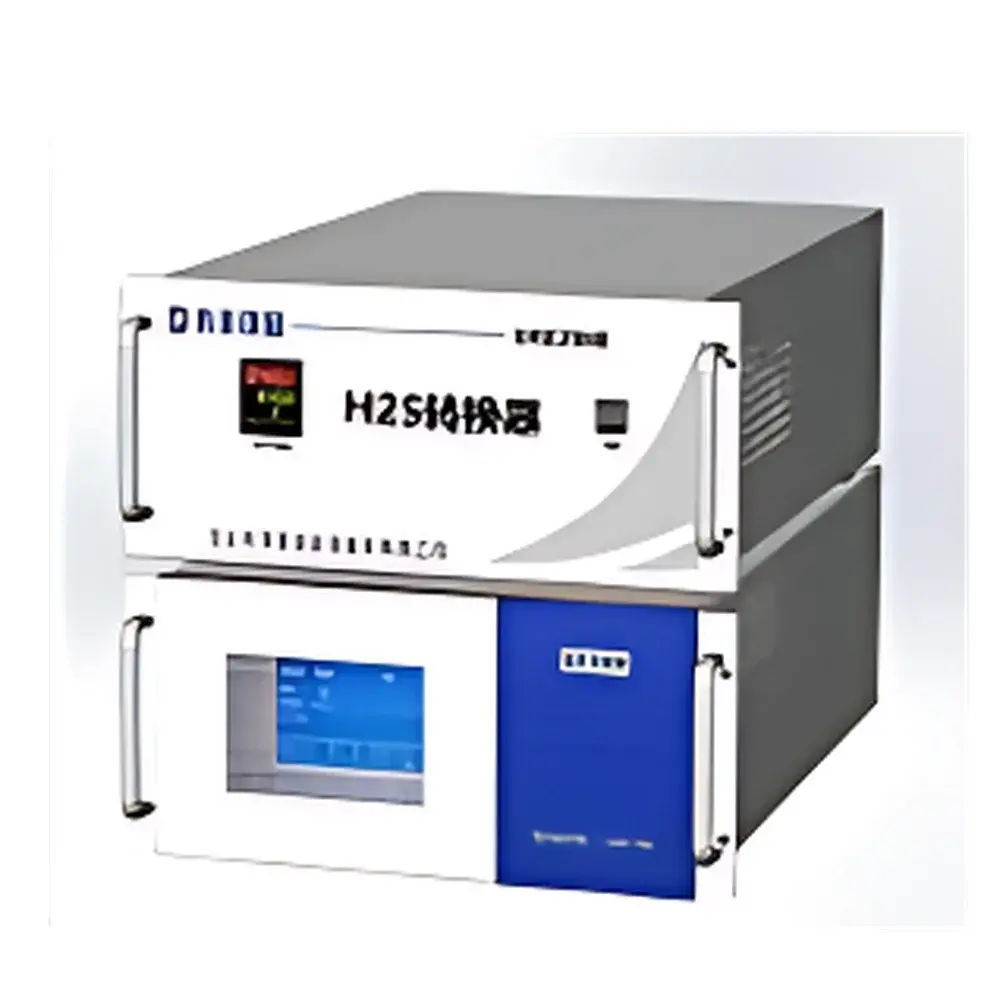
SAIL HERO XHS2100B Hydrogen Sulfide (H₂S) Gas Analyzer
| Brand | SAIL HERO |
|---|---|
| Origin | Hebei, China |
| Manufacturer Type | OEM Manufacturer |
| Country of Origin | China |
| Model | XHS2100B |
| Measured Pollutant | H₂S |
| Detection Principle | Catalytic Thermal Conversion + UV Fluorescence (SO₂) |
| Conversion Efficiency | >96% |
| Zero/Span Calibration | Manual or Remote Automated |
| Data Storage | Internal Dynamic Memory ≥1 Year (1-Minute Averages) |
| Environmental Compensation | Automatic Temperature & Pressure Correction |
| Interference Mitigation | Integrated Hydrocarbon Scrubber (PAH Removal) |
| Communication Interfaces | RS232, RS485, 0–5 V Analog Output, 4–20 mA Current Loop (Optional) |
Overview
The SAIL HERO XHS2100B Hydrogen Sulfide (H₂S) Gas Analyzer is a continuous emission monitoring system (CEMS) engineered for regulatory-grade measurement of hydrogen sulfide in ambient air and industrial stack emissions. It operates on a two-stage analytical principle: sample gas passes through a high-efficiency catalytic thermal converter where H₂S is quantitatively oxidized to sulfur dioxide (SO₂) at controlled temperature (>750 °C); the resulting SO₂ is then detected via ultraviolet fluorescence (UVF), a method standardized in EPA Method 16A and ISO 7935. This indirect measurement approach ensures high selectivity for H₂S in complex matrices containing sulfur-containing interferents (e.g., COS, CS₂, mercaptans), while eliminating cross-sensitivity to non-sulfur compounds. The analyzer is designed for unattended operation in fixed-site environmental monitoring stations, wastewater treatment plants, biogas facilities, and oil & gas upstream/downstream operations where real-time H₂S compliance tracking is mandated under national ambient air quality standards (e.g., China’s GB 3095-2012, US EPA NAAQS).
Key Features
- High-fidelity catalytic conversion furnace with >96% H₂S-to-SO₂ conversion efficiency, validated per ASTM D5502 and EN 14791 protocols
- Integrated hydrocarbon scrubber utilizing selective catalytic oxidation to remove polycyclic aromatic hydrocarbons (PAHs) and volatile organic compounds (VOCs) that otherwise quench UVF signal stability
- Real-time temperature and barometric pressure compensation algorithms compliant with ISO 4223-1:2021 for trace-level gas concentration reporting
- Self-diagnostic subsystem with fault logging, status LED indicators, and configurable alarm thresholds (local audible/visual + relay output)
- Power-loss recovery function enabling automatic reinitialization and data continuity upon mains restoration
- Modular analog and digital I/O architecture supporting RS232/RS485 serial communication, isolated 0–5 V DC output, and 4–20 mA current loop (optional, configurable per site requirements)
Sample Compatibility & Compliance
The XHS2100B accepts sample gas streams with flow rates of 0.5–2.0 L/min and particulate loading <1 mg/m³. It accommodates inlet temperatures from −20 °C to +50 °C and relative humidity up to 95% non-condensing. Sample conditioning includes heated sampling line (optional), particle filter (0.3 µm pore), and moisture removal via Nafion® membrane dryer or chilled mirror dew point control. The system meets electromagnetic compatibility (EMC) requirements per IEC 61326-1 and safety standards IEC 61010-1. Its measurement uncertainty complies with EU Directive 2010/75/EU (IED) for continuous monitoring of acid gases, and supports audit-ready data integrity under GLP/GMP-aligned operational procedures.
Software & Data Management
Embedded firmware provides a bilingual (English/Chinese) menu-driven interface with intuitive navigation via tactile keypad. All calibration events—zero, span, and multi-point linearity checks—are timestamped and stored with operator ID, gas standard lot number, and deviation metrics. Internal flash memory retains minute-averaged H₂S concentrations (ppb or µg/m³), conversion efficiency logs, diagnostic codes, and environmental sensor readings for ≥12 months without external storage. Data export is supported via USB mass storage mode or Modbus RTU over RS485. Optional PC-based configuration software enables remote firmware updates, trend visualization, and report generation compliant with ISO/IEC 17025 documentation requirements.
Applications
- Ambient air quality monitoring networks requiring long-term H₂S trend analysis near landfills, pulp & paper mills, and petrochemical clusters
- Continuous stack emission monitoring (CEM) for sulfur recovery units (SRUs), Claus plants, and flare gas systems
- Odor impact assessment studies in municipal wastewater infrastructure and composting facilities
- Biogas quality control in anaerobic digestion plants prior to engine or fuel cell utilization
- Occupational exposure monitoring in confined spaces where H₂S accumulation poses acute toxicity risk (per OSHA PEL and ACGIH TLV® guidelines)
FAQ
What is the detection limit and typical range for H₂S measurement?
The instrument achieves a method detection limit (MDL) of 0.5 ppb with full-scale ranges configurable from 0–10 ppb to 0–100 ppm, depending on application-specific sensitivity and dynamic range requirements.
How often does the thermal converter require maintenance or replacement?
Under normal operating conditions (clean sample gas, ≤1 mg/m³ particulates), the catalyst cartridge is rated for ≥12 months of continuous service; preventive replacement is recommended annually or after 8,760 operational hours.
Is the analyzer compatible with third-party data acquisition systems (SCADA, DCS)?
Yes—Modbus RTU protocol over RS485 enables seamless integration into industrial control systems; analog outputs support direct connection to PLC analog input modules without protocol translation.
Does the system meet U.S. EPA or European Union certification requirements for regulatory reporting?
While not individually certified by EPA or TÜV, the XHS2100B implements measurement principles and QA/QC protocols aligned with EPA Method 16A and EN 15267-3, and is routinely deployed in projects requiring equivalency validation per local environmental authority specifications.
Related Products







