
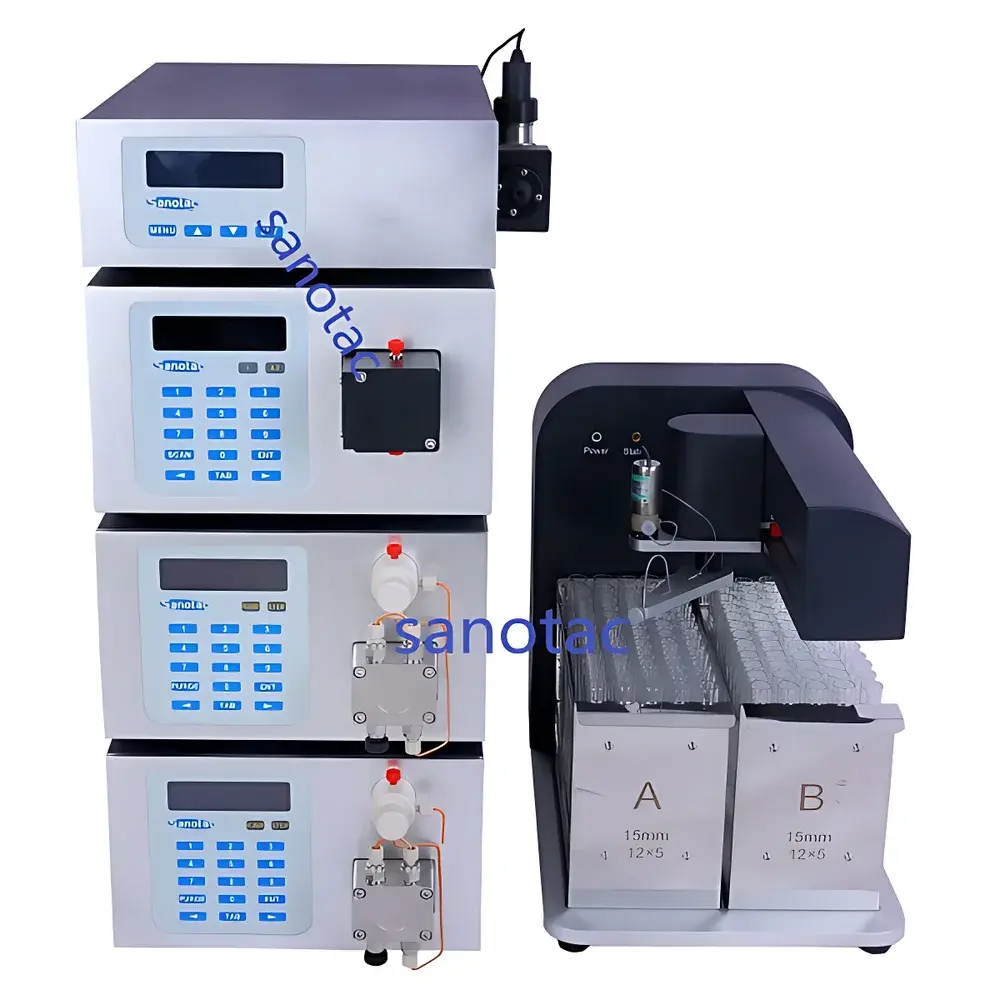
Sanotac BioLot 50 Preparative Liquid Chromatography System for Protein Purification
| Brand | Sanotac |
|---|---|
| Origin | Shanghai, China |
| Manufacturer Type | Manufacturer |
| Product Category | Domestic |
| Model | BioLot 50 |
| Application Level | Laboratory-scale |
| Instrument Type | Medium-to-Low Pressure Preparative HPLC |
| Flow Rate Range | 0.01–50.00 mL/min |
| Flow Accuracy | ±1% |
| Flow Precision (RSD) | ≤0.5% |
| Maximum Pressure | 20 MPa |
| Wavelength Accuracy | ±1 nm |
| Wavelength Reproducibility | 0.2 nm |
| Baseline Noise | ±0.75×10⁻⁵ AU at 254 nm (TC = 1 s) |
| Data Acquisition Frequency | 10 Hz |
Overview
The Sanotac BioLot 50 is a dedicated preparative liquid chromatography system engineered for the isolation and purification of biopharmaceutical molecules—including recombinant proteins, monoclonal antibodies, peptides, nucleic acids, viral vectors, insulin analogs, and synthetic oligonucleotides. Based on medium-pressure liquid chromatography (MPLC) principles, the system operates within a pressure range up to 20 MPa and supports gradient-elution separations using dual PEEK piston pumps with active pulse dampening. Its design prioritizes biomolecular integrity: all fluidic pathways are constructed from bio-inert PEEK tubing and fittings, eliminating metal ion leaching and minimizing adsorption or denaturation risks. The system integrates UV-Vis detection (190–800 nm), real-time conductivity and pH monitoring, and automated fraction collection—enabling orthogonal characterization of elution profiles critical for process development in compliance-driven environments.
Key Features
- Modular architecture supporting scalable method development—from analytical scouting to gram-scale purification
- Dual PEEK piston pump with ±1% flow accuracy and ≤0.5% RSD for high reproducibility across variable viscosity mobile phases
- Simultaneous dual-wavelength UV detection (e.g., 280 nm for protein, 260 nm for nucleic acid) with auto-switching deuterium/tungsten lamp source
- Integrated conductivity and pH sensors enabling real-time monitoring of buffer exchange and ion-exchange elution profiles
- Autoclavable PEEK flow cells and chemically resistant wetted materials compliant with ICH Q5A/Q5B guidelines for biologics handling
- Automated fraction collector with programmable collection modes (sequential, loop, threshold-triggered) and dual 60-tube racks (15 mm × 150 mm)
- Onboard pump head self-cleaning protocol to prevent salt crystallization and buffer carryover between runs
- Gradient flexibility: linear, step, or custom multi-segment gradients; online adjustment capability during runtime
Sample Compatibility & Compliance
The BioLot 50 accommodates diverse sample matrices including clarified cell lysates, fermentation supernatants, plasma-derived fractions, and synthetic oligo solutions. It supports standard chromatographic media—such as Sepharose CL-4B/6B, Capto series, POROS resins, and custom-packed columns—up to 50 mm internal diameter. All hardware components meet ISO 9001 manufacturing standards. The control software implements full audit trail functionality, electronic signatures, and user-access-level permissions aligned with FDA 21 CFR Part 11 requirements. Data integrity safeguards include immutable method storage, timestamped event logs, and version-controlled parameter archiving—facilitating GLP/GMP-aligned process documentation and regulatory submissions.
Software & Data Management
BioView™ software provides a unified Windows-based interface (compatible with Windows 7 through 11) for instrument control, method building, real-time visualization, and post-run analysis. Method templates support rapid replication of affinity, ion-exchange, size-exclusion, and hydrophobic interaction chromatography workflows. Raw data are stored in vendor-neutral .csv and .chm formats; peak integration follows USP and EP 2.2.46 guidelines. Software modules include batch processing, overlay comparison, purity assessment via peak area normalization, and export-ready reporting for SOP adherence. All method changes trigger automatic revision logging, ensuring traceability per ALCOA+ principles.
Applications
- Early-stage purification process development for therapeutic proteins and antibody fragments
- Buffer screening and gradient optimization for cation/anion exchange chromatography
- Removal of host-cell proteins (HCP), DNA, and endotoxins during downstream processing
- Polishing steps in mAb purification workflows (e.g., polishing SEC or multimodal chromatography)
- Preparative isolation of CRISPR guide RNAs, siRNA duplexes, and antisense oligonucleotides
- Recovery and refolding of inclusion body-derived proteins under denaturing/native conditions
- Quality control of biosimilar candidates against reference standards via comparative chromatographic fingerprinting
FAQ
What column dimensions and packing materials are compatible with the BioLot 50?
Standard columns range from 10 mm to 50 mm ID with bed heights up to 30 cm. Compatible media include agarose-, silica-, and polymer-based resins; packed-bed and monolithic columns are supported.
Does the system support method transfer to analytical or production-scale systems?
Yes—method parameters (flow rate, gradient slope, dwell volume compensation) are scalable using retention time normalization and linear velocity equivalence principles, facilitating seamless transition to analytical HPLC or pilot-scale AKTA platforms.
How is data security ensured during long-duration purification runs?
All acquisition data are written continuously to non-volatile storage with periodic checksum validation; power-loss recovery resumes from last stable checkpoint without data corruption.
Can the system perform simultaneous multi-detector analysis?
UV, conductivity, and pH signals are acquired synchronously at 10 Hz with hardware-level time alignment, enabling co-registered peak identification and stoichiometric ratio calculations.
Is remote monitoring and control available?
Via optional Ethernet module and BioView™ Web Server extension, users can access live chromatograms, adjust setpoints, and initiate shutdown sequences from authenticated external devices.
Related Products




