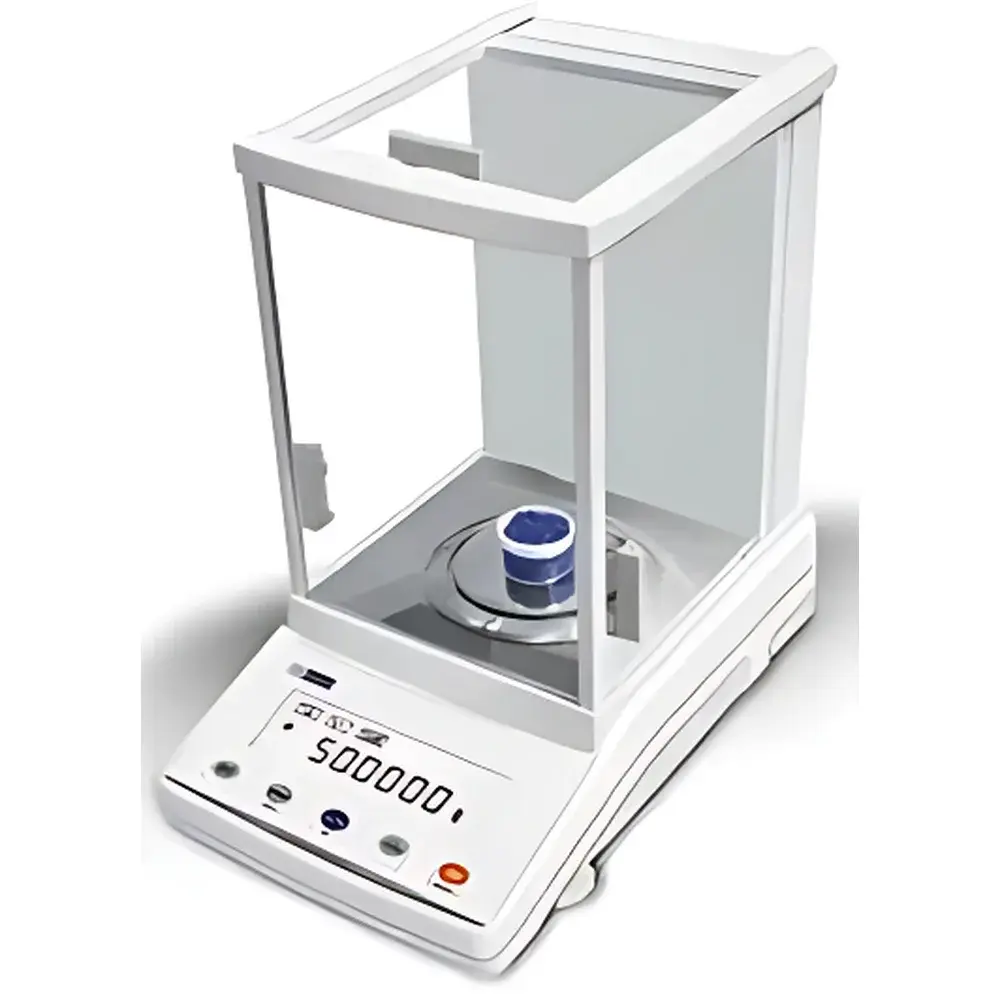
ZiQi FA2204 Advanced Analytical Balance
| Key | Brand: ZiQi |
|---|---|
| Origin | Shanghai, China |
| Manufacturer Type | Direct Manufacturer |
| Model | FA2204 |
| Max Capacity | 220 g |
| Readability | 0.1 mg (0.0001 g) |
| Repeatability | ±0.0002 g |
| Linearity Error | ±0.0003 g |
| Stabilization Time | ≤4 s |
| Pan Diameter | Ø80 mm |
| Dimensions (L×W×H) | 340 × 215 × 350 mm |
| Net Weight | 6.5 kg |
| Power Supply | AC Adapter |
| Calibration | External |
| Interface | RS-232 |
| Accuracy Class | Class I (per OIML R76) |
Overview
The ZiQi FA2204 Advanced Analytical Balance is a high-precision Class I analytical instrument engineered for laboratory environments requiring reliable mass measurement at the 0.1 mg readability level. Based on electromagnetic force compensation (EMFC) sensor technology, the balance achieves stable equilibrium by dynamically counterbalancing sample weight with a precisely regulated magnetic field—eliminating mechanical wear and delivering superior long-term stability compared to strain-gauge or piezoresistive systems. Designed for routine QC testing, formulation verification, gravimetric titration, and sample preparation in pharmaceutical, chemical, and academic laboratories, the FA2204 operates across its full 220 g capacity range with consistent linearity and minimal thermal drift. Its robust aluminum die-cast housing provides EMI/RFI shielding, while the spacious draft shield ensures environmental isolation without compromising ergonomics or accessibility.
Key Features
- Electromagnetic force compensation (EMFC) transducer system for high reproducibility, fast stabilization (≤4 seconds), and extended service life with no moving mechanical parts.
- Full-range tare, zero, cumulative weighing, overload/underload indication, and real-time fault diagnostics displayed via high-contrast LCD.
- Adjustable weighing speed settings to optimize throughput versus stability depending on sample volatility or ambient conditions.
- Integrated RS-232 serial interface compliant with standard ASCII protocols, enabling direct connection to label printers, data loggers, or LIMS-compatible PCs without additional hardware drivers.
- Multi-unit conversion functionality supporting g, mg, oz, ct, dwt, grain, and %—configurable per user preference and traceable to SI base units.
- Large Ø80 mm stainless steel weighing pan and optimized draft shield geometry for rapid air exchange and minimal static interference during fine-powder handling.
Sample Compatibility & Compliance
The FA2204 accommodates solid, granular, and low-viscosity liquid samples within standard laboratory containers (e.g., weighing boats, crucibles, vials). Its external calibration architecture supports traceable adjustment using certified Class E2 or better weights, ensuring compliance with ISO/IEC 17025 requirements for accredited testing laboratories. While not pre-certified for GMP or FDA 21 CFR Part 11 out-of-the-box, the balance’s deterministic output, audit-ready error logging (via RS-232), and absence of internal memory or user-accessible firmware make it suitable for environments implementing procedural controls for electronic records. It meets OIML R76-1:2006 Class I accuracy specifications and conforms to EN 61326-1 (EMC) and EN 61010-1 (safety) standards.
Software & Data Management
No proprietary software is bundled; raw ASCII data streams are transmitted via RS-232 at configurable baud rates (9600 default), allowing seamless integration with third-party applications—including LabWare LIMS, Thermo Fisher SampleManager, and custom Python/Excel automation scripts using pySerial or VBA. Each transmission includes timestamp (if host-provided), gross/net/tare values, unit identifier, and status flags (e.g., “OVR” for overload). For GLP/GMP workflows, users may implement external validation protocols covering installation qualification (IQ), operational qualification (OQ), and performance qualification (PQ) using documented calibration weights and repeatability checks per USP and ASTM E898.
Applications
- Pharmaceutical: Active pharmaceutical ingredient (API) dispensing, excipient ratio verification, and reference standard preparation per USP .
- Chemistry: Molar mass determination, stoichiometric reagent weighing, and gravimetric analysis of precipitates.
- Materials Science: Density calculation of powders and composites using calibrated pycnometers.
- Education: Teaching fundamental metrology concepts including uncertainty propagation, calibration hierarchy, and measurement traceability.
- Quality Control: In-process checks for tablet weight variation (per USP ) and content uniformity sampling.
FAQ
What calibration standards are recommended for the FA2204?
Class E2 stainless steel weights certified to ISO/IEC 17025, with uncertainty ≤ 1/3 of the balance’s readability (i.e., ≤ 0.033 mg), are recommended for routine external calibration.
Is internal calibration available?
No—the FA2204 uses external calibration only, which enhances transparency and facilitates audit readiness in regulated environments.
Can the balance be integrated into a networked lab environment?
Yes, via RS-232-to-Ethernet converters or USB-serial adapters, provided host software supports ASCII-based polling or event-driven data capture.
Does the FA2204 support automatic data logging?
Not natively—but when connected to a computer or PLC with appropriate scripting, interval-triggered or event-triggered logging is fully achievable.
What environmental conditions affect measurement stability?
Air currents, temperature gradients >0.5 °C/h, and electrostatic charge accumulation on insulating samples are primary influences; use of antistatic brushes and draft shield closure is advised.