
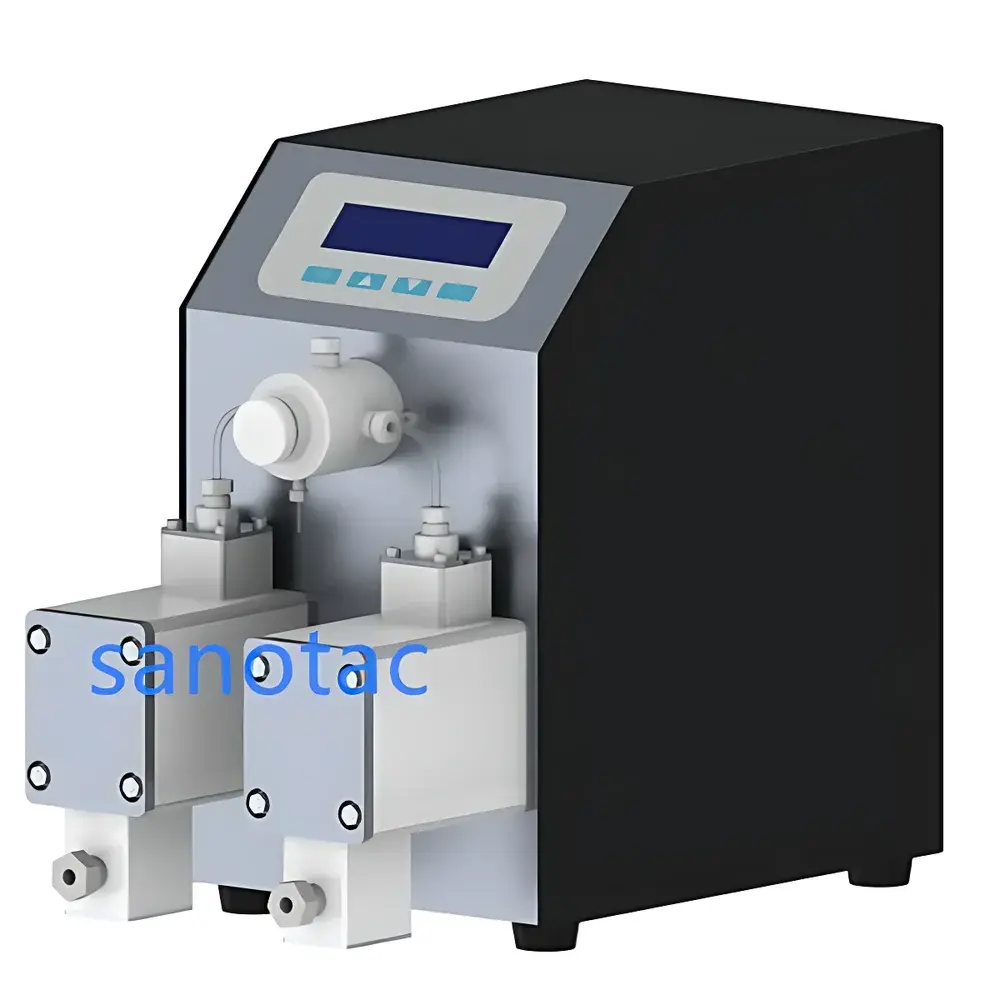
Sanotac BM50 Diaphragm Metering Pump with Fully Fluorinated Fluid Path
| Brand | Sanotac |
|---|---|
| Model | BM50 |
| Type | Precision Diaphragm Metering Pump |
| Fluid Path Materials | PTFE & PFA (Metal-Free) |
| Flow Range | 1.0–50.0 mL/min |
| Flow Resolution | 0.1 mL/min |
| Accuracy | ±1% of setpoint |
| Max Operating Pressure | ≤0.5 MPa |
| Viscosity Handling | up to 300 cP |
| Inlet Tubing | φ6 mm × φ4 mm |
| Outlet Tubing | φ3.175 mm × φ1.58 mm |
| Wetted Materials | PTFE, PFA, Specialty Ceramic |
| Communication Interfaces | USB, RS232, RS485 (Modbus RTU) |
| Power Supply | 85–264 VAC, 50 Hz |
| Power Consumption | 20 W |
| Origin | Shanghai, China |
| Manufacturer | Sanotac Scientific Co., Ltd. |
Overview
The Sanotac BM50 Diaphragm Metering Pump is an engineered solution for precise, leak-free, and chemically inert fluid delivery in ultra-aggressive chemical environments. Unlike conventional plunger or peristaltic pumps, the BM50 employs a fully encapsulated fluoropolymer diaphragm actuation system—eliminating dynamic seals, shaft penetrations, and metal wetted components. Its operation is based on positive displacement via precision screw-driven diaphragm displacement, ensuring repeatable volumetric delivery without pulsation-induced shear or contamination. This architecture is particularly critical when handling pyrophoric reagents (e.g., butyllithium), moisture-sensitive organometallics (e.g., Grignard reagents), fuming acids (oleum, fuming nitric acid), and highly oxidizing halogens (e.g., bromine, chlorine). The absence of sliding interfaces or elastomeric seals prevents particle generation, gas ingress, and electrolyte crystallization—key failure modes in semiconductor front-end processes and battery electrolyte formulation.
Key Features
- Metal-free, fully fluorinated fluid path constructed exclusively from PTFE, PFA, and specialty ceramic—validated for continuous exposure to concentrated H₂SO₄, HF, HBr, ClSO₃H, PCl₃, Br₂, and anhydrous LiAlH₄ solutions.
- Hermetically sealed diaphragm design with no dynamic seals or rotating shafts—eliminates leakage paths and prevents atmospheric moisture/oxygen ingress during handling of air-sensitive reagents.
- Screw-driven linear actuation ensures high positional repeatability and fine flow resolution (0.1 mL/min), enabling stable continuous-flow operation across viscosity ranges up to 300 cP.
- No internal lubricants or elastomers in contact with process fluid—meets USP Class VI and ISO 10993-5 biocompatibility requirements for pharmaceutical intermediate transfer.
- Integrated Modbus RTU support over RS485 enables seamless integration into PLC-controlled synthesis platforms and automated reaction workstations compliant with ISA-88/ISA-95 architectures.
Sample Compatibility & Compliance
The BM50 is routinely deployed in applications requiring strict material compatibility and regulatory traceability. Its fluoropolymer fluid path complies with ASTM D471 (fluid resistance of elastomers) and ASTM F2217 (chemical resistance of fluoropolymers). For semiconductor-grade chemical delivery, it meets SEMI F57 specifications for metallic impurity leaching (<10 ppt for Fe, Ni, Cr). In GMP-regulated battery electrolyte manufacturing, the pump supports 21 CFR Part 11-compliant audit trails when paired with Sanotac’s optional SCADA interface module. All wetted surfaces are passivated per ASTM A967 and verified by ICP-MS post-exposure testing.
Software & Data Management
The BM50 supports bidirectional communication via USB (virtual COM port), RS232, and industrial RS485 networks using standard Modbus RTU protocol (function codes 03h/06h/10h). Firmware includes configurable flow ramping profiles, real-time pressure monitoring (via optional external transducer input), and event logging with timestamped start/stop cycles. When integrated with Sanotac’s PumpControl Suite v3.2 (Windows/Linux), users can generate IQ/OQ documentation packages, export CSV-formatted flow logs with metadata (operator ID, batch number, ambient temperature), and enforce role-based access control aligned with ALCOA+ data integrity principles.
Applications
- Continuous feeding of fuming sulfuric acid (oleum) and fuming nitric acid in nitration and sulfonation reactors—avoiding decomposition pathways triggered by metal-catalyzed side reactions.
- Precise metering of n-BuLi and Grignard reagents in cryogenic (-78 °C) anhydrous solvent systems for controlled lithiation and cross-coupling reactions.
- Delivery of ultra-high-purity photoresist solvents and developers in 300 mm wafer lithography tracks—maintaining sub-ppq metallic contamination thresholds.
- Electrolyte filling in pouch and prismatic lithium-ion cells—ensuring consistent SEI formation through stoichiometric LiPF₆ delivery without hydrolysis-induced HF generation.
- Controlled infusion of cytotoxic APIs in continuous-flow biocatalysis systems where stainless steel corrosion would compromise enzyme activity.
FAQ
Does the BM50 require periodic seal replacement?
No—its diaphragm is statically clamped and non-rotating; there are no consumable elastomeric seals in the fluid path.
Can it handle two-phase flow containing dissolved gases?
Yes—the gas-tight diaphragm chamber prevents nucleation-induced cavitation and allows stable delivery of degassed or gas-saturated streams up to 300 cP.
Is the pump suitable for use in Class 10 cleanrooms?
Yes—validated particulate emission rate is <0.1 particles ≥0.5 µm per cubic foot per minute under ISO 14644-1 Class 5 conditions.
What calibration standards does Sanotac provide for GLP compliance?
NIST-traceable gravimetric calibration reports (per ISO/IEC 17025) are available upon request, including uncertainty budgets for flow rate, linearity, and repeatability.
How is overpressure protection implemented?
The pump incorporates dual-stage mechanical pressure relief (0.55 MPa setpoint) and firmware-enforced pressure fault shutdown via optional inline pressure sensor feedback loop.



