
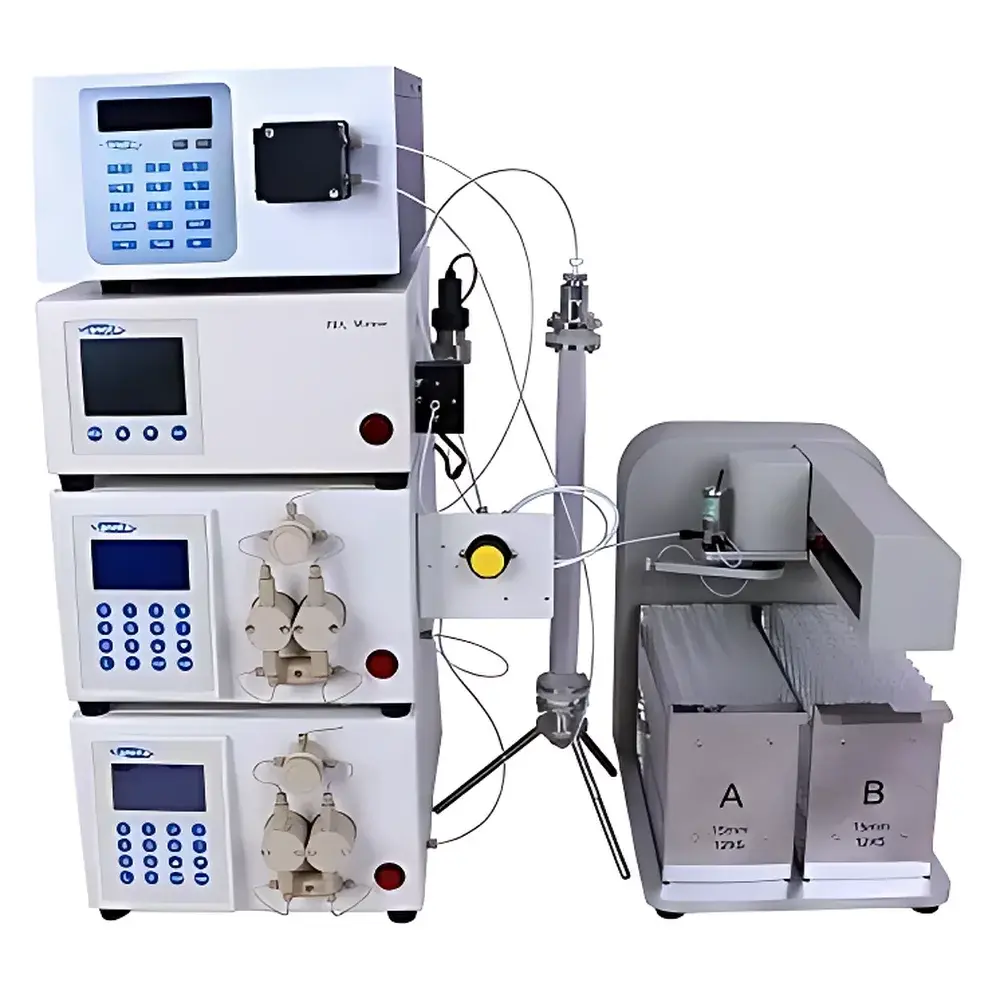
Sanotac BQ2005 Pilot-Scale Protein Purification System
| Brand | Sanotac |
|---|---|
| Origin | Shanghai, China |
| Manufacturer Type | OEM Manufacturer |
| Region of Origin | Domestic (China) |
| Model | BQ2005 |
| Price Range | USD 7,000–14,000 (FOB Shanghai) |
| Purification Principle | Affinity Chromatography (AC) |
| Detector Type | Conductivity Detector |
| Conductivity Range | 0–999.9 mS/cm |
| Pump Material | PEEK |
| Flow Rate Range | 0.01–50.00 mL/min |
| Flow Accuracy | ≤±1% |
| Maximum Pressure | 5 MPa |
| Pressure Pulsation | ≤0.1 MPa |
| Gradient Types | Linear & Isocratic, On-the-Fly Gradient Editing |
| Minimum Gradient Increment | 1% |
| UV-Vis Detector | Dual-lamp (Deuterium + Tungsten), 190–800 nm, ±1 nm wavelength accuracy, 0–2 AU absorbance range |
| Fraction Collector | 2 × 60-tube rack (15 mm diameter × 150 mm height), programmable collection modes (sequential, loop, trigger-based) |
| Injection Valve | Manual 10 mL fixed-loop injector (20 mL optional) |
| Sample Loading | Liquid or solid-phase |
| pH Detection Range | 0–14 |
| Power Supply | 220 V ±10%, 50 Hz |
| Control Interface | RS-232 / USB, Windows XP/7-compatible workstation software |
Overview
The Sanotac BQ2005 Pilot-Scale Protein Purification System is an engineered solution for intermediate-scale preparative chromatography in academic, biopharmaceutical development, and contract research laboratories. Designed around the principles of low-pressure liquid chromatography (LPLC), it supports multiple orthogonal purification modalities—including affinity chromatography (AC), ion exchange chromatography (IEX), size exclusion chromatography (SEC), and hydrophobic interaction chromatography (HIC)—with full system integration of gradient generation, real-time detection, and fraction collection. Its modular architecture enables reproducible separation of proteins, enzymes, nucleic acids, peptides, and other biomacromolecules under controlled buffer conditions. The system operates within a pressure limit of 5 MPa and delivers flow precision of ≤±1% across its 0.01–50.00 mL/min range—optimized for scalability from analytical to early-process development workflows.
Key Features
- High-chemical-resistance PEEK pump heads ensure long-term compatibility with aggressive solvents, chaotropic agents, and high-salt mobile phases commonly used in protein purification.
- Dual-lamp UV-Vis detector (deuterium + tungsten) provides continuous spectral acquisition from 190–800 nm, enabling simultaneous monitoring at multiple wavelengths (e.g., 280 nm for protein, 260 nm for nucleic acid contaminants).
- Integrated conductivity and pH sensors allow real-time tracking of buffer composition and elution profiles—critical for method transfer and process understanding per ICH Q5A and Q5D guidelines.
- Automated fraction collector supports 120-position tube handling with configurable collection logic (time-, volume-, peak-, or threshold-triggered), ensuring traceability and alignment with GLP-compliant sample archiving practices.
- Onboard gradient programming permits dynamic adjustment of solvent composition during runs without interruption—facilitating rapid method optimization and scouting experiments.
- RS-232 and USB interfaces enable bidirectional communication with Windows-based control software, supporting audit trail generation and user-access-level management compliant with FDA 21 CFR Part 11 requirements when deployed with validated configurations.
Sample Compatibility & Compliance
The BQ2005 accommodates a broad range of biological samples—from crude lysates and clarified supernatants to partially purified fractions—across column formats up to 2.6 cm ID and 30 cm length. It supports standard resin chemistries including Ni-NTA, Protein A/G/L, glutathione-Sepharose, and DEAE/Capto Q resins. All wetted materials (PEEK, stainless steel 316L, fused silica capillaries) meet USP Class VI biocompatibility standards. System validation documentation aligns with ISO 9001:2015 manufacturing controls and supports IQ/OQ protocols required for regulated environments. While not pre-certified for GMP production, the platform is routinely employed in Stage I–II process development under cGMP-aligned quality systems.
Software & Data Management
The native Windows workstation software provides intuitive graphical workflow configuration, real-time chromatogram visualization, and post-run analysis tools including peak integration, baseline correction, and overlay comparison. Raw data files are stored in vendor-neutral ASCII format (.csv) with embedded metadata (timestamp, method name, operator ID, instrument serial number). Audit trails record all parameter changes, run starts/stops, and user logins—configurable to retain ≥18 months of activity logs. Export functions support direct import into third-party platforms such as Empower, Chromeleon, or MATLAB for advanced multivariate analysis.
Applications
- Recombinant monoclonal antibody capture and polishing steps using Protein A followed by SEC or IEX.
- Purification of His-tagged proteins under native or denaturing conditions with on-column refolding capability.
- Isolation of CRISPR-Cas ribonucleoprotein complexes for functional characterization studies.
- Preparative-scale isolation of plant-derived lectins or antimicrobial peptides from tissue extracts.
- Buffer exchange and desalting of enzymatically digested samples prior to LC-MS/MS analysis.
- Method development for downstream processing of viral vectors and extracellular vesicles.
FAQ
What column dimensions and flow rates are recommended for optimal resolution with the BQ2005?
For analytical-to-preparative transitions, columns up to 26 mm ID × 300 mm length are supported at flow rates between 5–20 mL/min, depending on resin particle size and backpressure profile.
Does the system support automated buffer blending with more than two solvents?
The BQ2005 features dual-pump gradient capability; tertiary blending requires external manifold integration or sequential binary gradient staging via method scripting.
Can the conductivity detector be calibrated in-house, and what standards are recommended?
Yes—calibration is performed using certified KCl standard solutions (e.g., 1.413 mS/cm at 25°C); calibration curves are stored per method and validated before each critical run.
Is remote monitoring or cloud-based data backup available?
The base software does not include native cloud connectivity; however, local network deployment allows integration with institutional NAS or LIMS via shared folder mapping and scheduled export scripts.
What maintenance intervals are specified for pump seals and UV lamp replacement?
PEEK pump seals are rated for ≥5,000 hours of continuous operation; deuterium lamps are specified for 1,000–1,500 hours and should be replaced based on intensity decay monitoring in the software diagnostic module.



