
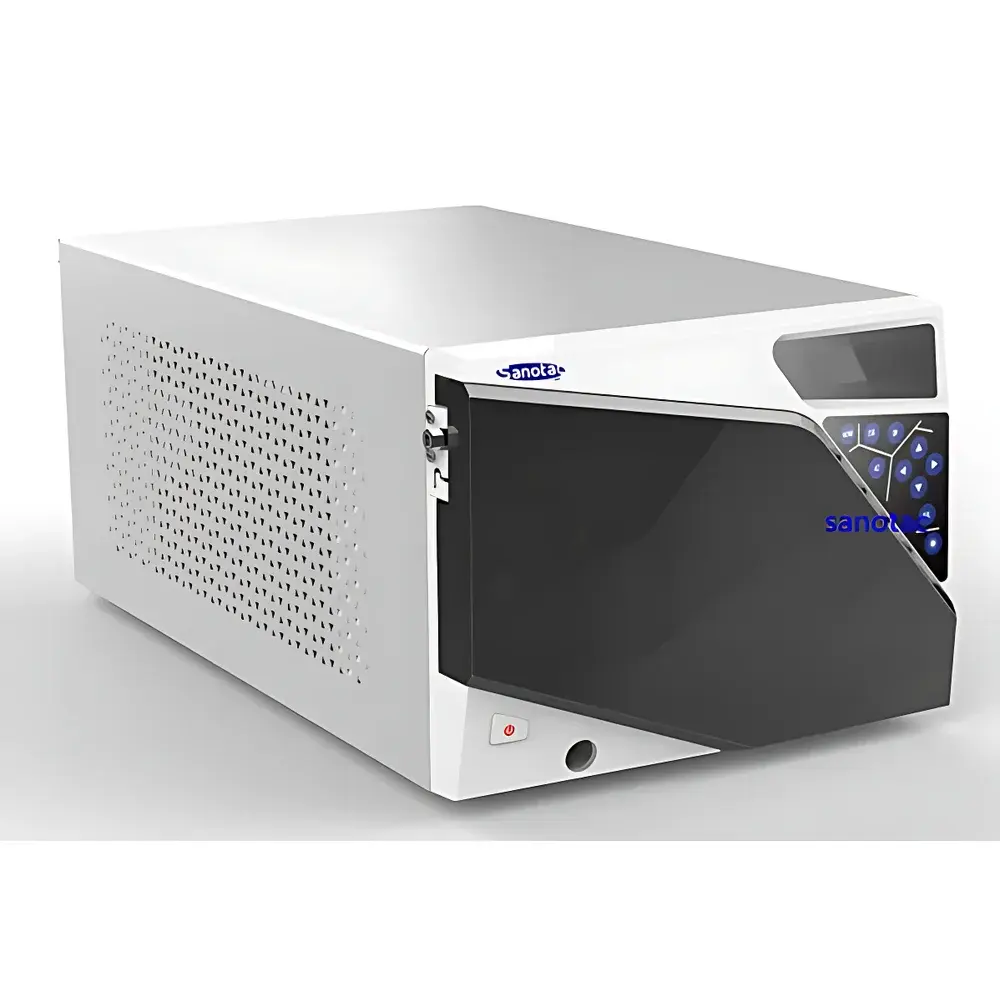
Sanotac ELSD 9000 Evaporative Light Scattering Detector with CE Certification
| Brand | Sanotac |
|---|---|
| Origin | Shanghai, China |
| Manufacturer Type | Original Equipment Manufacturer (OEM) |
| Product Category | Domestic |
| Model | ELSD 9000 |
| Instrument Type | Evaporative Light Scattering Detector (ELSD) |
| Wavelength | 650 nm |
| Detection Mode | Low-Temperature Evaporation |
| Light Source | Semiconductor Laser Diode |
Overview
The Sanotac ELSD 9000 is a CE-certified evaporative light scattering detector engineered for robust, universal detection of non-volatile and semi-volatile analytes in liquid chromatography applications. Unlike UV-Vis or refractive index detectors, the ELSD operates on a physical detection principle—nebulization, solvent evaporation, and light scattering measurement—making it inherently insensitive to chromophore presence, molecular absorption characteristics, or optical activity. This enables quantitative analysis of compounds lacking UV absorbance, including carbohydrates, lipids, surfactants, polymers, glycosides, and natural product fractions commonly found in herbal medicine, pharmaceutical QC, and synthetic chemistry workflows. The detector employs a stabilized 650 nm semiconductor laser (30 mW output) and a high-sensitivity photomultiplier tube (PMT) to capture scattered light from dried analyte particles generated under precisely controlled low-temperature evaporation conditions. Its design prioritizes baseline stability, low noise, and reproducible response across wide dynamic ranges—critical for method transfer, regulatory compliance, and multi-laboratory validation.
Key Features
- CE-marked design compliant with EU Directive 2014/30/EU (EMC) and 2014/35/EU (LVD), supporting audit readiness for ISO/IEC 17025 and GLP environments
- Ultra-low baseline noise ≤ 0.01 mV and drift ≤ 0.2 mV / 30 min, enabling reliable quantitation down to sub-nanogram levels
- Compact footprint (26 × 19 × 46 cm) optimized for benchtop integration or stacked configuration with HPLC systems
- Dual-zone temperature control: evaporation chamber (room temperature to 150 °C, ±1 °C accuracy) and nebulizer zone (room temperature to 56 °C, ±1 °C accuracy)
- Mass-flow-controlled gas delivery (clean air or nitrogen, 2–5 bar; flow accuracy ±0.02 L/min) ensuring consistent droplet formation and particle drying
- Automated 16-point self-diagnostic routine at startup, monitoring laser status, heater integrity, gas valve operation, and PMT gain stability
- Intelligent method management: 10 user-defined methods, each storing 25 configurable parameters—including temperature ramps, gain settings, zero offset, and event-triggered actions
- Multi-interface connectivity: RS-232, RS-485, USB 2.0, and Ethernet (TCP/IP & HTTP API), facilitating integration into centralized lab data systems
Sample Compatibility & Compliance
The ELSD 9000 detects any solute with volatility lower than the mobile phase—regardless of UV absorbance, fluorescence, or electrochemical activity. It is routinely applied to HPLC and UHPLC analyses of polysaccharides (e.g., dextrans, inulin), fatty acids, triglycerides, phospholipids, amino acid derivatives, saponins, flavonoid glycosides, and synthetic polymers. Compatible with reversed-phase, HILIC, and normal-phase mobile phases containing volatile modifiers (e.g., acetonitrile, methanol, ammonium acetate, formic acid). Not suitable for highly volatile analytes (e.g., small organic acids, alcohols) or thermally labile compounds prone to decomposition above 150 °C. Meets functional requirements referenced in USP , EP 2.2.46, and ASTM D7217 for universal LC detection. Supports 21 CFR Part 11-compliant data acquisition when used with validated Clarity™ software and appropriate audit trail configuration.
Software & Data Management
The ELSD 9000 is supported by Sanotac’s native control software and fully interoperable with third-party chromatography data systems via Clarity™ DLL (v6.1+). It delivers real-time analog output (±1200 mV), digital data streaming at 100 Hz (high-resolution mode) or 20 Hz (standard mode), and programmable external event triggers (e.g., auto-zero, laser shutdown, gas valve actuation). All method parameters—including temperature profiles, gain, offset, and sampling rate—are stored internally and recalled without host PC dependency. Firmware supports remote firmware updates over LAN, secure HTTP-based configuration, and timestamped system logs for GLP traceability. Data export formats include ASCII (.txt), CSV, and native .clr for direct import into ChemStation, Empower, or OpenLab CDS.
Applications
- Quantitative analysis of herbal extracts and TCM formulations where UV-inactive markers dominate (e.g., ginsenosides, astragalosides)
- Residual solvent and excipient profiling in biopharmaceutical manufacturing (e.g., PEGylated proteins, lipid nanoparticles)
- Stability-indicating assays for non-UV-absorbing degradation products in forced degradation studies
- Method development support for preparative HPLC fraction collection, especially in natural product isolation
- QC testing of food-grade emulsifiers, prebiotic oligosaccharides, and cosmetic actives per ISO 17025-accredited protocols
- Academic research in polymer characterization (Mn, Mw determination via SEC-ELSD) and metabolomics of polar metabolites
FAQ
What regulatory certifications does the ELSD 9000 hold?
It carries full CE marking under the Electromagnetic Compatibility (2014/30/EU) and Low Voltage (2014/35/EU) Directives, verified by an EU-notified body.
Can the ELSD 9000 be integrated with Agilent or Waters HPLC systems?
Yes—via RS-232/RS-485 serial interface or Ethernet, using standard ASCII command protocol or Clarity™ DLL integration.
Is nitrogen required, or can compressed air be used?
Both are acceptable; however, oil-free, desiccated, and particulate-filtered air (≤ 0.01 µm) or nitrogen (2–5 bar) must be supplied to prevent nozzle clogging and baseline artifacts.
What is the minimum recommended flow rate for microbore columns?
The detector supports flow rates as low as 0.01 mL/min, making it compatible with 1.0 mm ID capillary and microbore HPLC columns.
Does the instrument support automated calibration or performance qualification?
While no built-in calibration standard is included, the 16-point self-test, baseline stability metrics, and configurable diagnostic logging enable PQ/OQ execution per laboratory SOPs.






