
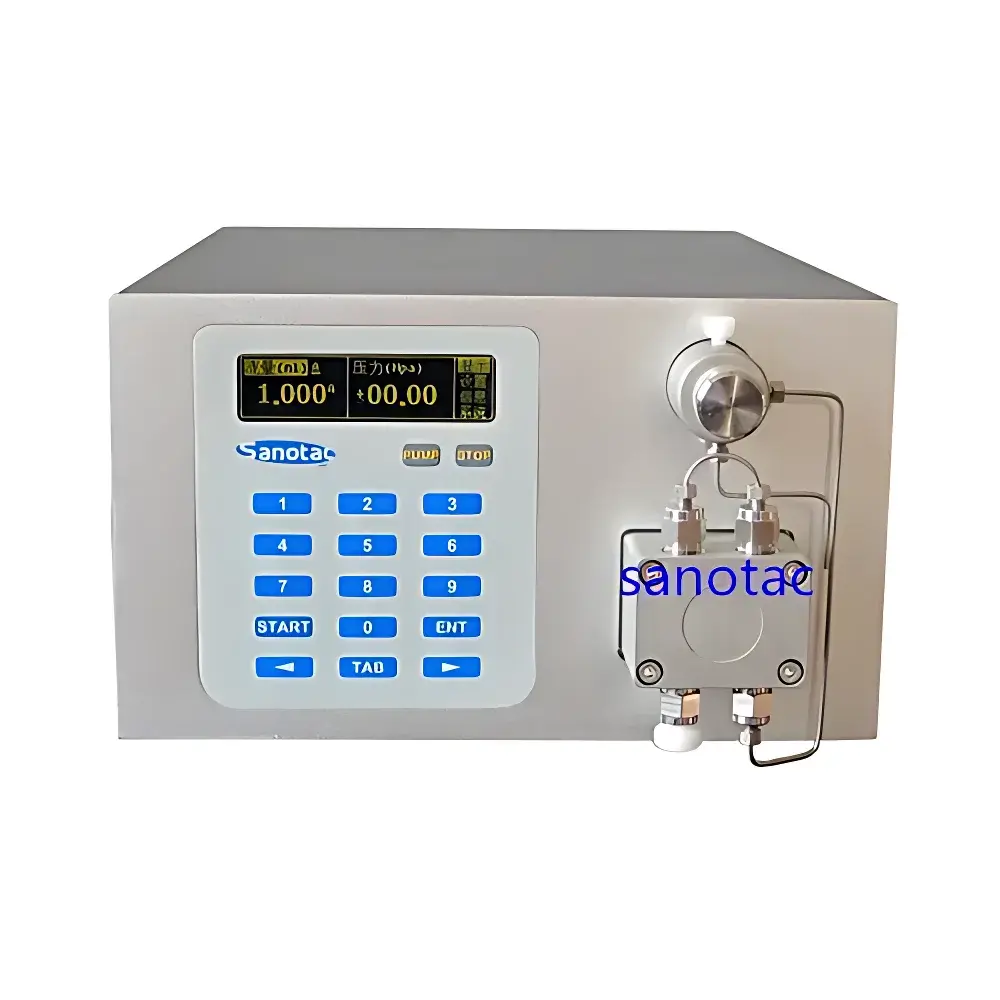
Sanotac HXZR0530 High-Pressure Chemical Injection Pump (Constant-Pressure & Constant-Flow Mode)
| Brand | Sanotac |
|---|---|
| Model | HXZR0530 |
| Origin | Shanghai, China |
| Manufacturer Type | OEM/ODM Manufacturer |
| Country of Origin | China |
| Flow Range | 0.01–50.00 mL/min |
| Flow Increment | 0.01 mL/min |
| Flow Accuracy | ±0.5% |
| Flow Precision (RSD) | ≤0.1% |
| Maximum Pressure | 30 MPa |
| Pressure Pulsation | ≤0.2 MPa |
| Pump Head Volume | 50 mL |
| Fluidic Path Materials | 316L Stainless Steel, Sapphire, PTFE, Ceramic |
| Tubing Connection | 1/16" Standard |
| Display | 256×64 Dot Matrix Backlit LCD |
| Control Interface | Front Panel Keypad + RS232/USB Computer Reverse Control (Open Protocol) |
| Power Supply | 85–264 VAC, 50 Hz |
| Dimensions | 370 × 240 × 152 mm |
| Compliance | Designed for GLP/GMP-aligned lab environments |
Overview
The Sanotac HXZR0530 is a high-precision, dual-plunger parallel-drive high-pressure chemical injection pump engineered for stable fluid delivery under demanding analytical and process-critical conditions. Operating on the principle of positive displacement with floating plunger architecture and cam-profiled mechanical actuation, it delivers consistent volumetric flow across a wide dynamic range—from trace-level micro-injection (0.01 mL/min) to preparative-scale delivery (50.00 mL/min)—while maintaining pressure stability up to 30 MPa. Its dual-mode operational capability supports both constant-flow and constant-pressure control strategies, making it suitable for applications requiring either precise volumetric dosing (e.g., HPLC mobile phase delivery) or pressure-regulated infusion (e.g., membrane permeation studies, reactor feed control). The pump integrates solvent compressibility compensation algorithms and multi-point flow calibration curves to minimize system-induced deviations, particularly at low flow rates where compressibility effects dominate.
Key Features
- Dual-plunger parallel drive architecture with floating plunger design reduces seal wear and extends service life of high-pressure sealing components.
- Cam curve compensation combined with real-time electronic pulse suppression lowers pressure pulsation to ≤0.2 MPa—critical for noise-sensitive detection systems and column integrity preservation.
- Microprocessor-based control enables programmable gradient generation: isocratic, linear, step, and composite gradients are configurable via onboard memory or external workstation.
- Fluidic path constructed from chemically inert, high-strength materials—including 316L stainless steel, sapphire check valves, ceramic plungers, and PTFE seals—ensuring compatibility with aggressive solvents (e.g., concentrated acids, halogenated organics, supercritical CO₂ co-solvents).
- Open communication protocol (RS232/USB) supports bidirectional computer control and integration into third-party chromatography data systems (CDS), LIMS, or custom automation frameworks without proprietary driver dependencies.
- Backlit 256×64 dot-matrix display provides real-time visualization of flow rate, pressure, gradient profile, error codes, and active method parameters—even under low-ambient-light laboratory conditions.
Sample Compatibility & Compliance
The HXZR0530 accommodates a broad spectrum of liquid-phase samples including aqueous buffers, organic solvents (acetonitrile, methanol, THF), corrosive reagents (HCl, HNO₃, HF-diluted solutions), viscous polymer solutions (up to 500 cP), and suspensions containing sub-5 µm particulates when filtered inline. Its material selection complies with FDA-recommended contact surface standards for pharmaceutical manufacturing equipment (21 CFR Part 211), and its pressure-rated construction conforms to PED 2014/68/EU Annex I essential safety requirements for Category IV fluid systems. For regulated laboratories, audit trails, method locking, and user-access-level controls can be implemented via external CDS platforms supporting 21 CFR Part 11 electronic signature compliance.
Software & Data Management
While the pump operates autonomously via its embedded 10-method memory, full remote orchestration is enabled through ASCII-based serial command sets documented in the publicly available communication manual. Integration with OpenLab CDS, Chromeleon, Empower, or Python-based control scripts (using pySerial or LabVIEW VIs) is routinely deployed in QC labs performing method transfer validation. All flow and pressure events—including start/stop timestamps, parameter changes, and fault logs—are timestamped and exportable as CSV for trend analysis. Firmware updates are performed via USB mass-storage mode, ensuring traceability and version control per ISO/IEC 17025 clause 5.9.
Applications
- HPLC/UHPLC mobile phase delivery in research and quality control laboratories.
- Chemical feed control in catalytic reaction screening reactors and continuous flow synthesis modules.
- Calibration standard delivery for ICP-MS, AAS, and ion chromatography systems requiring ultra-low pulsation.
- Controlled infusion in dissolution testing apparatus (USP Apparatus II/IV) and permeation cell studies (Franz cells).
- High-pressure solvent delivery in SFE (supercritical fluid extraction) and APPI (atmospheric pressure photoionization) interfaces.
- Process analytical technology (PAT) deployments where real-time flow feedback loops interface with PLCs or DCS systems.
FAQ
What is the difference between constant-flow and constant-pressure operation modes?
In constant-flow mode, the pump actively adjusts motor torque and plunger stroke timing to maintain a user-defined volumetric rate regardless of backpressure changes. In constant-pressure mode, it regulates output to hold a set system pressure—ideal for applications where flow resistance varies unpredictably (e.g., fouling-prone filters or packed-bed reactors).
Can this pump be used with aggressive solvents like hydrofluoric acid?
HF compatibility requires optional PCTFE or Hastelloy C-276 fluidic path upgrades; standard configuration (316L/PTFE/sapphire) is rated for ≤10% HF at ambient temperature and ≤5 MPa. Consult Sanotac’s chemical compatibility matrix before deployment.
Is gradient programming limited to linear profiles?
No—the firmware supports segmented gradient tables with up to 20 time–composition breakpoints, enabling quadratic, exponential, and discontinuous step gradients for method development flexibility.
How is flow accuracy validated per ISO 5725?
Sanotac provides NIST-traceable gravimetric calibration certificates (optional) performed using Class A volumetric flasks and analytical balances (±0.1 mg resolution) across five flow points per ISO 5725-2:2019 repeatability and reproducibility protocols.
Does the pump support analog input for external pressure feedback control?
Not natively—but 0–10 V or 4–20 mA analog inputs can be integrated via optional I/O expansion module (HXZR-IO-01), enabling closed-loop pressure regulation in custom-engineered systems.



