
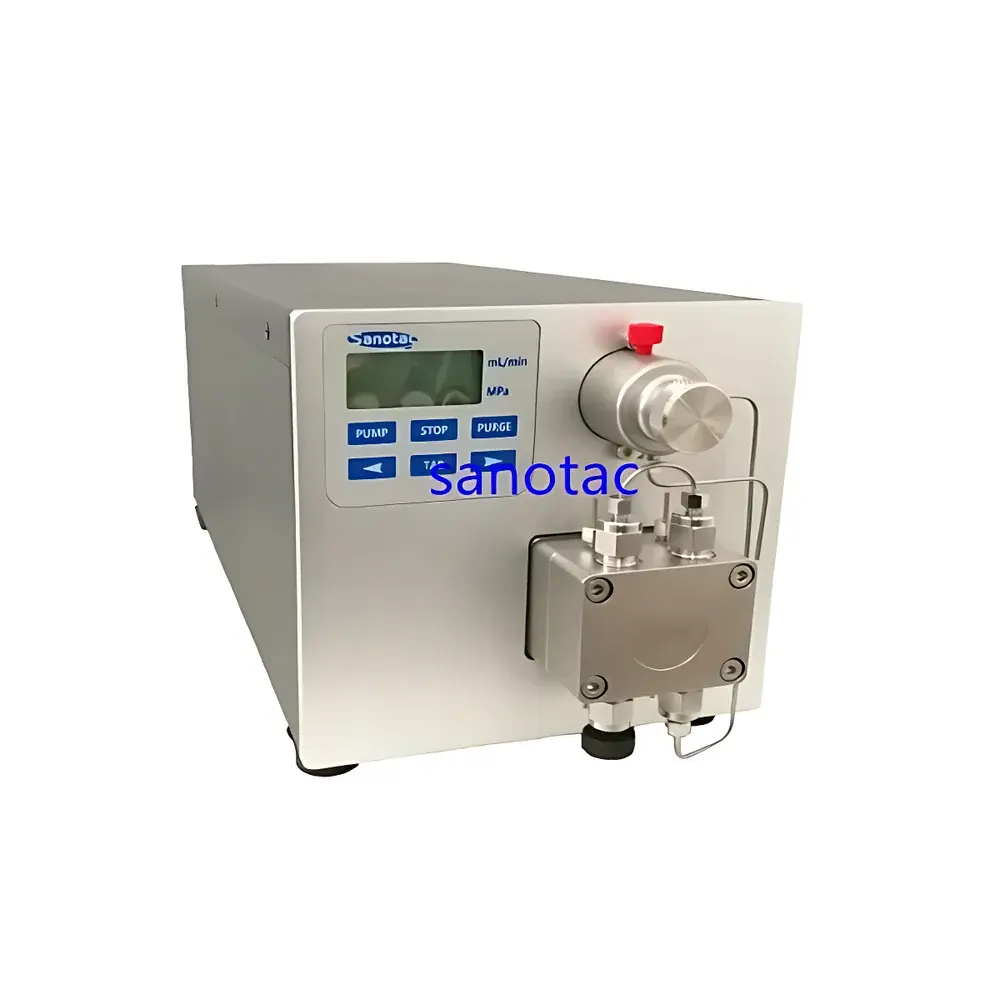
Sanotac JL0530 High-Pressure Constant Flow Pump for Reactor Integration
| Brand | Sanotac |
|---|---|
| Model | JL0530 |
| Flow Range | 0.01–50.00 mL/min |
| Flow Increment | 0.01 mL/min |
| Flow Accuracy | ±0.5% |
| Flow Precision (RSD) | ≤0.1% |
| Max Pressure | 30 MPa |
| Pressure Pulsation | ≤0.2 MPa |
| Pump Head Volume | 50 mL |
| Drive Mechanism | Dual Parallel Plungers with Floating Plunger Design |
| Flow Compensation | Solvent Compressibility Correction, Multi-Point Flow Curve Calibration, Cam Profile Compensation, Electronic Flow Pulse Suppression |
| Wetted Materials | 316L Stainless Steel, Sapphire, PTFE, Ceramic |
| Tubing Connection | 1/16" Standard |
| Display | 256×64 Dot Matrix Backlit LCD |
| Control Interface | Front Panel Keypad + RS232/Ethernet Computer Remote Control (Open Protocol) |
| Power Supply | 85–264 VAC, 50 Hz |
| Dimensions | 370 × 240 × 152 mm |
| Compliance | Designed for GLP/GMP-aligned laboratory environments |
Overview
The Sanotac JL0530 High-Pressure Constant Flow Pump is an engineered precision fluid delivery system designed specifically for integration into pressurized chemical reaction platforms—including batch reactors, continuous flow microreactors, and automated synthesis workstations. It operates on a dual parallel plunger architecture with floating plunger mechanics, enabling stable, pulse-minimized solvent or reagent delivery across a wide dynamic range (0.01–50.00 mL/min) at pressures up to 30 MPa. Unlike conventional peristaltic or single-piston pumps, the JL0530 employs a positive-displacement principle grounded in calibrated volumetric displacement, where real-time solvent compressibility compensation and cam-profile-driven motion synchronization ensure metrological consistency under variable temperature and viscosity conditions. Its design intent aligns with the operational demands of exothermic, catalytic, and stoichiometrically sensitive reactions—such as nitration, sulfonation, fluorination, carbonylation, and diazotization—where deviations in flow rate or pressure stability directly impact reaction selectivity, yield reproducibility, and safety margins.
Key Features
- Dual parallel plunger system with floating plunger mechanism to minimize seal wear and extend service life under sustained high-pressure operation
- Integrated solvent compressibility compensation algorithm, dynamically adjusting stroke volume based on fluid density and compressibility data
- Multi-point flow curve calibration across the full operating range (0.01–50 mL/min), validated at ≥5 discrete flow points per pump head
- Cam profile optimization and electronic pulse suppression circuitry reduce pressure pulsation to ≤0.2 MPa (peak-to-peak), critical for pressure-sensitive reactor control loops
- Wetted path constructed from chemically inert, high-strength materials: 316L stainless steel housing, sapphire check valves, ceramic plungers, and PTFE seals—rated for compatibility with aggressive reagents including chlorine, nitric acid, hydrogen fluoride, and organic peroxides
- Open-protocol remote control interface (RS232/Ethernet) supporting integration with third-party chromatography data systems (CDS), PLC-based reactor controllers, and LIMS platforms
- Front-panel programmability with 10 user-defined methods storing flow rate, gradient profile, pressure limit, and start/stop timing parameters
Sample Compatibility & Compliance
The JL0530 accommodates a broad spectrum of process fluids—from low-viscosity solvents (e.g., acetonitrile, THF) to moderately viscous reaction mixtures (<500 cP) encountered in polymerization or peptide coupling workflows. Its 316L stainless steel and sapphire/PTFE fluidic path meets ASTM F2217 requirements for metallic component corrosion resistance in halogenated media. The pump’s mechanical architecture conforms to ISO 13849-1 PL e functional safety principles for Category 3 architectures, and its pressure containment design follows ASME B31.3 process piping guidelines for laboratory-scale pressurized systems. While not intrinsically rated for Zone 1 hazardous areas, it serves as the core metering unit in ATEX-certified reactor skids when paired with external explosion-proof enclosures and purge systems. Documentation packages include IQ/OQ templates aligned with FDA 21 CFR Part 11 data integrity expectations for audit-ready deployment in regulated pharmaceutical and fine chemical development labs.
Software & Data Management
The JL0530 supports bidirectional communication via ASCII-based command protocol over RS232 or TCP/IP. This open interface enables native integration with LabVIEW, Python (PySerial), MATLAB, and commercial CDS platforms such as Chromeleon or Empower without proprietary drivers. All flow and pressure events are timestamped and logged internally (non-volatile memory) with configurable sampling intervals (1–10 Hz). Audit trail functionality records operator actions—including method edits, manual overrides, and emergency stops—with user ID attribution. Raw data exports support CSV and XML formats, ensuring traceability during analytical method transfers or regulatory submissions. Firmware updates are delivered via signed binary files with SHA-256 verification, maintaining cryptographic integrity throughout the device lifecycle.
Applications
- Continuous-flow synthesis of APIs and intermediates under elevated pressure and temperature
- Automated catalyst screening in fixed-bed and slurry-phase reactors
- Precision dosing of initiators, quenching agents, or gaseous reagents (via dissolved-phase delivery)
- High-pressure hydrogenation and hydroformylation requiring stoichiometric flow control
- Microfluidic reaction optimization with integrated inline IR/UV monitoring
- Calibration reference standard for flowmeter validation in ISO/IEC 17025-accredited testing laboratories
FAQ
What is the maximum allowable inlet pressure for the JL0530?
The pump is designed for atmospheric or slightly pressurized inlet conditions (≤0.5 MPa); backpressure regulation must occur downstream of the pump head.
Can the JL0530 be used with corrosive halogenated solvents such as sulfuryl chloride?
Yes—provided wetted materials (316L SS, sapphire, PTFE, ceramic) remain within their documented chemical compatibility limits at operating temperature and concentration; consult Sanotac’s Material Compatibility Matrix prior to deployment.
Is gradient programming supported in both isocratic and multi-step modes?
Yes—the internal controller supports linear, stepwise, and custom-defined gradient profiles across two or more solvents when operated in dual-pump configurations; standalone JL0530 units support time-programmed flow ramps only.
Does the pump comply with FDA 21 CFR Part 11 for electronic records?
The hardware supports Part 11–aligned practices (audit trails, electronic signatures via external software, role-based access), but full compliance requires implementation within a validated system architecture managed by the end user.
What maintenance intervals are recommended for the 316L pump head assembly?
Plunger seals should be inspected every 500 hours of operation or after 1000 cycles at >25 MPa; sapphire check valves require replacement every 3000 hours under typical lab use conditions.



