
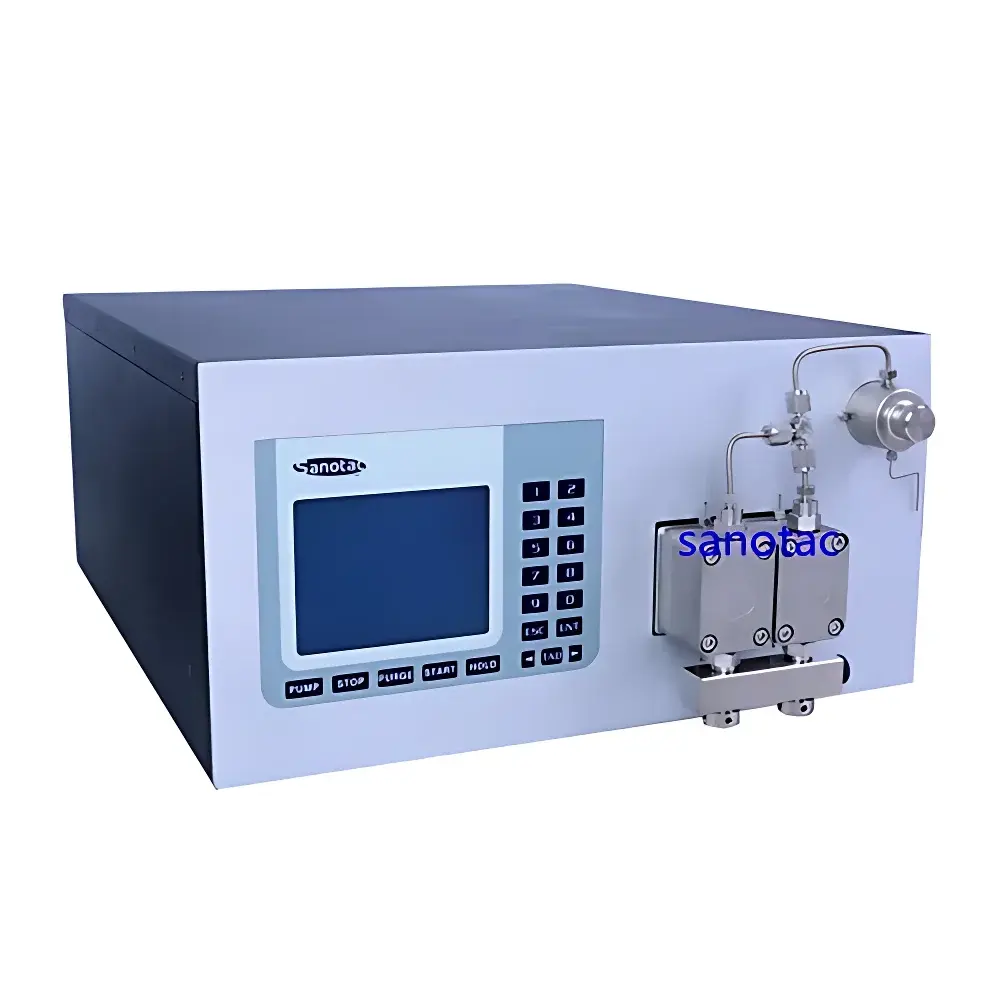
Sanotac JL1020 High-Pressure Constant Flow Pump for Reactor Feed Applications
| Brand | Sanotac |
|---|---|
| Origin | Shanghai, China |
| Manufacturer Type | OEM Manufacturer |
| Country of Origin | China |
| Model | JL1020 |
| Flow Rate | 100 mL/min |
| Maximum Pressure | 20 MPa |
| Flow Accuracy | ±0.5% |
| Flow Precision (RSD) | ≤0.1% |
| Pressure Pulsation | ≤0.2 MPa |
| Pump Head Material | 316L Stainless Steel, Sapphire, PTFE, Ceramic |
| Connection | 1/16" Standard Fittings |
| Display | 256×64 Dot Matrix LCD with Backlight |
| Control Interface | Front Panel Keypad + RS232/USB Computer Reverse Control (Open Protocol) |
| Power Supply | 85–264 VAC, 50 Hz |
| Dimensions | 370 × 240 × 152 mm |
Overview
The Sanotac JL1020 is a high-precision, low-pulsation constant flow pump engineered for continuous, stable delivery of process fluids into high-pressure reactors and catalytic reaction systems. Based on dual parallel plunger architecture with floating plunger design and cam-profiled motion compensation, the pump delivers consistent volumetric displacement across its full operating range—eliminating flow surges common in conventional reciprocating pumps. Its core principle relies on microprocessor-controlled dual-drive synchronization, solvent compressibility compensation algorithms, and multi-point flow calibration curves to maintain accuracy from 0.01 to 100.00 mL/min under pressures up to 20 MPa. Designed specifically for integration with bench-scale and pilot-scale high-pressure reactors—including autoclaves, tubular flow reactors, and fixed-bed catalytic systems—the JL1020 ensures stoichiometric feed control essential for kinetic studies, catalyst evaluation, and process intensification experiments.
Key Features
- Dual parallel plunger system with floating plunger mechanism to minimize seal wear and extend service life of high-pressure sealing components
- Cam curve compensation combined with real-time electronic pulse suppression to reduce pressure pulsation to ≤0.2 MPa (peak-to-peak), critical for sensitive downstream instrumentation and stable reactor hydrodynamics
- Microprocessor-based flow calibration across ten discrete flow points, enabling linear and non-linear correction over the entire 0.01–100.00 mL/min range
- Chemically resistant fluid path constructed from 316L stainless steel, sapphire check valves, PTFE seals, and ceramic components—compatible with aggressive solvents, acids, bases, and supercritical fluids
- Open-protocol RS232/USB reverse control interface compliant with standard SCPI command sets; supports integration with third-party chromatography data systems (CDS), LIMS, and custom LabVIEW or Python automation frameworks
- Front-panel programmable operation with 10 user-defined methods storing flow rate, gradient profiles (isocratic, linear, step), start/stop timing, and pressure limits
- Self-illuminating 256×64 dot-matrix LCD display with real-time visualization of flow rate, pressure, error codes, and method status
Sample Compatibility & Compliance
The JL1020 accommodates a broad spectrum of liquid-phase reagents and slurries commonly used in heterogeneous catalysis, hydrogenation, hydrothermal synthesis, and electrochemical flow cells. Its wetted materials meet ASTM F2136-19 (biocompatibility of metallic implant alloys) and ISO 10993-1 requirements for extractables testing when configured with appropriate seals. For regulated environments—including GMP-compliant pharmaceutical process development and GLP-certified environmental testing—the pump supports audit-trail-capable software logging (via external host system) and complies with FDA 21 CFR Part 11 when deployed with validated electronic record workflows. It is routinely employed in laboratories adhering to ASTM D7504 (high-pressure liquid delivery for fuel cell testing), ISO 14852 (biodegradability assessment under pressurized conditions), and USP method transfer protocols requiring precise mobile phase delivery.
Software & Data Management
While the JL1020 operates autonomously via front-panel controls, its open communication protocol enables seamless bidirectional interfacing with laboratory automation platforms. The pump transmits real-time flow and pressure telemetry at 10 Hz resolution and accepts parameter updates—including dynamic gradient programming—without interrupting operation. When integrated with validated chromatography data systems (e.g., Waters Empower, Thermo Chromeleon, Agilent OpenLab), it supports electronic signature capture, method versioning, and change control documentation. All operational logs—including flow deviation alerts, pressure limit breaches, and power cycle events—are timestamped and exportable as CSV or XML for traceability. Firmware updates are delivered via signed binary packages verified through SHA-256 checksums to ensure integrity in regulated settings.
Applications
- Catalyst screening under elevated pressure and temperature in fixed-bed or slurry-phase reactors
- Continuous-flow hydrogenation, oxidation, and nitration processes requiring stoichiometric reagent dosing
- Supercritical CO₂ extraction and reaction systems demanding pulse-free solvent delivery
- Electrochemical flow cells where current density stability depends on laminar, uninterrupted electrolyte supply
- High-pressure polymerization studies involving monomer feeding into autoclaves or microreactors
- Environmental simulation chambers replicating deep-sea or geothermal conditions for corrosion and degradation testing
- QC/QA labs performing forced degradation studies per ICH Q1 guidelines using pressurized thermal stress protocols
FAQ
What materials are in contact with the fluid path?
The primary wetted components consist of ASTM A276 316L stainless steel pump body and head, sapphire inlet/outlet check valves, PTFE diaphragms and seals, and alumina ceramic plungers—selected for compatibility with organic solvents, concentrated mineral acids (e.g., HCl, HNO₃), caustic solutions (NaOH/KOH), and halogenated media.
Can the JL1020 be used in explosion-hazardous areas?
The standard JL1020 is not certified for Zone 1/21 hazardous locations. However, Sanotac offers ATEX-certified variants (e.g., JL1020-EX series) with intrinsic safety barriers and explosion-proof enclosures upon request.
Is gradient programming limited to linear profiles?
No—the firmware supports composite gradients combining isocratic hold, linear ramp, and discrete step transitions, enabling complex elution profiles required for multi-component reaction monitoring or sequential reagent addition.
How is flow accuracy validated across the operating range?
Each unit undergoes NIST-traceable gravimetric calibration at five flow points (0.1, 1, 10, 50, and 100 mL/min) under 15 MPa backpressure using certified mass standards and temperature-compensated analytical balances.
Does the pump support remote diagnostics?
Yes—via USB or RS232, diagnostic registers report plunger position error, valve actuation latency, motor current draw, and thermal sensor readings, facilitating predictive maintenance and root-cause analysis of flow anomalies.



