
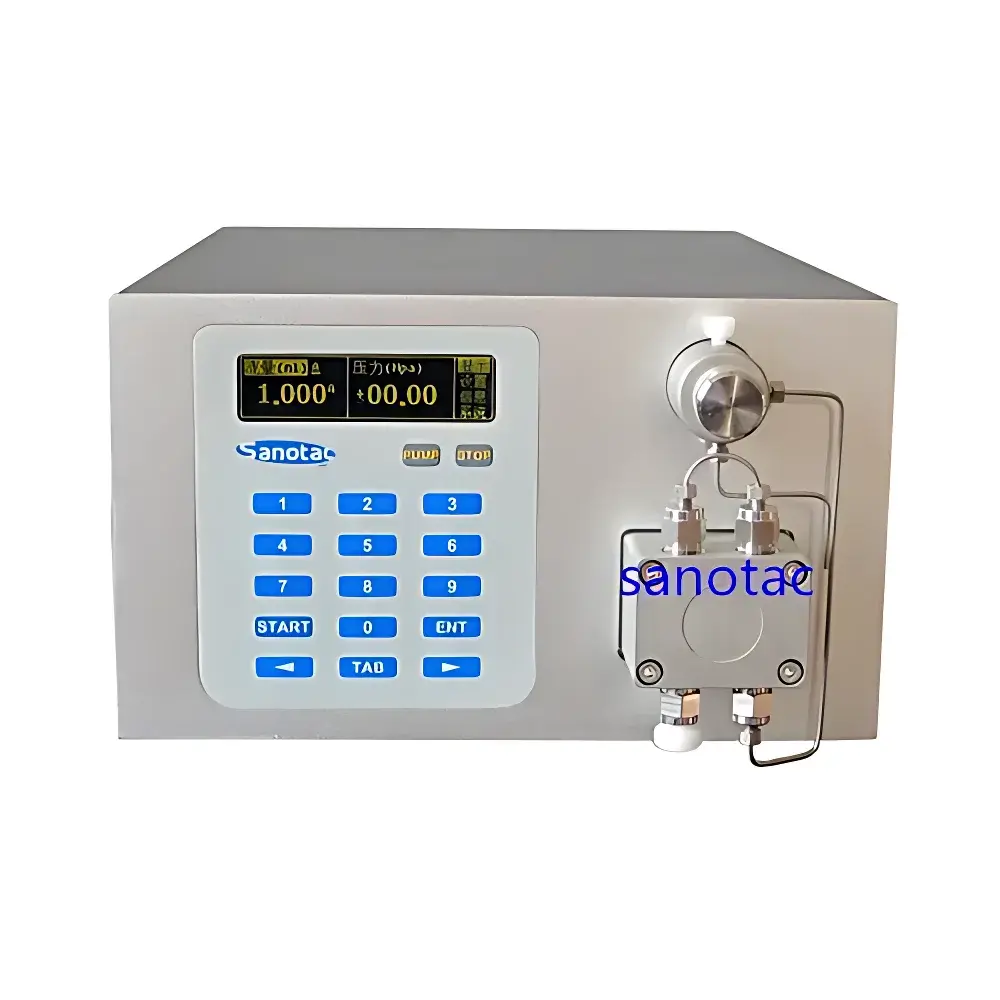
Sanotac NRP0530 High-Pressure Constant Flow Pump (50 mL Head, 30 MPa)
| Brand | Sanotac |
|---|---|
| Origin | Shanghai, China |
| Manufacturer Type | Direct Manufacturer |
| Country of Origin | China |
| Model | NRP0530 |
| Price Range | USD 1,400 – 2,800 |
| Flow Mode | Dual Parallel Piston with Floating Piston Design |
| Flow Range | 0.01–50.00 mL/min |
| Flow Increment | 0.01 mL/min |
| Flow Accuracy | ±0.5% |
| Flow Precision (RSD) | ≤0.1% |
| Max Pressure | 30 MPa |
| Pressure Pulsation | ≤0.2 MPa |
| Wetted Materials | 316L Stainless Steel, Sapphire, PTFE, Ceramic |
| Tubing Connection | 1/16" Standard |
| Display | 256×64 Dot Matrix Backlit LCD |
| Control Interface | Front Panel Keypad + RS232/USB Computer Remote Control (Open Protocol) |
| Power Supply | 85–264 VAC, 50 Hz |
| Dimensions | 370 × 240 × 152 mm |
Overview
The Sanotac NRP0530 is a high-pressure constant flow pump engineered for precision fluid delivery in analytical and preparative chromatographic systems, including HPLC, SFC, and specialized process-scale applications. Unlike conventional peristaltic pumps—whose inherent pulsation, limited pressure capability (<1 MPa), and compressibility-induced flow inaccuracies restrict their use in high-resolution separation workflows—the NRP0530 employs a dual parallel piston architecture with floating piston design and active solvent compressibility compensation. This architecture enables stable, pulse-minimized delivery across a wide dynamic flow range (0.01–50.00 mL/min) at pressures up to 30 MPa. Its operation follows positive displacement principles governed by volumetric piston displacement, real-time flow feedback correction, and cam-profile-based mechanical synchronization—ensuring traceable, repeatable, and metrologically robust flow control compliant with ISO 5725 (accuracy and precision) and ASTM D3417 (pump performance testing).
Key Features
- Dual parallel piston system with floating piston mechanism: Reduces seal wear, extends service life of high-pressure seals, and maintains consistent volumetric displacement under thermal and pressure cycling.
- Multi-point flow calibration and solvent compressibility compensation: Dynamically adjusts stroke volume based on solvent density and compressibility (e.g., methanol vs. water vs. CO₂-rich mobile phases), minimizing systematic drift across gradient methods.
- Low-pressure-pulsation engineering: Combines optimized cam profile kinematics with real-time electronic flow pulse suppression (via closed-loop current modulation of stepper motor drivers), achieving ≤0.2 MPa pressure ripple (measured per ISO 11439 at 1 mL/min, 20 MPa, acetonitrile/water 80:20).
- Chemically inert fluid path: Constructed from 316L stainless steel, sapphire check valves (Swiss-sourced), PTFE seals, and ceramic plungers—fully compatible with aggressive solvents (e.g., THF, DMF, concentrated acids/bases) and particulate-laden slurries up to 5 µm.
- Open-protocol remote control interface: RS232 and USB ports support ASCII-based command sets compliant with ANSI X3.4; fully integrable with third-party chromatography data systems (CDS), LabVIEW, Python (PySerial), or custom SCADA environments without proprietary driver dependencies.
- Embedded programmability: Stores up to 10 user-defined methods with independent flow rate ramps, gradient profiles (isocratic, linear, step, or composite), and pressure limit thresholds—enabling unattended overnight operation under GLP audit trails.
Sample Compatibility & Compliance
The NRP0530 accommodates a broad spectrum of liquid-phase samples and mobile phases used in regulated and research-grade laboratories. It supports aqueous buffers (pH 1–13), organic solvents (acetonitrile, methanol, IPA, ethyl acetate), supercritical CO₂ mixtures (in SFC), and viscous polymer solutions (up to 500 cP at 25 °C). All wetted materials conform to USP Class VI biocompatibility standards and FDA 21 CFR Part 11 requirements when paired with validated CDS software featuring electronic signatures and audit trail logging. The pump meets CE marking directives (2014/30/EU EMC, 2014/35/EU LVD) and operates within IEC 61000-6-3 emission limits. Its mechanical design complies with ISO 13849-1 PLd safety integrity for emergency pressure cutoff integration.
Software & Data Management
The NRP0530 does not require vendor-locked software. Its open ASCII command protocol enables seamless integration into existing laboratory informatics infrastructure. Command syntax supports real-time query of operational parameters (e.g., QFLW? for current flow, QPRES? for system pressure), method upload (LOAD 3), and asynchronous status polling. When deployed in GxP environments, the pump’s timestamped event log—including start/stop commands, pressure fault triggers, and flow deviation alerts—can be exported via serial dump or embedded Ethernet gateway (optional add-on) for inclusion in 21 CFR Part 11-compliant audit packages. Firmware updates are performed via USB mass storage mode, with SHA-256 checksum verification to ensure integrity.
Applications
- HPLC and UHPLC method development requiring sub-0.1% RSD flow stability over 24-hour gradients.
- Preparative chromatography (10–100 g scale) where consistent loading and fraction collection depend on pulse-free eluent delivery.
- Supercritical fluid chromatography (SFC) with CO₂/methanol mobile phases demanding rapid pressure ramping and low compressibility error.
- Reaction monitoring systems integrating inline UV/Vis or conductivity detection, where flow-induced baseline noise must remain below 25 µAU.
- Material science workflows involving nanoparticle dispersion delivery into microfluidic synthesis chips (e.g., PLGA encapsulation) requiring precise bolus injection timing and volume fidelity.
- Pharmaceutical QC labs performing dissolution testing per USP , where pump accuracy directly impacts release profile compliance.
FAQ
Does the NRP0530 support gradient formation natively?
Yes—it features onboard gradient generation with isocratic, linear, step, and user-defined composite profiles. Gradient delay volume is minimized to <150 µL via integrated mixer design.
Can it be operated without a computer?
Yes—full functionality is accessible via the front-panel keypad and backlit LCD. All 10 methods can be recalled, edited, and executed locally.
What maintenance intervals are recommended for the high-pressure seals?
Under continuous operation at ≤25 MPa with compatible solvents, sapphire/PTFE check valves and ceramic plungers typically exceed 12,000 hours MTBF; seal replacement is advised every 6,000 operating hours or after exposure to abrasive slurries.
Is firmware update capability included?
Yes—updates are delivered as signed .bin files via USB stick. Each release includes version-locked changelogs and cryptographic hash validation.
How is pressure pulsation measured and verified?
Per ISO 11439 Annex B: using a calibrated piezoresistive pressure transducer (±0.05% FS) sampled at ≥10 kHz, with RMS calculation over 10,000 cycles at defined flow/pressure setpoints. Factory test reports are supplied with each unit.



