
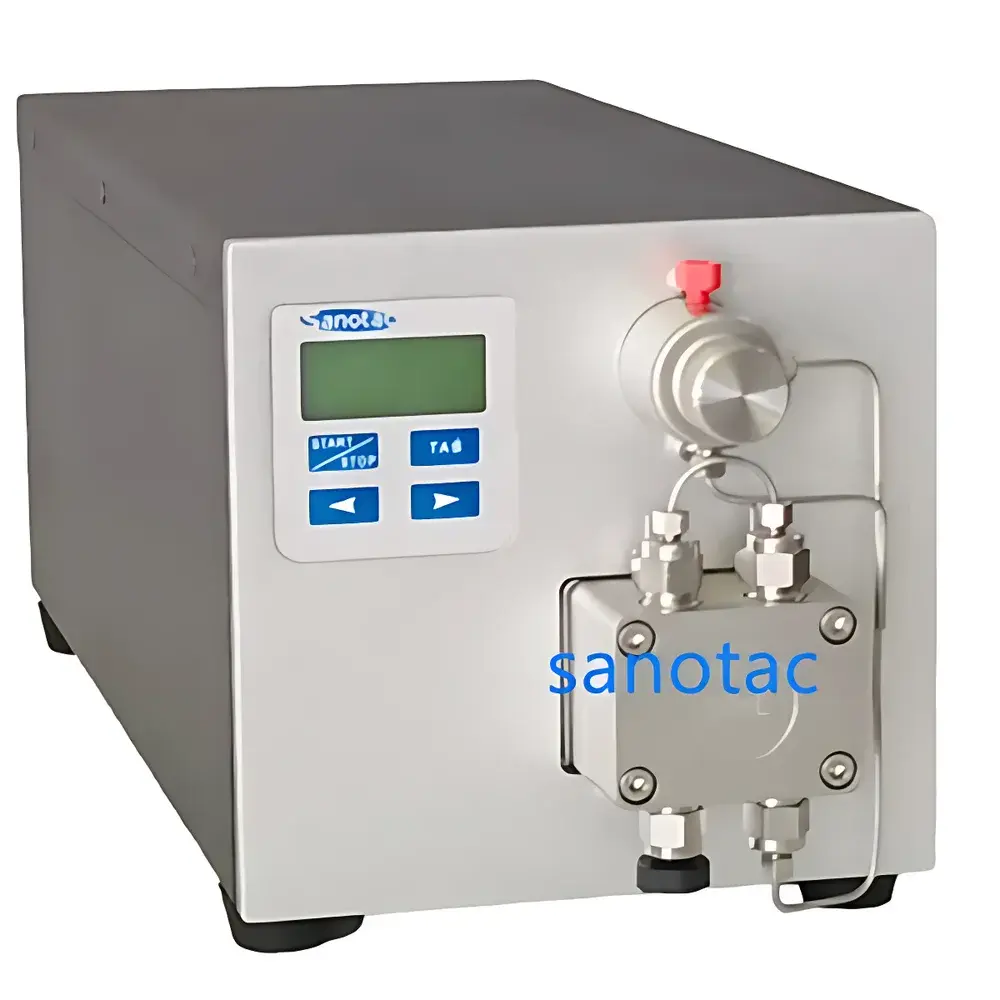
Sanotac S1020 High-Pressure Constant Flow Pump
| Brand | Sanotac |
|---|---|
| Origin | Shanghai, China |
| Manufacturer Type | Direct Manufacturer |
| Country of Origin | China |
| Model | S1020 |
| Flow Rate Range | 0.01–100 mL/min |
| Maximum Pressure | 20 MPa |
| Flow Accuracy | ±0.5% |
| Flow Repeatability | ≤0.1% |
| Pressure Pulsation | ≤0.1 MPa |
| Wetted Materials | 316L Stainless Steel, Ruby, PTFE, Ceramic |
| Communication Interfaces | RS232, RS485, USB, Modbus RTU/ASCII (standard) |
| Power Supply | 85–264 VAC, 50 Hz |
| Power Consumption | 75 W |
| Dimensions | 370 × 240 × 152 mm |
| Weight | 8 kg |
Overview
The Sanotac S1020 High-Pressure Constant Flow Pump is an engineered precision fluid delivery system designed for continuous, pulse-minimized volumetric flow control under elevated pressure conditions. Based on positive displacement reciprocating plunger technology, it operates via a cam-driven dual-piston architecture with active flow pulse suppression and real-time compression compensation—enabling stable delivery across variable backpressures up to 20 MPa. Unlike peristaltic or diaphragm pumps, the S1020 maintains metrological traceability through multi-point volumetric calibration across its full operating range (0.01–100 mL/min), making it suitable for applications requiring long-term stability, quantitative reagent dosing, and compliance with GLP/GMP fluid handling protocols. Its robust mechanical design integrates thermally stable ceramic-ruby check valves and chemically inert wetted path materials—including 316L stainless steel, PTFE, and high-purity ceramics—to ensure compatibility with aggressive solvents, supercritical CO₂, catalyst slurries, and high-viscosity process streams.
Key Features
- Multi-point volumetric calibration: Enables traceable flow accuracy of ±0.5% and repeatability ≤0.1% across the entire 0.01–100 mL/min range.
- Active pulse suppression: Combines optimized cam profile geometry with electronic flow feedback to limit pressure pulsation to ≤0.1 MPa—critical for sensitive downstream instrumentation (e.g., HPLC detectors, microreactors).
- Compression compensation algorithm: Dynamically adjusts plunger stroke in real time to offset fluid compressibility effects at high pressures, preserving volumetric fidelity.
- Column plunger post-wash function: Automates solvent flush behind the plunger seal to minimize particulate accumulation and extend seal lifetime—especially vital in catalytic slurry or nanoparticle feed applications.
- Dual-mode pressure protection: Configurable safety cutoff and zero-offset correction compensate for thermal drift and ambient pressure fluctuations.
- Industrial-grade communication suite: Standard RS232/RS485/USB with Modbus RTU/ASCII; optional Modbus TCP, Profibus DP, Profinet, and Ethernet (wired/wireless) for seamless integration into SCADA, DCS, or PLC-controlled process environments.
Sample Compatibility & Compliance
The S1020 accommodates a broad spectrum of process fluids—from aqueous buffers and organic solvents (e.g., THF, DMF, acetonitrile) to supercritical CO₂, molten salts, and abrasive catalyst suspensions—thanks to its selectable wetted path configurations (316L SS, Hastelloy, PEEK, or PTFE pump heads). All models conform to IEC 61000-6-2/6-4 electromagnetic compatibility standards and meet CE marking requirements for laboratory and industrial equipment. For regulated environments, the pump supports audit-trail-capable operation when paired with validated control software compliant with FDA 21 CFR Part 11 (electronic records/signatures) and ISO/IEC 17025 documentation workflows. It is routinely deployed in ASTM D6985-compliant catalytic evaluation rigs and USP method transfer setups where flow consistency directly impacts kinetic data integrity.
Software & Data Management
The optional Sanotac FlowControl Suite provides a Windows-based interface supporting method-driven operation: users define constant, linear, or multi-segment gradient flow profiles with pressure-triggered hold points. Real-time visualization includes synchronized flow rate vs. pressure trend plots, progress bar indicators, and dynamic error flagging (e.g., overpressure, seal leak detection). All operational parameters—including timestamps, setpoints, actual flow/pressure values, and alarm logs—are recorded in CSV and XML formats, exportable for LIMS ingestion or statistical process control (SPC) analysis. Calibration data is stored per pump head serial number; user-defined calibration curves can be imported/exported to maintain metrological continuity across instrument lifecycles. Remote monitoring and parameter adjustment are enabled via secure Ethernet connection using TLS-encrypted HTTP API endpoints.
Applications
- Continuous-flow microreactor systems requiring stoichiometric reagent addition under 10–20 MPa backpressure.
- Catalyst evaluation units (e.g., fixed-bed, slurry-phase reactors) for hydrodesulfurization, Fischer–Tropsch synthesis, and ammonia decomposition studies.
- Supercritical fluid processing—including SFE (supercritical fluid extraction) and SFC (supercritical fluid chromatography) mobile phase delivery.
- Electrochemical flow cells and electrolyzer test benches demanding precise liquid electrolyte circulation.
- Layer-by-layer polymer deposition and nanomaterial ink delivery in printed electronics R&D.
- Automated column chromatography and preparative HPLC systems where gradient reproducibility affects fraction purity.
FAQ
What is the maximum allowable backpressure for continuous operation?
The S1020 is rated for continuous duty at up to 20 MPa; sustained operation above this threshold requires custom validation and may void warranty coverage.
Can the pump handle abrasive slurries containing solid catalysts?
Yes—when equipped with optional ceramic-ruby valve assemblies and PTFE-coated plungers, it achieves >5,000 hours MTBF in 5–20 µm particle-laden feeds typical of FCC or NiMo catalyst testing.
Is flow calibration traceable to NIST standards?
Calibration is performed using gravimetric reference methods traceable to national metrology institutes; full calibration certificates (including uncertainty budgets) are available upon request.
Does the pump support fail-safe shutdown during communication loss?
Yes—configurable watchdog timers trigger immediate flow stop and pressure venting if host command signals are interrupted for >2 seconds.
How often is maintenance required for standard lab use?
With clean solvent operation, seal replacement is recommended every 6–12 months; column wash cycles extend intervals by 30–50% depending on fluid abrasivity.



