
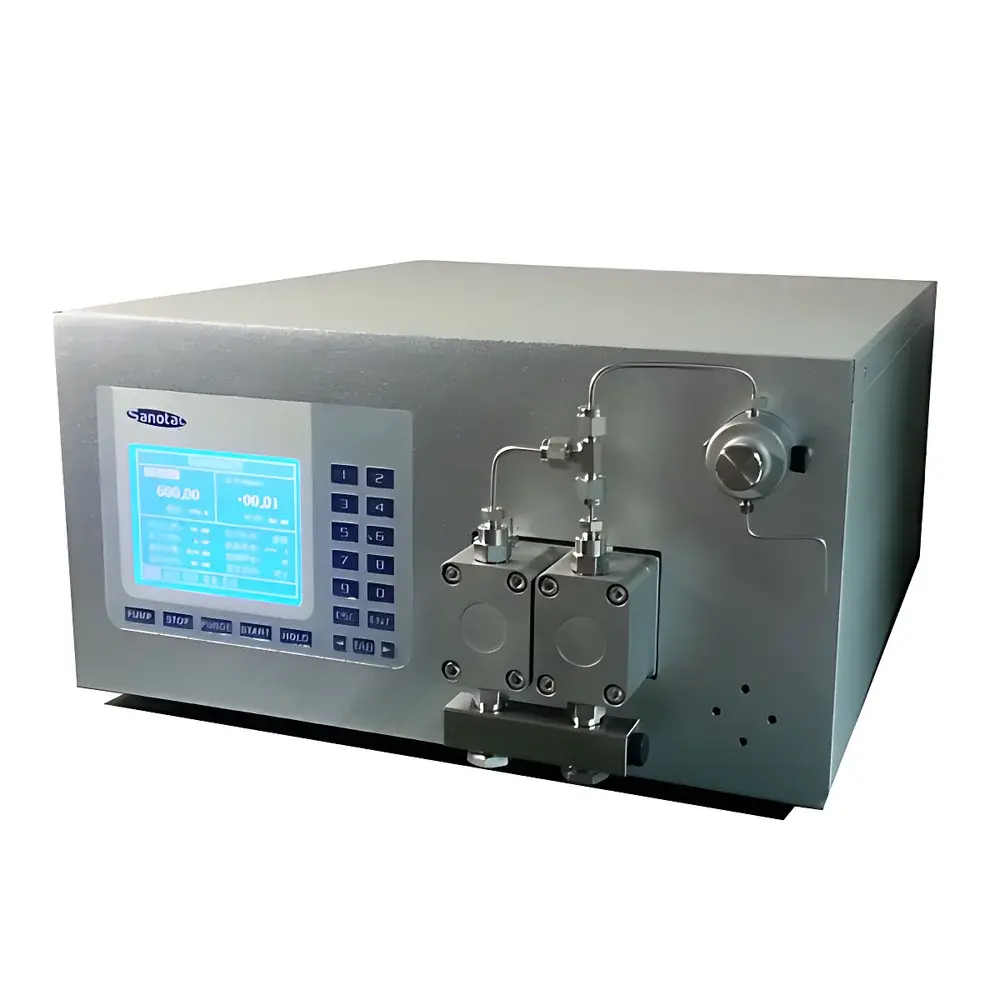
Sanotac SP3010 Preparative High-Pressure Solvent Delivery Pump (300 mL/min, 10 MPa)
| Brand | Sanotac |
|---|---|
| Origin | Shanghai, China |
| Manufacturer Type | Direct Manufacturer |
| Model | SP3010 |
| Flow Rate | 0.01–300.00 mL/min (0.01 mL/min increment) |
| Pressure Range | ≤10 MPa |
| Flow Accuracy | ±1.0% |
| Flow Precision (RSD) | ≤0.5% |
| Pressure Pulsation | ≤0.5 MPa |
| Display | 256×64 dot matrix LCD with adjustable backlight |
| Control Interface | Front-panel keypad + RS232/USB open communication protocol for third-party software integration |
| Power Supply | 85–264 VAC, 500 W |
Overview
The Sanotac SP3010 Preparative High-Pressure Solvent Delivery Pump is an engineered solution for robust, high-throughput liquid delivery in preparative chromatography, process-scale purification, and continuous-flow synthesis applications. Designed around a dual-piston parallel architecture with floating piston technology, the pump delivers stable, pulse-minimized flow across a wide dynamic range—from trace-level analytical support (0.01 mL/min) to full-scale preparative operation (300 mL/min) at pressures up to 10 MPa. Its microprocessor-based control system integrates real-time chamber pressure feedback to dynamically compensate for solvent compressibility and refilling lag—critical for maintaining volumetric fidelity during gradient elution or solvent switching. Unlike fixed-displacement peristaltic or syringe-based systems, the SP3010 employs positive displacement via precision-machined 316L stainless steel pump heads, ensuring chemical compatibility with organic solvents, aqueous buffers, and mildly corrosive mobile phases common in pharmaceutical and fine chemical workflows.
Key Features
- Dual-piston parallel configuration with floating piston design—reduces mechanical stress on seals and extends service life of high-pressure sealing components beyond typical industry benchmarks.
- Advanced cam-profile flow compensation algorithm minimizes pulsation (<0.5 MPa), delivering baseline stability essential for UV/Vis and mass spectrometric detection in downstream inline monitoring.
- Multi-point flow calibration curve (10-point user-definable) ensures linear accuracy across the entire 0.01–300.00 mL/min range, meeting ISO 5725-2 repeatability requirements (RSD ≤0.5%).
- Open RS232 and USB communication protocols conform to standard SCPI command sets—enabling seamless integration with third-party chromatography data systems (CDS), LIMS, or custom automation platforms without proprietary drivers.
- Self-illuminating 256×64 pixel monochrome LCD display with uniform brightness and wide viewing angle—optimized for glovebox, fume hood, or cleanroom environments where ambient lighting varies.
- Ten programmable user methods support complex flow and gradient profiles, including step, linear, and multi-segment ramping—ideal for method development and scale-up transfer from analytical to preparative conditions.
Sample Compatibility & Compliance
The SP3010 accommodates a broad spectrum of solvents—including acetonitrile, methanol, THF, dichloromethane, and aqueous acid/base buffers—thanks to its 316L stainless steel fluid path and chemically resistant seal materials (e.g., PTFE, Kalrez®). It complies with IEC 61010-1 for laboratory equipment safety and meets electromagnetic compatibility (EMC) requirements per EN 61326-1. While not certified for GMP production environments out-of-the-box, its deterministic flow control, audit-ready parameter logging (via external software), and reproducible performance align with GLP documentation standards. The open communication interface supports 21 CFR Part 11-compliant electronic records when paired with validated CDS software featuring user authentication, audit trails, and electronic signatures.
Software & Data Management
The pump operates autonomously via front-panel controls but is fully controllable through ASCII-based serial commands over RS232 or USB virtual COM port. Command syntax follows widely adopted conventions (e.g., :FLOW 150.00, :GRADIENT START 0%, END 80%), enabling integration with Python, LabVIEW, MATLAB, or commercial chromatography platforms such as Chromeleon™ or Empower™. All operational parameters—including actual flow rate, setpoint, pressure reading, and error codes—are queryable in real time. When connected to a host PC, timestamped event logs (start/stop, pressure limit triggers, flow deviations >±2%) can be exported in CSV format for QA/QC review and regulatory submission packages.
Applications
- Preparative HPLC and flash chromatography systems requiring high-volume, high-pressure solvent delivery.
- Continuous-flow reactor feed control for API synthesis, where precise stoichiometric ratios and residence time consistency are critical.
- Automated fraction collection synchronization—triggering collector valves based on real-time flow-integrated volume counters.
- Method scouting and scalability studies bridging analytical UHPLC (µL/min) and pilot-scale purification (mL/min to L/min).
- Mobile phase blending in multi-solvent gradient systems—leveraging dual-pump coordination via external master controller.
FAQ
What is the maximum recommended operating pressure for the SP3010?
The rated pressure limit is 10 MPa (1450 psi) when equipped with the standard 316L stainless steel pump head. Operation above this threshold voids warranty and risks mechanical failure.
Can the SP3010 be used with aggressive solvents like HFIP or TFA?
Yes—provided appropriate wetted material selection (e.g., Hastelloy C-276 pump heads or specialized seals) is confirmed with Sanotac technical support prior to deployment.
Does the pump support gradient mixing internally?
No—the SP3010 is a single-solvent delivery unit. Gradient formation requires external low-dead-volume mixers or coordination with a second SP3010 unit under master-slave control.
Is firmware upgrade capability available?
Yes—field-upgradable firmware is distributed via Sanotac’s secure technical portal and applied using the included USB-to-serial adapter and configuration utility.
How often should flow calibration be performed?
We recommend quarterly calibration verification using gravimetric or timed-volume measurement per ASTM D3487 or internal SOPs; more frequent checks are advised after maintenance or solvent system changes.



