
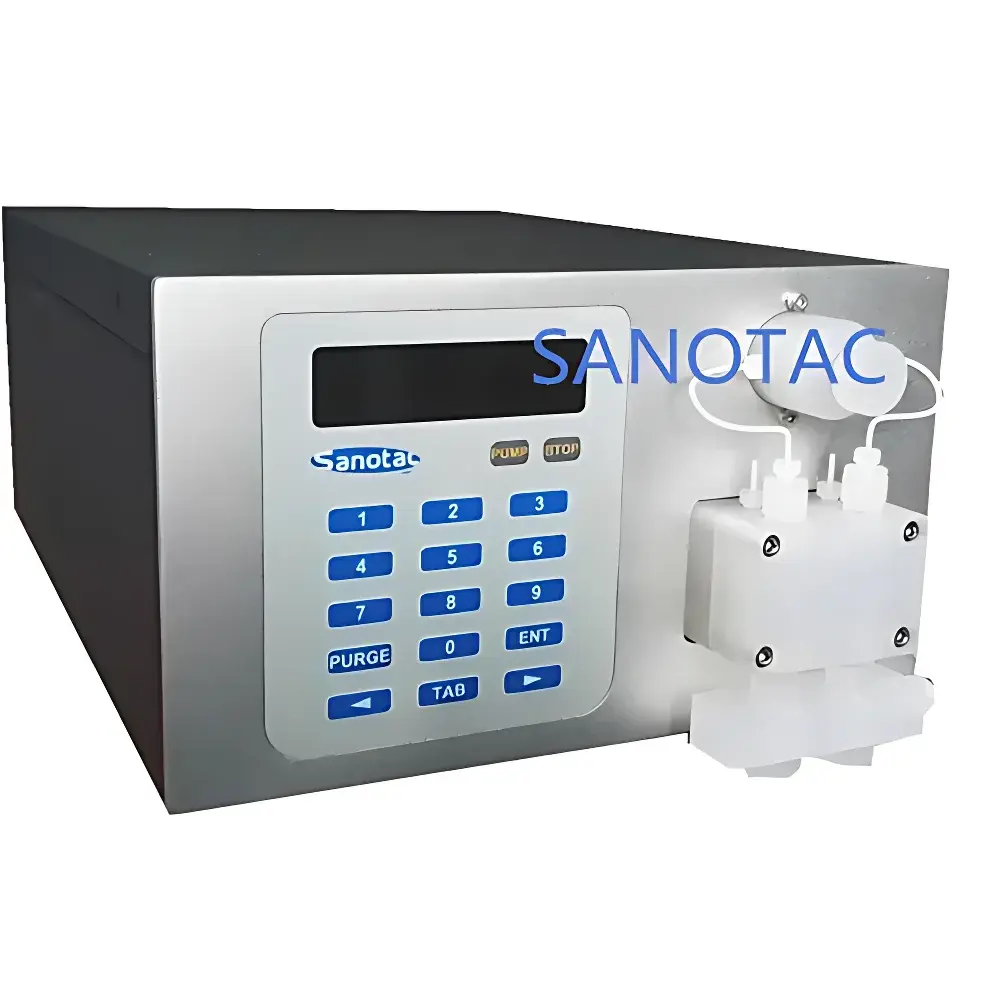
Sanotac SPF0102 PTFE-Lined Constant Flow Pump
| Brand | Sanotac |
|---|---|
| Model | SPF0102 |
| Flow Rate | 10 mL/min |
| Maximum Pressure | 2 MPa |
| Pump Head Material | PTFE & PCTFE |
| Flow Accuracy | ±0.1% |
| Flow Precision (RSD) | ≤0.1% |
| Flow Range | 0.001–9.999 mL/min |
| Increment | 0.001 mL/min |
| Pressure Pulsation | ≤0.1 MPa |
| Wetted Materials | PTFE, PCTFE, Sapphire, Ceramic |
| Tubing Connection | 1/16" Standard |
| Display | 256×64 Dot Matrix Backlit LCD |
| Control Interface | Front Panel + RS232/USB Computer Reverse Control (Open Protocol) |
| Power Supply | 85–264 VAC, 50 Hz |
| Dimensions | 370 × 240 × 152 mm |
Overview
The Sanotac SPF0102 PTFE-Lined Constant Flow Pump is an engineered solution for precise, chemically inert fluid delivery in demanding laboratory and pilot-scale applications. Designed around a dual-piston series architecture with floating plunger technology, it operates on positive displacement principles to deliver stable, pulse-dampened flow across a wide dynamic range—from 0.001 to 9.999 mL/min—while maintaining ≤0.1% RSD flow repeatability and ±0.1% absolute accuracy. Its wetted path consists exclusively of fluoropolymer materials (PTFE and PCTFE), sapphire check valves, and ceramic components, ensuring exceptional resistance to aggressive solvents, strong acids (e.g., concentrated HNO₃, HF), bases, oxidizers, and halogenated compounds. This makes the SPF0102 particularly suited for applications where metallic contamination, adsorption, or chemical degradation must be eliminated—such as in trace-level analysis, catalyst handling, supercritical fluid processing, and corrosion-prone reaction systems.
Key Features
- Fluoropolymer-wetted fluid path (PTFE pump head + PCTFE tubing + sapphire/ ceramic valves) for broad chemical compatibility and zero metal leaching
- Dual-piston serial configuration with floating plunger design minimizes seal wear and extends service life under continuous 2 MPa operation
- Microprocessor-controlled flow compensation, including solvent compressibility correction and multi-point flow calibration curves
- Low-pressure pulsation (<0.1 MPa) achieved via cam-profile optimization and real-time electronic pulse suppression
- Open-protocol RS232/USB reverse control interface compliant with common chromatography data systems (CDS); supports integration into custom LabVIEW, Python, or MATLAB workflows
- Front-panel programmability with 10 user-defined methods, enabling gradient elution profiles (isocratic, linear, step) without external software
- Backlit 256×64 dot-matrix display with intuitive menu navigation and real-time monitoring of pressure, flow, and error status
Sample Compatibility & Compliance
The SPF0102 is compatible with aqueous, organic, and mixed-phase solvents—including acetonitrile, THF, DMF, chlorinated hydrocarbons, and supercritical CO₂—without risk of swelling, creep, or hydrolytic degradation. Its all-fluoropolymer construction meets material requirements for ISO 13485 cleanroom assembly environments and aligns with USP Class VI biocompatibility testing criteria for non-implantable devices. While not certified to IEC 61010-1 as a standalone analytical instrument, its electrical safety design conforms to EN 61010-1:2010 for laboratory equipment. For regulated environments, audit trails and method locking may be implemented at the workstation level when paired with 21 CFR Part 11–compliant CDS platforms.
Software & Data Management
The pump supports bidirectional ASCII-based communication via open command protocol (documented in the technical manual), enabling full remote control—including flow rate setting, gradient programming, start/stop commands, and real-time pressure readback. No proprietary drivers are required; standard terminal emulators or Python’s pySerial library suffice for integration. When used with validated chromatography software (e.g., Thermo Chromeleon, Waters Empower, or Agilent OpenLab), the SPF0102 can participate in electronic record-keeping workflows supporting ALCOA+ data integrity principles. All parameter changes are timestamped and logged locally on the device’s non-volatile memory for GLP/GMP traceability.
Applications
- HPLC and UHPLC auxiliary solvent delivery in corrosive mobile phase systems (e.g., TFA-containing gradients, high-pH ammonium bicarbonate buffers)
- Controlled reagent dosing in catalytic hydrogenation, Fischer–Tropsch synthesis, and electrochemical flow cells
- Supercritical fluid extraction (SFE) and impregnation using CO₂ or ethane-based solvents
- Continuous-flow polymerization and microreactor feed systems requiring inert, low-particulate fluid paths
- Electrolyte circulation in battery R&D test benches (Li-metal, solid-state, Na-ion)
- Calibration standard delivery for gravimetric flowmeter validation per ISO 4064-2
FAQ
What solvents are compatible with the SPF0102’s PTFE/PCTFE fluid path?
All common HPLC-grade solvents, concentrated mineral acids (up to 48% HF, 65% HNO₃), alkalis (e.g., 1 M NaOH), peroxides, and supercritical fluids are fully compatible. Avoid molten alkali metals or fluorine gas.
Can the SPF0102 be used in GMP-regulated environments?
Yes—when integrated into a validated system with appropriate electronic records, audit trail, and access controls. The pump itself provides timestamped local logging and open-protocol control suitable for 21 CFR Part 11 alignment.
Is gradient capability built-in or requires external controller?
Full gradient programming (isocratic, linear, multi-step) is supported natively via front-panel interface or computer command set—no external gradient mixer or controller is needed.
How is flow accuracy verified and maintained over time?
Factory calibration uses gravimetric NIST-traceable standards. Users may perform field verification using certified flow meters or timed volumetric collection; multi-point recalibration is supported through the service menu.
What maintenance intervals are recommended for continuous 24/7 operation?
Plunger seals require inspection every 6 months under constant 2 MPa load; sapphire valves typically exceed 20,000 cycles before replacement. A preventive maintenance log template is included in the user manual.



