
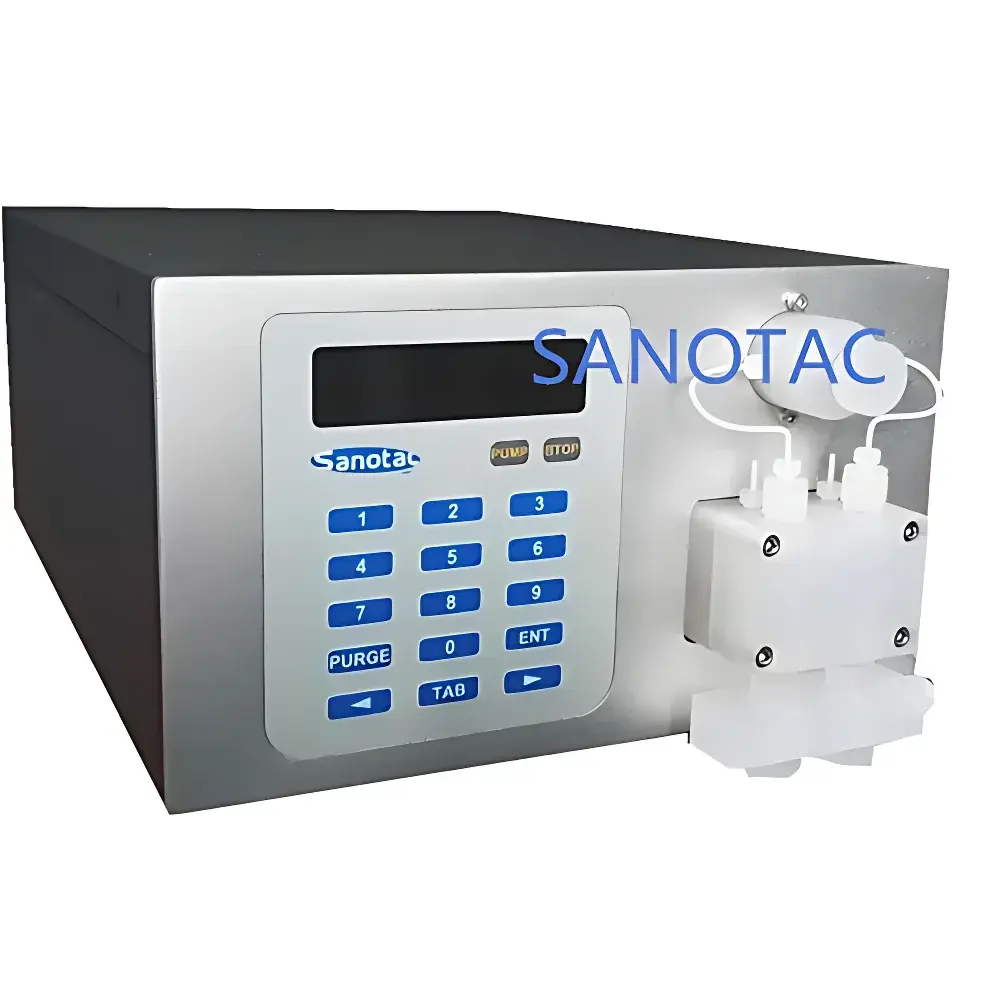
Sanotac SPF1002 PTFE-Compatible Constant-Flow High-Pressure Liquid Delivery Pump
| Brand | Sanotac |
|---|---|
| Model | SPF1002 |
| Construction | PTFE & PCTFE Fluidic Path |
| Max Pressure | 2 MPa |
| Flow Range | 0.01–100.00 mL/min |
| Flow Accuracy | ±0.5% |
| Flow Precision (RSD) | ≤0.1% |
| Flow Increment | 0.01 mL/min |
| Pressure Pulsation | ≤0.2 MPa |
| Drive | Dual Parallel Plunger with Floating Plunger Design |
| Valve | Imported Sapphire & Ceramic Check Valves |
| Display | 256×64 Backlit LCD |
| Control Interface | Front Panel + Open-Protocol RS232/USB Remote Control |
| Power | 85–264 VAC, 50 Hz |
| Dimensions | 370 × 240 × 152 mm |
| Compliance | Designed for GLP/GMP-aligned lab environments |
Overview
The Sanotac SPF1002 is a high-reliability, chemically inert constant-flow liquid delivery pump engineered for precision fluid handling in demanding analytical and process-critical applications. Built around a dual parallel plunger architecture with floating plunger mechanics, it operates on positive displacement principles to deliver stable, pulse-dampened flow across a wide dynamic range—from trace-level additions (0.01 mL/min) to preparative-scale delivery (100 mL/min). Its fluidic path is constructed entirely from fluoropolymer materials—PTFE (polytetrafluoroethylene) and PCTFE (polychlorotrifluoroethylene)—alongside sapphire and ceramic check valves, ensuring exceptional resistance to aggressive solvents, strong acids, alkalis, and supercritical fluids. This makes the SPF1002 particularly suitable for integration into HPLC/UHPLC systems, catalytic reaction monitoring setups, electrochemical flow cells, supercritical fluid chromatography (SFC), and continuous-flow synthesis platforms where material compatibility and long-term seal integrity are non-negotiable.
Key Features
- Dual parallel plunger system with floating plunger design minimizes mechanical stress on high-pressure seals, extending service life and reducing maintenance frequency.
- Microprocessor-based flow control with multi-point volumetric calibration compensates for solvent compressibility across varying viscosities and pressures, maintaining accuracy within ±0.5% across the full flow range.
- Integrated electronic pulse suppression and cam-profile optimization reduce pressure pulsation to ≤0.2 MPa—critical for baseline stability in sensitive detection systems such as UV-Vis, fluorescence, or mass spectrometry.
- Open communication protocol (RS232/USB) supports bidirectional computer control and integration with third-party chromatography data systems (CDS) or custom LabVIEW/Python automation frameworks.
- Front-panel interface features a 256×64 backlit LCD display and supports up to 10 user-defined methods, including programmable gradient profiles combining isocratic, linear, and stepwise segments.
- All wetted components meet USP Class VI biocompatibility requirements and exhibit ASTM D5204-rated resistance to >95% of common organic and inorganic reagents used in research and pilot-scale chemistry.
Sample Compatibility & Compliance
The SPF1002 accommodates a broad spectrum of sample types and process media—including acetonitrile, methanol, hydrochloric acid (up to 37%), sodium hydroxide (up to 50%), hydrogen peroxide, supercritical CO₂, and viscous polymer solutions—without degradation of flow performance or structural integrity. Its PTFE/PCTFE fluid path eliminates metal ion leaching, making it ideal for trace-metal analysis, battery electrolyte formulation, and catalyst screening where contamination must be avoided. The pump is designed to support workflows aligned with Good Laboratory Practice (GLP) and Good Manufacturing Practice (GMP) requirements, including audit-ready operation logs when paired with compliant CDS software. While not inherently 21 CFR Part 11 certified, its open-control architecture allows integration with validated electronic lab notebook (ELN) and data acquisition systems that provide required electronic signature, audit trail, and change control functionality.
Software & Data Management
The SPF1002 does not include proprietary workstation software but provides full command-line access via ASCII-based SCPI-like protocol over RS232 or USB virtual COM port. This enables seamless scripting in Python (using PySerial), MATLAB, or LabVIEW for automated method sequencing, real-time flow/pressure logging, and synchronization with detectors or reactors. All operational parameters—including current flow rate, setpoint, pressure reading, error status, and method ID—are queryable in real time. When integrated into regulated environments, users may deploy validated middleware to enforce user authentication, session locking, and immutable data export (CSV/TXT) with timestamped metadata—meeting core ALCOA+ data integrity expectations.
Applications
- HPLC and preparative LC systems requiring chemically resistant, low-pulse solvent delivery.
- Continuous-flow catalysis and reactor feed control in academic and industrial R&D labs.
- Electrolyte dosing in lithium-ion battery slurry preparation and solid-state electrolyte testing.
- Supercritical fluid extraction (SFE) and SFC mobile phase delivery at pressures up to 2 MPa.
- In-line dilution and standard addition workflows for ICP-MS and AAS sample introduction.
- Controlled reagent addition in photochemical and enzymatic microreactors.
- Calibration fluid delivery for flowmeter validation and gravimetric flow verification protocols.
FAQ
Is the SPF1002 compatible with aqueous alkaline solutions such as 1 M NaOH?
Yes—the PCTFE and PTFE fluid path exhibits excellent resistance to caustic media up to 50% w/w NaOH at ambient temperatures; however, prolonged exposure above 60 °C is not recommended without thermal derating verification.
Can the pump be operated in gradient mode with external solvent selection valves?
Yes—its open command protocol supports synchronized triggering of external 6-port or 10-port switching valves via TTL or relay outputs when integrated into a custom control loop.
Does the pump support pressure feedback control or automatic overpressure shutdown?
No—SPF1002 operates in open-loop flow control mode; pressure monitoring is for diagnostic display only. External pressure transducers and safety interlocks must be implemented at the system level.
What is the maximum operating temperature for the pump head?
The fluoropolymer components are rated for continuous operation up to 120 °C; however, standard configuration uses elastomer-free sealing, limiting practical use to ≤80 °C unless specified with high-temp optional seals.
Are replacement parts such as plungers, seals, and check valves available separately?
Yes—Sanotac supplies OEM-grade PTFE-coated stainless steel plungers, PCTFE valve seats, and sapphire ball assemblies as field-replaceable kits with documented torque specifications and assembly procedures.



