
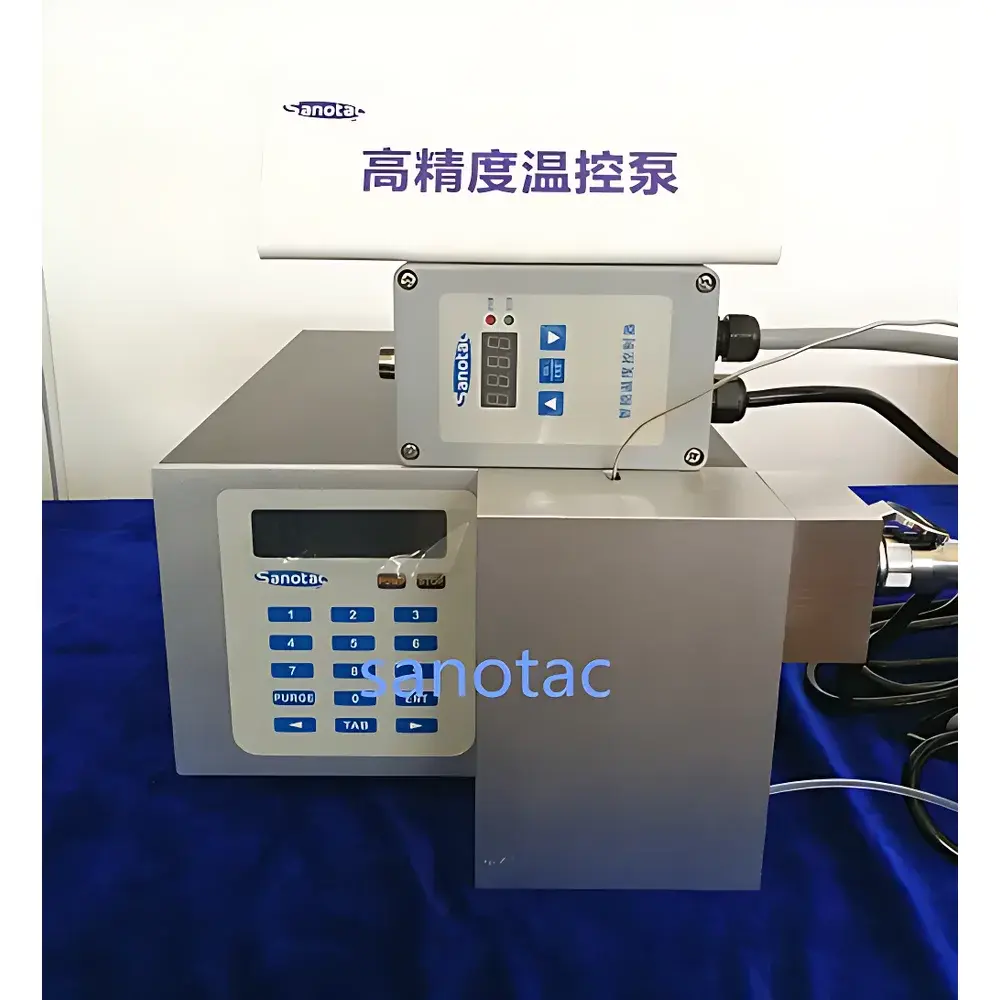
Sanotac TP0520 High-Temperature Heated Constant-Flow Piston Pump
| Brand | Sanotac |
|---|---|
| Origin | Shanghai, China |
| Manufacturer Type | Direct Manufacturer |
| Model | TP0520 |
| Flow Rate | 0.01–50.00 mL/min |
| Maximum Pressure | 20 MPa |
| Temperature Control Range | Ambient to 100 °C |
| Temperature Accuracy | ±1 °C |
| Flow Accuracy | ±0.5% |
| Flow Precision (RSD) | ≤0.1% |
| Pressure Pulsation | ≤0.2 MPa |
| Wetted Materials | 316L stainless steel, sapphire, PTFE, ceramic |
| Tubing Connection | 1/16″ standard fittings |
| Display | 256×64 dot matrix backlit LCD |
| Control Interface | Front-panel keypad or RS232/USB computer remote control |
| Power Supply | 85–264 VAC, 50 Hz |
Overview
The Sanotac TP0520 High-Temperature Heated Constant-Flow Piston Pump is an engineered solution for precise, thermally stable liquid delivery under elevated pressure and temperature conditions. Designed around a dual-piston parallel architecture with floating piston compensation, the pump delivers continuous, pulse-dampened flow across its full operating range — from 0.01 to 50.00 mL/min — while maintaining structural integrity up to 20 MPa. Its integrated thermal management system enables active, uniform heating of the entire fluid path: inlet tubing, pump head cavity, and outlet tubing are all independently monitored and regulated to ensure thermal homogeneity (<±1 °C deviation) throughout the wetted zone. This eliminates cold spots, prevents premature crystallization or solvent condensation, and ensures consistent fluid rheology during delivery — critical for kinetic studies, catalytic dosing, and high-temperature reaction quenching.
Key Features
- Dual-piston parallel drive with floating piston design minimizes mechanical wear and improves long-term volumetric reproducibility (RSD ≤0.1%)
- Integrated triple-zone heating: inlet line, pump head chamber, and outlet line — all independently thermostatically controlled to maintain uniform fluid temperature
- Microprocessor-based temperature controller using embedded MCU architecture; features narrow hysteresis switching, fast thermal response, and programmable ramp profiles
- Thermally insulated pump housing with internal microenvironment stabilization — reduces ambient heat loss and improves energy efficiency
- Modular configuration options: compact all-in-one unit or split-system layout for integration into custom reactor manifolds or glovebox environments
- Chemically resistant fluidic path constructed from 316L stainless steel, sapphire check valves, PTFE seals, and ceramic plungers — compatible with aggressive solvents, acids, and organometallics
- Backlit 256×64 pixel LCD display with real-time visualization of setpoints and actual values for flow rate, pressure, and temperature
Sample Compatibility & Compliance
The TP0520 supports a broad spectrum of process fluids, including low-viscosity solvents (e.g., THF, DMF), mid-range polymer solutions, and moderately viscous catalyst slurries (up to ~500 mPa·s at 80 °C). Its inert wetted materials meet ASTM F2136 requirements for metallic component biocompatibility and ISO 10993-1 general safety principles. The pump’s temperature and flow control firmware complies with GLP documentation standards, supporting audit-ready operation logs when used with optional data acquisition software. While not intrinsically rated for Class I Div 1 hazardous locations, it may be deployed in explosion-proof enclosures per NEC Article 500 when paired with appropriate barrier systems.
Software & Data Management
Remote operation is supported via RS232 and USB interfaces using ASCII command protocol, enabling seamless integration with LabVIEW, MATLAB, or custom SCADA platforms. Optional Sanotac Control Suite v3.x provides time-stamped event logging, multi-parameter trend analysis (flow vs. temp vs. pressure), and export to CSV or XML formats. All parameter changes, runtime events, and error states are recorded with timestamp and user ID — satisfying FDA 21 CFR Part 11 requirements for electronic records and signatures when configured with role-based access controls and audit trail activation.
Applications
- Controlled reagent addition in high-temperature batch reactors (e.g., Fischer-Tropsch synthesis, hydroformylation)
- Continuous catalyst feeding in fixed-bed or slurry-phase catalytic reactors
- Temperature-sensitive polymerization initiators delivery in extrusion-assisted synthesis
- High-pressure supercritical fluid delivery in SFE/SFC pre-concentration loops
- Staged feedstock introduction for molten-salt electrochemical cells and solid-state battery precursor synthesis
- In-line calibration fluid delivery for online viscometers or FTIR flow cells operating above ambient temperature
FAQ
What is the maximum allowable fluid temperature at the pump head?
The pump head is rated for continuous operation up to 100 °C; sustained exposure above this threshold may degrade PTFE seals and affect thermal sensor calibration.
Can the TP0520 be used with corrosive halogenated solvents such as chlorobenzene or bromobenzene?
Yes — provided the wetted path is specified with Hastelloy C-276 or pure titanium components (optional upgrade); standard 316L stainless steel is suitable for short-term exposure only.
Is pressure feedback control available as a closed-loop function?
No — the TP0520 operates as an open-loop constant-flow device; pressure is monitored but not actively regulated. For pressure-compensated flow, external PID controllers or third-party pressure transducers must be integrated.
Does the pump support gradient elution protocols?
Not natively — it lacks onboard multi-solvent selection valves or gradient programming logic. However, it can serve as a stable auxiliary pump in binary or ternary gradient systems when externally coordinated via TTL triggers.
What maintenance intervals are recommended for the piston seals under continuous 80 °C operation?
Sanotac recommends seal inspection every 500 operational hours or quarterly — whichever occurs first — with replacement advised after 1,000 hours or upon observed flow drift exceeding ±1.0%.



