
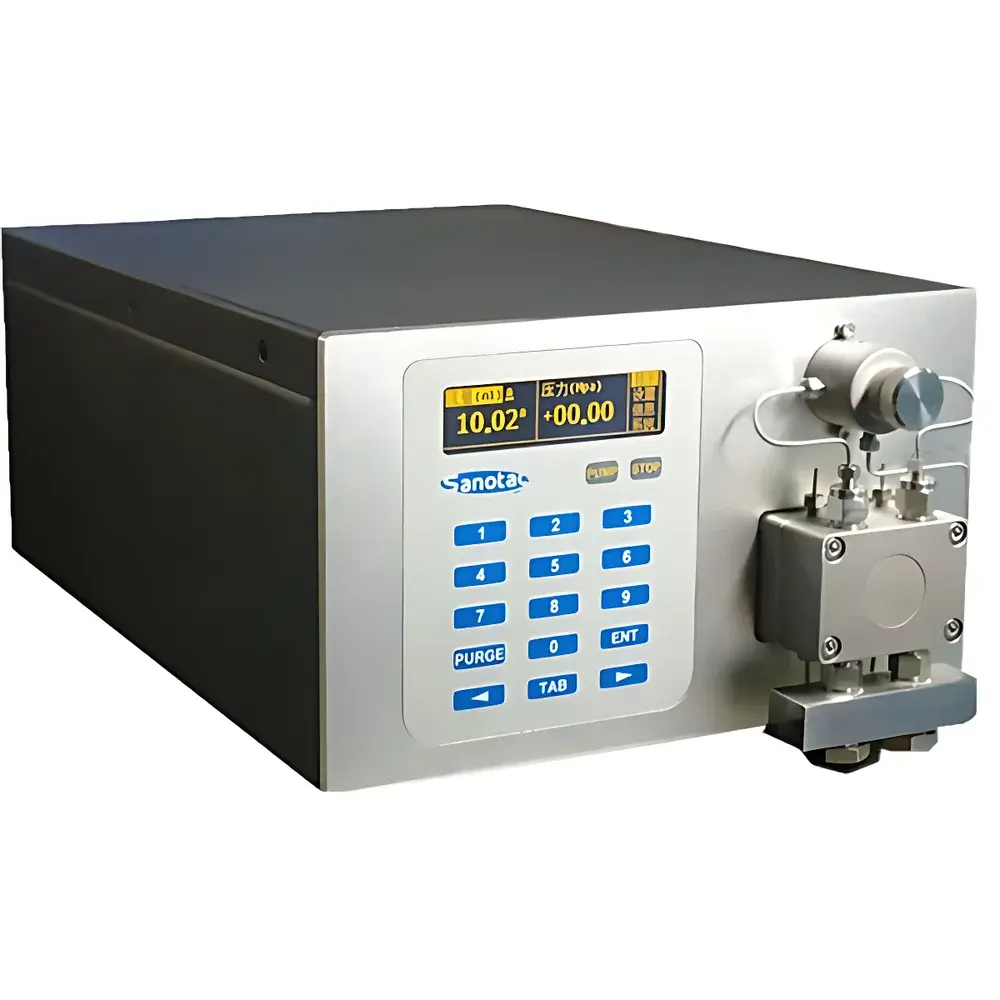
Sanotac TSP2010 High-Pressure Constant Flow Pump
| Brand | Sanotac |
|---|---|
| Origin | Shanghai, China |
| Manufacturer Type | OEM Manufacturer |
| Region of Origin | Domestic (China) |
| Model | TSP2010 |
| Price Range | USD 1,400 – 2,800 |
| Flow Rate | 10–10,000 mL/min |
| Maximum Pressure | 42 MPa |
| Pump Head Volume | 200 mL |
| Operating Pressure Range | 2–42 MPa |
| Construction Materials | Stainless Steel / Titanium / PTFE / PCTFE / Hastelloy / PEEK |
| Control Interface | Microprocessor-based dual-piston drive with open communication protocol (RS-485/Modbus or optional Ethernet) |
| Flow Accuracy | ≤ ±0.3% RSD (typical, calibrated across full range) |
| Pressure Pulsation | < 0.5% (measured at 1 mL/min, 10 MPa, using HPLC-grade solvent) |
| Gradient Capability | Isocratic, linear, step, and user-defined multi-segment gradient profiles |
| Onboard Memory | 10 programmable methods |
| Compliance | Designed to meet general requirements for ISO 9001-certified manufacturing |
Overview
The Sanotac TSP2010 is a high-pressure, dual-plunger constant flow pump engineered for precision fluid delivery in demanding laboratory and pilot-scale applications. It operates on positive displacement principles, utilizing synchronized cam-driven dual pistons to deliver consistent volumetric flow across wide pressure and flow-rate ranges. Unlike peristaltic or syringe-based systems, the TSP2010 employs a parallel dual-head architecture with real-time solvent compressibility compensation—enabling stable flow performance even with low-compressibility solvents (e.g., supercritical CO₂, dense-phase hydrocarbons) or highly viscous feedstocks (e.g., polymer melts, catalyst slurries). Its design targets applications requiring long-term stability under continuous operation, including preparative liquid chromatography (prep-LC), catalytic reaction engineering, electrochemical flow cells, and high-pressure material synthesis platforms.
Key Features
- Microprocessor-controlled dual-piston drive system with adaptive flow calibration across 10–10,000 mL/min, supporting both low-flow analytical and high-throughput process-scale delivery
- Multi-point flow curve correction algorithm compensates for solvent compressibility, thermal expansion, and mechanical hysteresis—ensuring ≤ ±0.3% RSD flow accuracy over extended runtime
- Low-pressure pulsation architecture: integrated cam-profile optimization and active electronic pulse suppression reduce pressure ripple to < 0.5% (at 1 mL/min, 10 MPa)
- Floating plunger mechanism minimizes radial loading on high-pressure seals, extending seal service life by up to 3× compared to fixed-bore designs; paired with Swiss-sourced check valves rated for >10 million cycles
- Modular wetted-path construction: interchangeable pump heads available in stainless steel (316L), titanium (Grade 2), PTFE, PCTFE, Hastelloy C-276, and PEEK—enabling compatibility with aggressive solvents, halogenated media, and high-pH reagents
- Open-protocol communication interface (RS-485 Modbus RTU standard, optional TCP/IP) allows seamless integration with third-party chromatography data systems (CDS), SCADA platforms, or custom LabVIEW/Python control scripts
Sample Compatibility & Compliance
The TSP2010 accommodates a broad spectrum of sample matrices—including aqueous buffers, organic solvents (acetonitrile, THF, DMF), supercritical fluids (CO₂, ethane), molten salts, nanoparticle suspensions, and viscous polymer solutions—without degradation of flow fidelity. Wetted materials conform to ASTM F2136 (biocompatibility of polymeric components) and USP Class VI standards where applicable. While the pump itself is not CE-marked as a standalone medical device, its mechanical and electrical design complies with IEC 61010-1:2010 safety requirements for laboratory equipment. When deployed in regulated environments (e.g., pharmaceutical process development), the TSP2010 supports 21 CFR Part 11-compliant audit trails when paired with validated CDS software that logs all parameter changes, method executions, and error events.
Software & Data Management
The onboard controller features a 4.3-inch TFT LCD touchscreen with intuitive icon-based navigation and 10 preloaded method slots. Users can define multi-step flow gradients (isocratic hold → linear ramp → step transition → dwell), set pressure limits with automatic shutdown, and schedule timed start/stop sequences. All parameters—including flow rate, pressure setpoint, gradient profile, and valve positions—are accessible via ASCII command set over serial or Ethernet. Raw operational logs (timestamped flow/pressure readings, temperature, fault codes) are exportable in CSV format. The open communication protocol enables direct scripting in Python (via PyModbus), MATLAB (Instrument Control Toolbox), or LabVIEW (Modbus I/O palette), facilitating automated method development and DoE workflows.
Applications
- Preparative and semi-preparative liquid chromatography (including chiral separations and peptide purification)
- Catalytic reaction monitoring in high-pressure batch and continuous-flow reactors (e.g., hydrogenation, hydroformylation, Fischer–Tropsch)
- Supercritical fluid processing: extraction, impregnation, and particle formation (RESS, SAS)
- Electrochemical energy research: electrolyte circulation in flow batteries and PEM fuel cell test stations
- Materials science: controlled precursor delivery in CVD/ALD precursor lines and slurry feeding for ceramic extrusion
- Chemical process intensification: precise stoichiometric reagent dosing in microreactor arrays and tubular flow reactors
FAQ
What is the maximum allowable backpressure for continuous operation?
The TSP2010 is rated for continuous operation up to 42 MPa (6,090 psi) at ambient temperatures ≤ 40 °C; derating is required above 40 °C per manufacturer’s thermal derating curve.
Can the pump handle abrasive slurries or particulates?
Yes—when equipped with PEEK or Hastelloy pump heads and optional sapphire-coated plungers, it supports slurries with particles ≤ 5 µm (D90); inline filtration (≤ 1 µm) is recommended for extended service life.
Is firmware upgrade supported in the field?
Yes—firmware updates are delivered via USB flash drive and applied through the front-panel menu without requiring factory service.
How is flow calibration performed?
Calibration uses gravimetric measurement against NIST-traceable mass standards; the system stores up to 12 calibration points per solvent type, automatically selecting the appropriate curve during operation.
Does the pump support remote start/stop via digital I/O?
Yes—opto-isolated TTL-compatible dry-contact inputs and outputs are provided for external PLC synchronization and emergency stop integration.



