
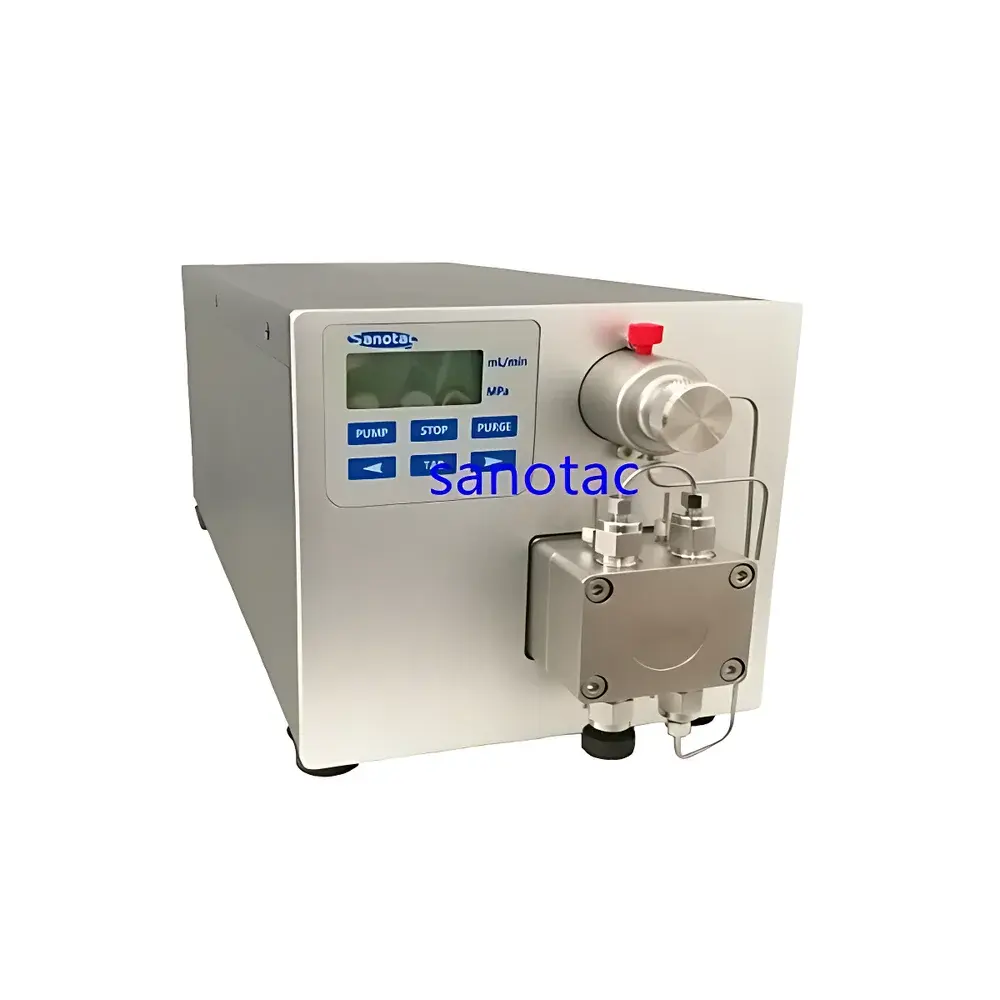
Sanotac XD-50 High-Pressure Constant-Flow Pump for Battery Research
| Brand | Sanotac |
|---|---|
| Origin | Shanghai, China |
| Manufacturer Type | Direct Manufacturer |
| Model | XD-50 |
| Flow Range | 0.01–50.00 mL/min |
| Flow Increment | 0.01 mL/min |
| Flow Accuracy | ±0.5% |
| Flow Precision (RSD) | ≤0.1% |
| Max Pressure | 30 MPa |
| Pressure Pulsation | ≤0.2 MPa |
| Wetted Materials | 316L SS, Ruby, PTFE, Ceramic |
| Connection | 1/16" Standard Fittings |
| Display | 256×64 Dot Matrix LCD with Backlight |
| Control | Front Panel or Open-Protocol PC Remote Control (RS232/USB) |
| Power Supply | 85–264 VAC, 50 Hz |
| Dimensions | 370 × 240 × 152 mm |
Overview
The Sanotac XD-50 High-Pressure Constant-Flow Pump is an engineered solution for precise, pulse-free fluid delivery in demanding electrochemical and battery R&D environments. Designed around dual-piston parallel architecture with floating plunger mechanics, it delivers stable volumetric flow across a wide dynamic range (0.01–50.00 mL/min) under sustained backpressures up to 30 MPa—critical for high-pressure electrolyte circulation, slurry metering, and in-situ cell conditioning in lithium-ion, solid-state, and flow battery development. Its operation adheres to the fundamental principle of positive displacement pumping, where microprocessor-regulated cam profiles, solvent compressibility compensation, and real-time flow curve correction ensure metrological traceability without reliance on feedback sensors. Unlike peristaltic or syringe-based systems, the XD-50 maintains constant flow rate independent of system resistance fluctuations—enabling reproducible electrode wetting, consistent SEI formation studies, and controlled pressure-driven membrane permeation experiments.
Key Features
- Dual-piston parallel drive with floating plunger design: Minimizes seal wear under continuous high-pressure operation, extending service life of critical wetted components and supporting >10,000 hours of uninterrupted runtime in QC/QA labs.
- Low-pressure pulsation performance: Achieves ≤0.2 MPa pressure ripple via optimized cam-profile compensation and active electronic pulse suppression—essential for minimizing mechanical stress during electrode coating or electrolyte infusion into porous electrodes.
- Chemically inert fluid path: Constructed with 316L stainless steel housings, ruby check valves, PTFE seals, and ceramic plungers—validated for compatibility with aggressive battery electrolytes (e.g., LiPF6 in EC/DMC, LiTFSI in DOL/DME, concentrated aqueous ZnSO4).
- Multi-point flow calibration and gradient capability: Supports programmable isocratic, linear, and step gradients—enabling systematic optimization of electrolyte composition ramping during cycling protocols or multi-solvent slurry dispersion studies.
- Open communication protocol: RS232 and USB interfaces implement a documented ASCII command set compliant with ASTM E1382-95 (Standard Practice for Interfacing Chromatographic Data Systems), permitting integration with LabVIEW, Python-based control frameworks, or third-party electrochemical workstations.
- Embedded operational memory: Stores 10 user-defined methods—including flow rate, gradient profile, and hold time—facilitating GLP-compliant method replication and audit-ready parameter logging.
Sample Compatibility & Compliance
The XD-50 accommodates a broad spectrum of battery-relevant fluids: carbonate-based organic electrolytes, ether-based formulations, aqueous salt solutions, polymer gel precursors, and nanosuspensions (e.g., NMC/LFP slurries with solid loading up to 65 wt%). All wetted materials conform to ISO 8502-3 for metallic corrosion resistance and USP Class VI for polymeric biocompatibility—ensuring no leachables interfere with electrochemical impedance spectroscopy (EIS) or coulombic efficiency measurements. The pump meets CE safety directives (2014/35/EU) and supports 21 CFR Part 11-compliant data integrity when paired with validated software platforms featuring electronic signatures, audit trails, and role-based access control.
Software & Data Management
While the XD-50 operates autonomously via its front-panel interface, full remote orchestration is enabled through Sanotac’s open-command SDK. Users may log flow/pressure timestamps at ≥1 Hz resolution, export CSV-formatted datasets with ISO 8601 timestamps, and synchronize pump events with potentiostat triggers using TTL-compatible I/O. Firmware updates preserve backward compatibility and include built-in diagnostic routines for seal integrity verification and motor torque profiling—supporting predictive maintenance planning in regulated battery testing facilities.
Applications
- Continuous electrolyte recirculation in high-pressure pouch or cylindrical cell test rigs
- Precise slurry metering for lab-scale electrode coating trials (slot-die, doctor blade)
- Controlled infusion of functional additives (e.g., FEC, LiNO3) during formation cycling
- High-pressure gas diffusion layer (GDL) saturation studies in PEM fuel cell R&D
- Calibration reference for in-line conductivity or density sensors in closed-loop battery recycling processes
- Delivery of corrosive etchants (e.g., HF-containing solutions) in cathode material surface modification workflows
FAQ
Is the XD-50 compatible with lithium metal anode testing environments?
Yes—the PTFE/ruby/ceramic fluid path resists reduction by lithiated species, and the absence of aluminum or copper wetted parts prevents galvanic contamination.
Can it be used for ultra-high-viscosity cathode slurries (e.g., >8,000 cP)?
It is rated for Newtonian fluids up to 1,500 cP at 50 mL/min; for non-Newtonian slurries, consult Sanotac’s XD-50-SV variant with shear-compensated piston stroke modulation.
Does the pump support automatic leak detection or pressure override shutdown?
Yes—integrated pressure transducer feedback triggers immediate stop-and-hold on exceeding user-set thresholds (configurable from 5–30 MPa), with event logging to internal memory.
What validation documentation is provided for GMP battery pilot lines?
Factory calibration certificates (traceable to NIST standards), IQ/OQ templates, and material compliance declarations (RoHS, REACH, FDA 21 CFR 177.2470) are included with each unit.
How frequently must the 316L pump head be passivated for fluoride-containing electrolytes?
No routine passivation is required; however, a citric acid rinse cycle (0.5 M, 60°C, 30 min) is recommended after every 200 hours of operation with >100 ppm HF-equivalent media.



