
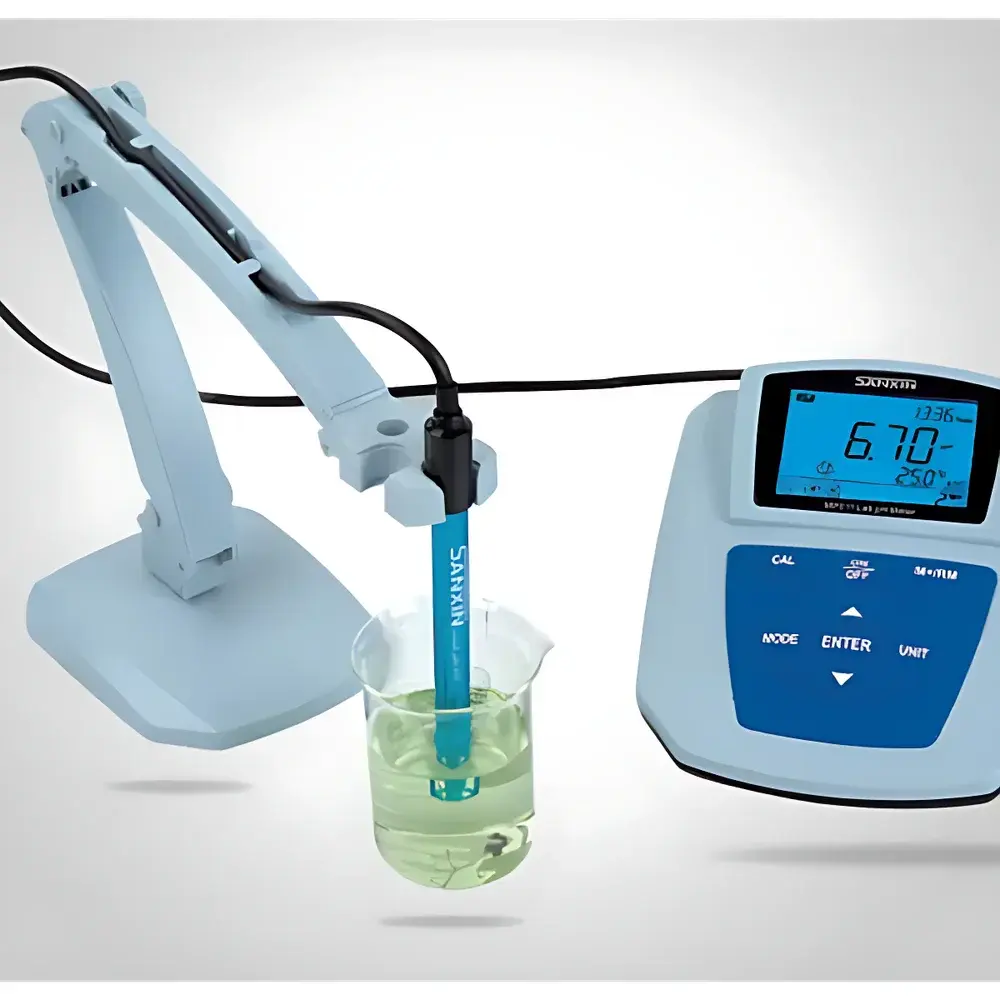
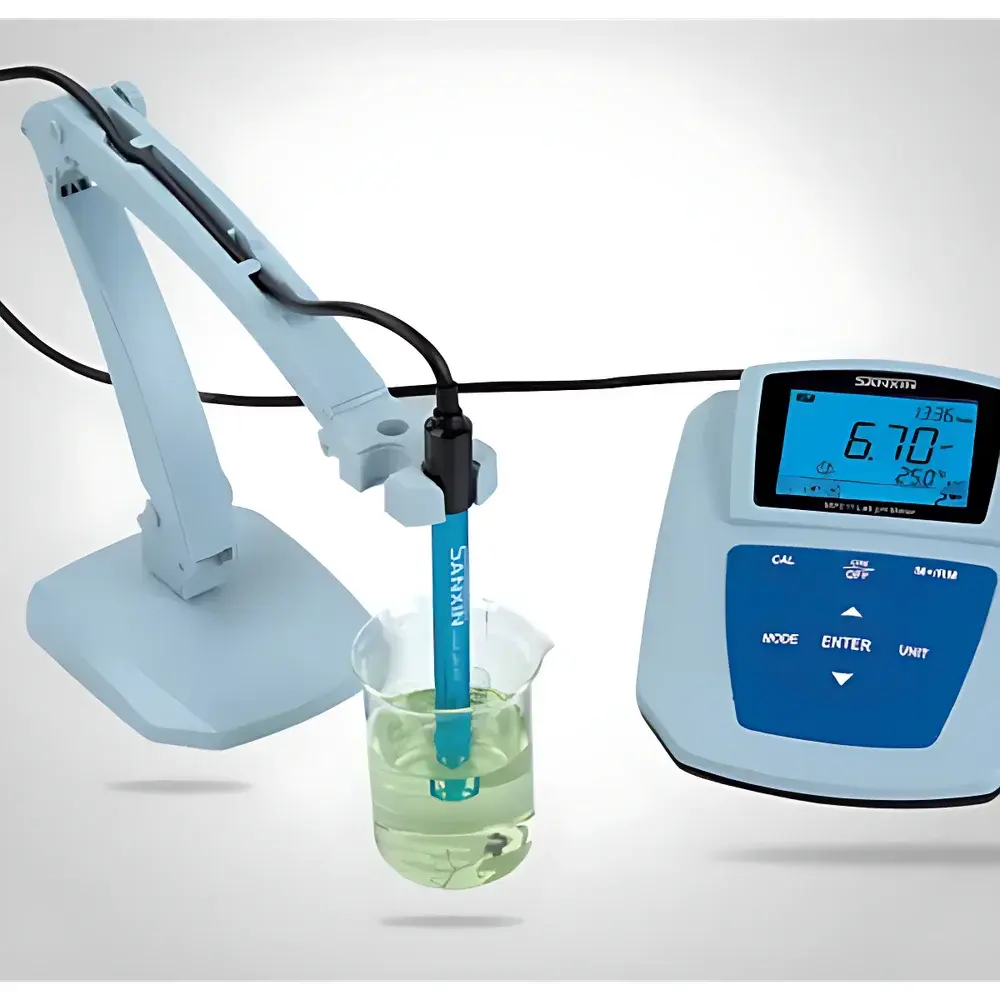
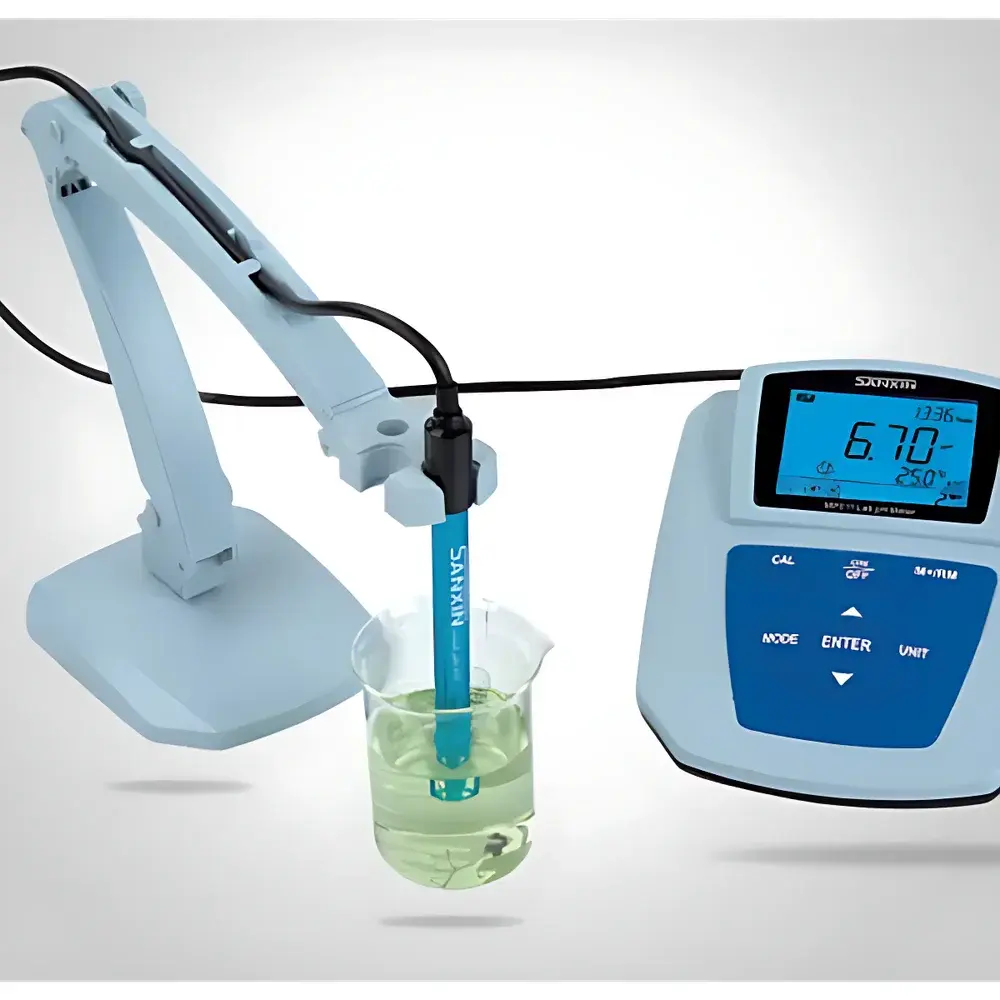
Sanxin MP512-01 Benchtop pH/ORP Meter
| Brand | Sanxin Peirui (SANXIN) |
|---|---|
| Origin | Shanghai, China |
| Instrument Type | Benchtop |
| Parameter Type | Single-parameter (pH/mV/°C) |
| pH Range | -2.000 to 19.999 pH |
| pH Resolution | 0.1 / 0.01 / 0.001 pH |
| mV Resolution | 0.1 mV |
| Temperature Resolution | 0.1 °C |
| pH Accuracy (Meter) | ±0.002 pH |
| (System w/ 2503-C electrode) | ±0.01 pH |
| mV Accuracy | ±0.03% FS |
| Temperature Accuracy | ±0.4 °C (5–60 °C), ±0.8 °C (other ranges) |
| Input Current | ≤1 × 10⁻¹² A |
| Input Impedance | ≥3 × 10¹² Ω |
| Stability | ±0.002 pH / 3 h |
| Temperature Compensation | Automatic or Manual, 0–100 °C |
| Buffer Recognition | 13 standard pH buffers (NIST, DIN, Chinese GB, and custom series) |
| Measurement Modes | Stable Read, Timed Read, Continuous Read |
| Special Modes | High-Purity Water pH, Ammoniated Pure Water pH, ORP (vs. SHE) |
| Data Storage | 600 records (ID, value, temperature, ATC/MTC status, date/time) |
| Interface | RS232 |
| Power | DC 9 V / 300 mA |
| Dimensions | 160 × 190 × 70 mm |
| Weight | 880 g |
| Environmental Rating | IP54 |
| Certifications | ISO 9001:2000, CE, CMC |
| Operating Conditions | 15–30 °C (for 0.001-class performance), ≤75% RH |
Overview
The Sanxin MP512-01 is a high-precision benchtop pH/ORP meter engineered for laboratory, quality control, and industrial process support environments where trace-level pH accuracy and electrochemical reliability are critical. Based on potentiometric measurement principles—detecting the potential difference between a glass pH sensing electrode (standard 2503-C combination electrode) and a stable reference system—the MP512-01 delivers metrologically traceable results across an extended pH range of –2.000 to +19.999. Its ultra-high input impedance (≥3 × 10¹² Ω) minimizes loading errors when measuring low-conductivity samples such as ultrapure water, while its sub-picomampere input current (≤1 × 10⁻¹² A) ensures minimal polarization drift during prolonged measurements. The instrument implements automatic temperature compensation (ATC) using either integrated or external Pt1000 sensors, supporting both manual and automatic modes across 0–100 °C. Designed in compliance with Good Laboratory Practice (GLP) frameworks, it provides full auditability through timestamped data logging, instrument identification (unique serial number), and configurable calibration history retention.
Key Features
- Triple-resolution pH display (0.1 / 0.01 / 0.001 pH) with real-time stability indication and user-selectable averaging
- Integrated ORP (EH) mode calibrated against the Standard Hydrogen Electrode (SHE), reporting values from –1999.9 to +1999.9 mV with 0.1 mV resolution
- Intelligent buffer recognition for 13 certified pH standards across four regional series: NIST, DIN (European), GB (Chinese national), and user-defined formulations
- Dedicated high-purity water and ammoniated pure water pH algorithms—compliant with ASTM D1125 and IAPWS guidelines for power plant feedwater monitoring
- Three operational modes: Stable Read (auto-hold upon signal stabilization), Timed Read (programmable interval acquisition), and Continuous Read (real-time waveform output)
- IP54-rated enclosure with silicone-sealed electrode and RS232 ports, enabling robust use in QC labs and semi-industrial settings with controlled ambient conditions (15–30 °C, ≤75% RH)
- GLP-compliant data management: 600 internal storage slots recording measurement ID, pH/mV/°C values, ATC/MTC status, date, and time stamp
Sample Compatibility & Compliance
The MP512-01 is validated for aqueous and low-ionic-strength matrices, including deionized water, boiler feedwater, pharmaceutical buffers, electroplating baths, and environmental leachates. Its 2503-C glass composite electrode features a low-resistance pH-sensitive membrane and double-junction reference system optimized for reduced junction clogging and improved longevity in challenging samples. While not intrinsically explosion-proof or rated for hazardous locations, the instrument meets CE marking requirements for electromagnetic compatibility (EMC Directive 2014/30/EU) and low-voltage safety (LVD Directive 2014/35/EU). It carries CMC (China Metrology Certification) and ISO 9001:2000 manufacturing certification. Although not preconfigured for 21 CFR Part 11 compliance, its RS232 interface supports integration into validated LIMS or ELN systems where electronic signatures and audit trails are externally managed.
Software & Data Management
Data export is supported via RS232 serial interface using ASCII-based protocol compatible with common terminal emulators (e.g., Tera Term, PuTTY) and custom SCADA or LabVIEW drivers. Each stored record includes a unique numeric ID, measured parameter value, temperature reading, ATC activation flag, and full Gregorian timestamp (YYYY-MM-DD HH:MM:SS). No proprietary software is bundled; however, the ASCII structure enables direct import into Excel, MATLAB, or statistical process control (SPC) platforms. Calibration logs—including date, buffer IDs used, slope (%), offset (mV), and asymmetry potential—are retained per session and accessible via front-panel navigation. All settings (units, resolution, auto-hold threshold, temperature unit) are non-volatile and preserved after power cycling.
Applications
- Power generation: Monitoring pH of condensate, feedwater, and steam cycle chemistry per EPRI TR-102391 and ASME PTC 19.11
- Pharmaceutical manufacturing: Conducting USP pH verification of purified water and water-for-injection (WFI) batches
- Academic research: Teaching potentiometric theory, calibrating Nernstian response, and characterizing acid dissociation constants (pKa)
- Environmental testing labs: Validating pH in wastewater effluents per EPA Method 150.1 and ISO 10523
- Chemical synthesis QA: Verifying buffer capacity and endpoint detection in titration workflows
- Electroplating & surface treatment: Controlling bath pH and redox potential (ORP) for nickel, chromium, and zinc deposition processes
FAQ
Does the MP512-01 support automatic calibration with two or three points?
Yes—it supports 1-, 2-, or 3-point calibration using any recognized buffer set. The instrument auto-detects buffer pH values and calculates slope and offset in real time.
Can the 2503-C electrode be replaced with other Sanxin or third-party electrodes?
Yes—the BNC input accepts standard pH electrodes with BNC connectors. However, optimal accuracy and ATC functionality require Sanxin-certified electrodes with integrated temperature sensors.
Is temperature measurement mandatory for pH readings?
No—manual temperature entry is supported, but automatic compensation (ATC) is strongly recommended for measurements outside 25 °C to correct for Nernstian slope variation.
What is the maximum allowable sample conductivity for reliable pH measurement?
The MP512-01 performs best at conductivities ≥25 µS/cm. For ultrapure water (<1 µS/cm), the high-purity water mode applies resistive correction algorithms per ASTM D1125 Annex A3.
How is instrument validation performed for regulated environments?
Users should perform periodic verifications using traceable NIST SRM buffers (e.g., SRM 186, 186a, 186b), document calibration certificates, and retain raw data files with timestamps for GLP/GMP audits.





