
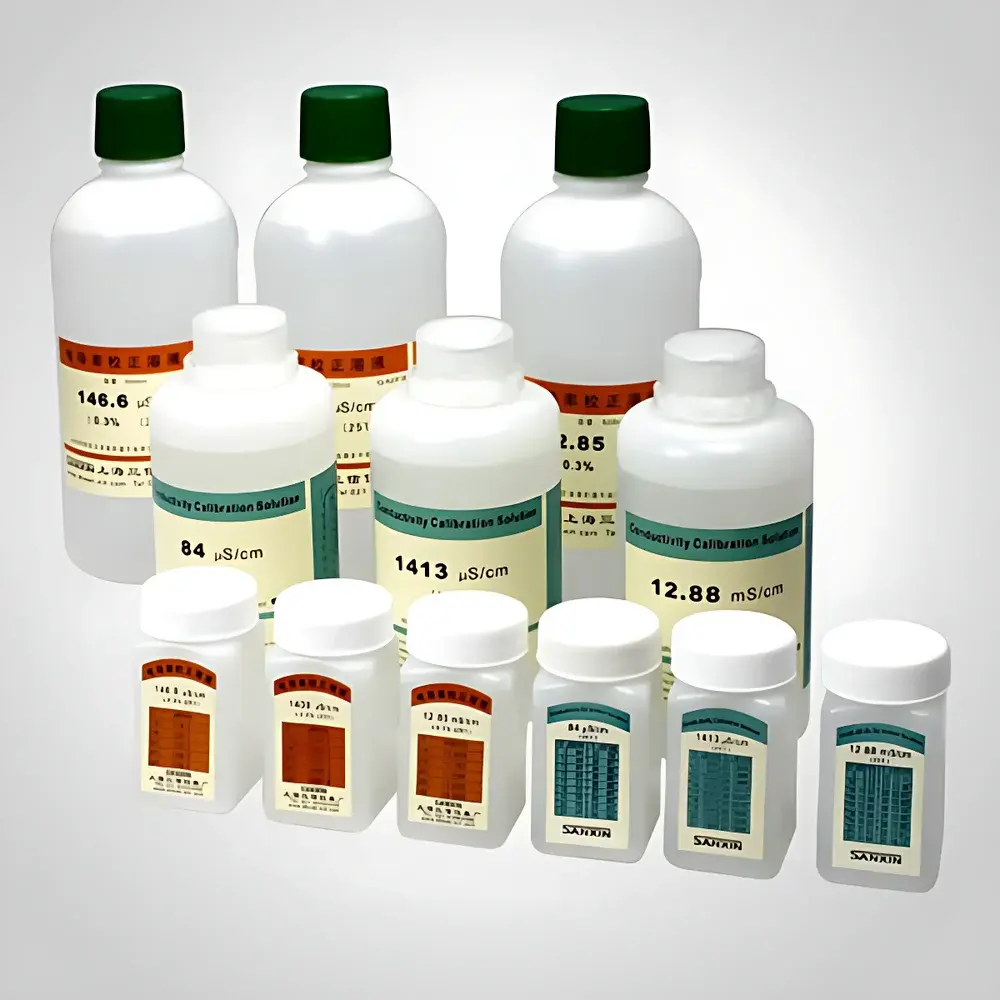
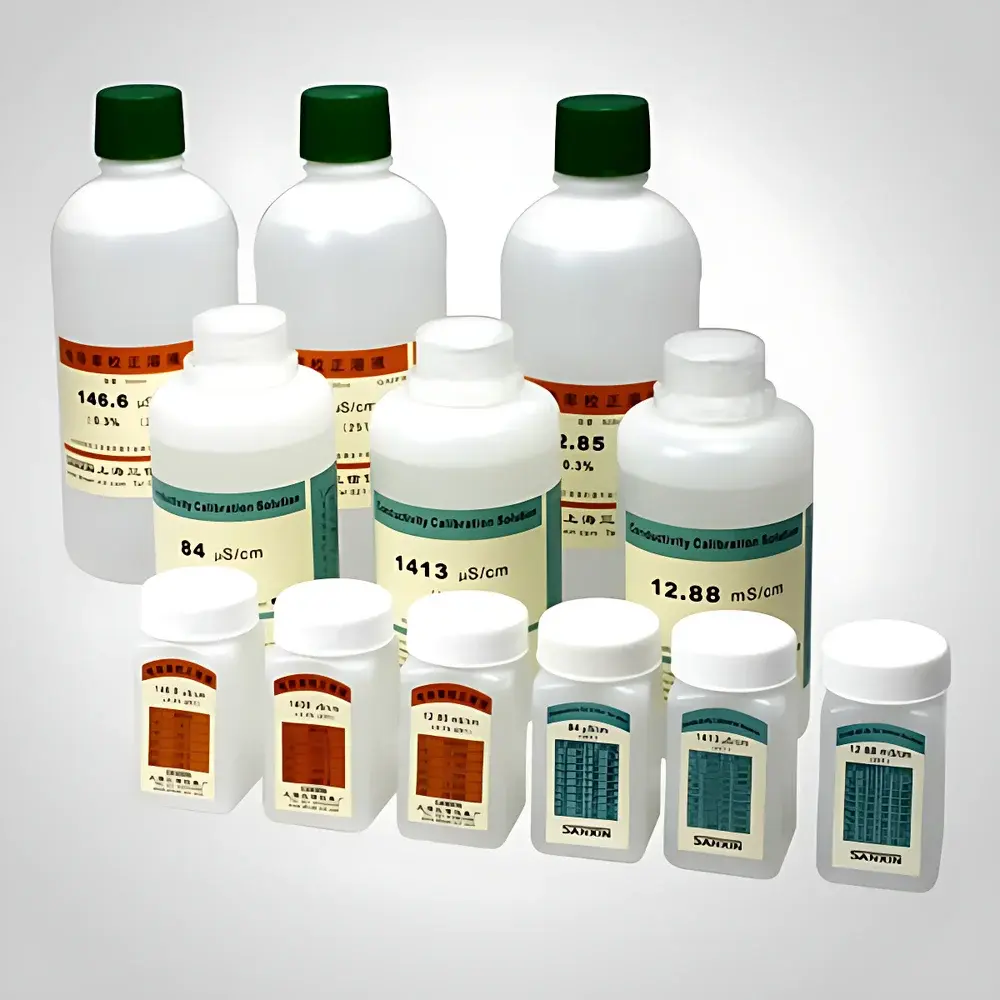
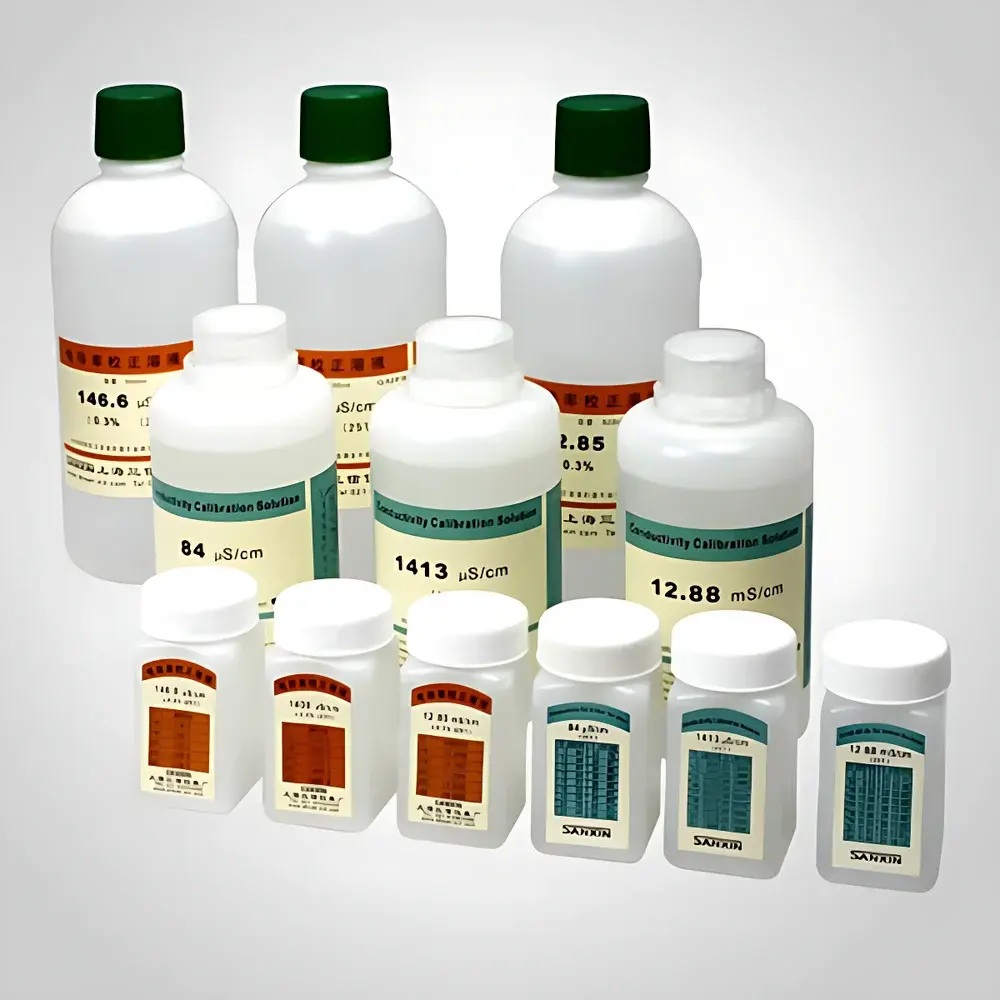
SANXIN SANXIN-Peirui Conductivity Calibration Standard Solutions
| Brand | SANXIN-Peirui |
|---|---|
| Origin | Shanghai, China |
| Manufacturer Type | Authorized Distributor |
| Product Category | Domestic |
| Model | Conductivity Calibration Standard |
| Pricing | Available Upon Request |
| Certified Accuracy | ±0.3% at 25 °C |
| Available Conductivity Values | 84 µS/cm, 146.6 µS/cm, 1408 µS/cm, 1413 µS/cm, 12.85 mS/cm, 12.88 mS/cm |
| Volumes | 50 mL, 250 mL, 500 mL per bottle |
Overview
SANXIN-Peirui Conductivity Calibration Standard Solutions are traceable, temperature-stabilized aqueous reference standards engineered for high-precision calibration and verification of laboratory and industrial conductivity meters, TDS analyzers, and salinity sensors. These solutions conform to internationally recognized electrochemical calibration principles—specifically, the defined conductance behavior of potassium chloride (KCl) and sodium chloride (NaCl) electrolytes at 25 °C under controlled ionic strength conditions. Each lot is certified against NIST-traceable reference materials and validated per ISO/IEC 17025–accredited procedures. The ±0.3% accuracy tolerance (at 25 °C) meets or exceeds requirements for routine QC in pharmaceutical water systems (USP ), environmental monitoring (EPA Method 120.1), and food & beverage process control. Unlike generic buffer solutions, these standards are formulated with ultra-pure deionized water (resistivity ≥18.2 MΩ·cm), low-volatility stabilizers, and rigorous particulate filtration (<0.22 µm), ensuring long-term stability and minimal drift during repeated use.
Key Features
- Traceable certification: Each batch includes a Certificate of Analysis (CoA) listing measured conductivity value, uncertainty budget, measurement temperature, and traceability path to NIST SRM 3199 or equivalent national metrology institutes.
- Multiple standard values: Six discrete conductivity levels cover the full operational range of benchtop and portable meters—from ultrapure water validation (84 µS/cm) to high-salinity applications (12.88 mS/cm).
- Temperature-controlled formulation: Optimized for 25 °C reference point; temperature coefficient (α) pre-characterized per solution to support automatic temperature compensation (ATC) validation.
- Consistent packaging integrity: Amber HDPE bottles with PTFE-lined caps minimize CO₂ absorption and evaporation; shelf life ≥24 months unopened, 6 months after first opening when stored at 15–25 °C.
- Application-specific labeling: Solutions designated for KCl-based calibration (e.g., 1413 µS/cm), NaCl-based resistance verification (e.g., 146.6 µS/cm), and 442™-type TDS correlation (e.g., 12.88 mS/cm) are clearly differentiated on vial and CoA.
Sample Compatibility & Compliance
These standards are compatible with all major conductivity sensor architectures—including two-electrode, four-electrode, and toroidal (inductive) cells—and validated for use with instruments compliant with ASTM D1125, ISO 7888, and EN 27888. They support GLP/GMP documentation workflows by enabling audit-ready calibration records: each CoA provides lot-specific uncertainty values required for instrument qualification (IQ/OQ/PQ). For regulated environments, the solutions satisfy FDA 21 CFR Part 11 data integrity requirements when used in conjunction with electronic lab notebooks (ELNs) or LIMS that capture calibration event metadata (operator ID, instrument ID, date/time, measured vs. certified deviation).
Software & Data Management
While the standards themselves are physical reference materials, their integration into digital calibration workflows is fully supported. Instrument firmware from leading manufacturers—including METTLER TOLEDO, HACH, Thermo Fisher Scientific, and HORIBA—recognizes the 1413 µS/cm and 12.88 mS/cm values as default factory standards. Users may import custom calibration points via CSV or direct USB upload where supported. All CoAs are supplied in PDF/A-1b format, digitally signed and embeddable in LIMS or ELN systems. Traceability logs—including retest dates, storage conditions, and usage history—can be maintained using built-in instrument audit trails or external calibration management software (e.g., LabWare LIMS, Veeva Vault QMS).
Applications
- Pharmaceutical water systems: Calibration of conductivity sensors in Purified Water (PW) and Water for Injection (WFI) loops per USP Stage 1–3 testing protocols.
- Environmental field analysis: Verification of handheld meters used in surface water, wastewater, and groundwater monitoring per EPA and ISO 5667 series standards.
- Food & beverage quality control: Routine calibration of inline conductivity probes in CIP rinse validation, brine concentration monitoring, and dairy processing lines.
- Academic and research laboratories: Teaching labs requiring reproducible, low-uncertainty standards for student experiments in electrochemistry and solution thermodynamics.
- Instrument service and repair: OEM-authorized reference sets for post-maintenance verification of cell constant and temperature compensation algorithms.
FAQ
What is the shelf life of an unopened bottle?
Unopened bottles retain certified accuracy for 24 months when stored between 15–25 °C, away from direct sunlight and humidity.
Can I use the 1413 µS/cm standard for both conductivity and TDS calibration?
No—1413 µS/cm is optimized for conductivity meter calibration only. For TDS correlation, use the 12.88 mS/cm standard with a 0.65 conversion factor, or the 442™-formulated variant if specified in your instrument’s manual.
Do these standards comply with ISO/IEC 17025 requirements for accredited labs?
Yes—each CoA includes expanded uncertainty (k=2), measurement procedure description, and traceability statement aligned with ISO/IEC 17025:2017 Clause 6.6 and ILAC-G8:2022.
Is temperature compensation applied automatically during calibration?
The certified value is strictly valid at 25 °C. Users must either equilibrate the solution to 25 °C prior to use or apply the documented temperature coefficient (provided in the CoA) to correct for ambient deviations.
Are bulk or custom-concentration formulations available?
Custom volumes (1 L, 5 L carboys) and non-standard concentrations (e.g., 500 µS/cm, 2.76 mS/cm) are available under contract manufacturing agreements with lead times of 4–6 weeks and full CoA documentation.





