
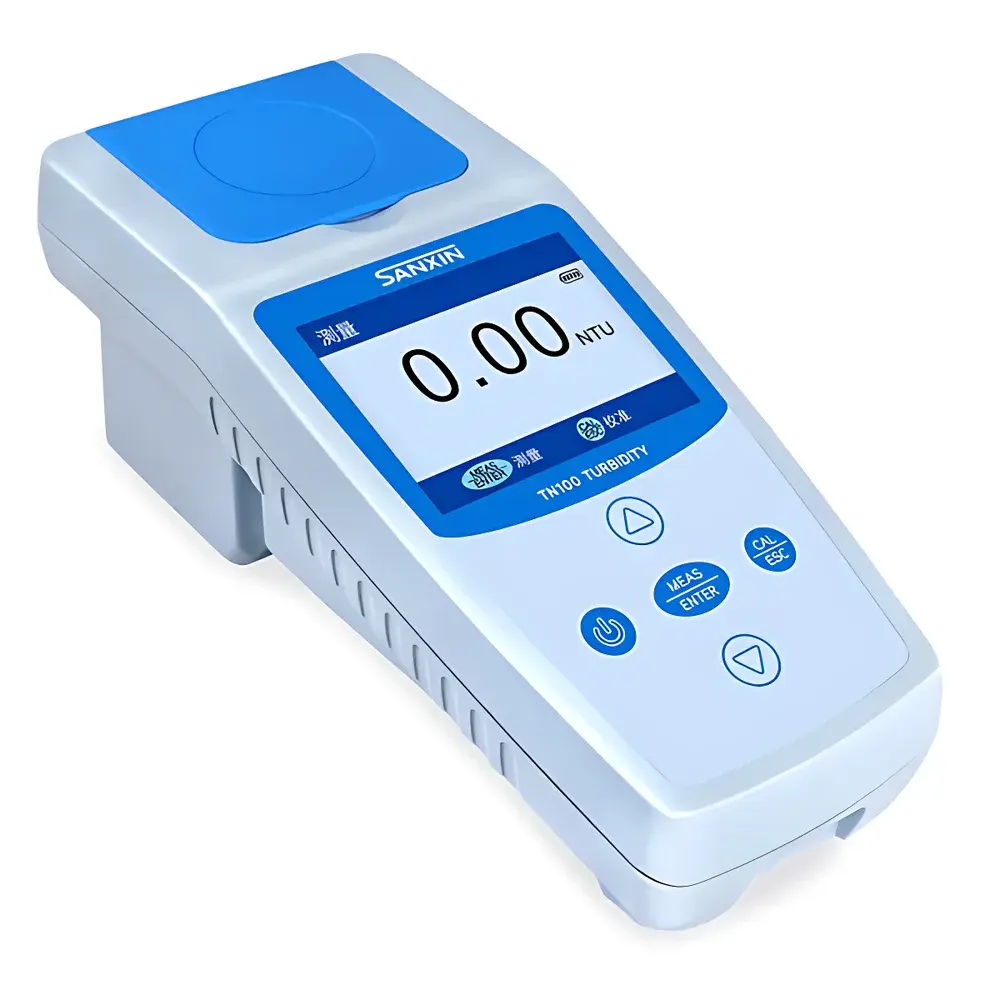
SANXIN TN100 Portable Turbidimeter (Red LED Basic Model)
| Brand | SANXIN |
|---|---|
| Origin | Shanghai, China |
| Manufacturer Type | OEM/ODM Manufacturer |
| Product Category | Domestic |
| Model | TN100 |
| Price | USD 420 (FOB Shanghai) |
| Type | Portable |
| Measurement Range | 0–1000 NTU (FNU), auto-ranging |
| Resolution | 0.01 NTU (0–19.99 NTU), 0.1 NTU (20.0–99.9 NTU), 1 NTU (100–1000 NTU) |
| Operating Temperature | 0–50 °C |
| Accuracy | ≤ ±8% FS |
| Repeatability | ≤ ±1.0% |
| Zero Drift | ≤ ±0.5% FS / 30 min |
| Stability | ≤ ±1.0% FS / 30 min |
| Detection Principle | 90° Nephelometric Scattering |
| Light Source | Infrared LED (860 ± 30 nm) |
| Detector | Silicon Photodiode |
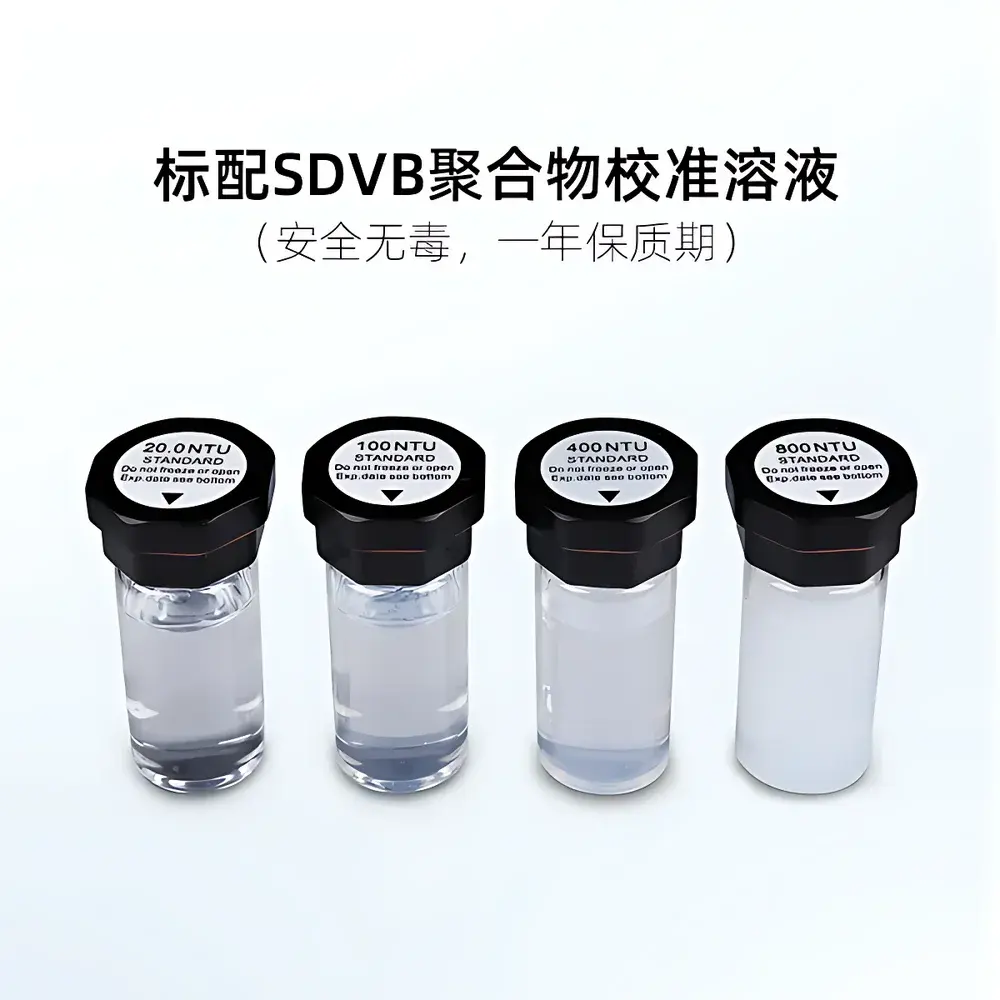
| Calibration Standards | Polymer-based certified standards (0, 20, 100, 400, 800 NTU/FNU), EPA & ASTM compliant |
| Display | 3.5″ TFT color LCD with multilingual GUI (English, Chinese, Spanish) |
| Sample Cell | Borosilicate glass vial (Φ25 × 60 mm, 18 mL capacity) |
| Enclosure Rating | IP67 |
| Power | 4 × AA alkaline batteries |
| Dimensions (Instrument) | 90 × 203 × 80 mm |
| Weight (Instrument) | 385 g |
| Warranty | 2 years (instrument), 1 year (calibration standards) |
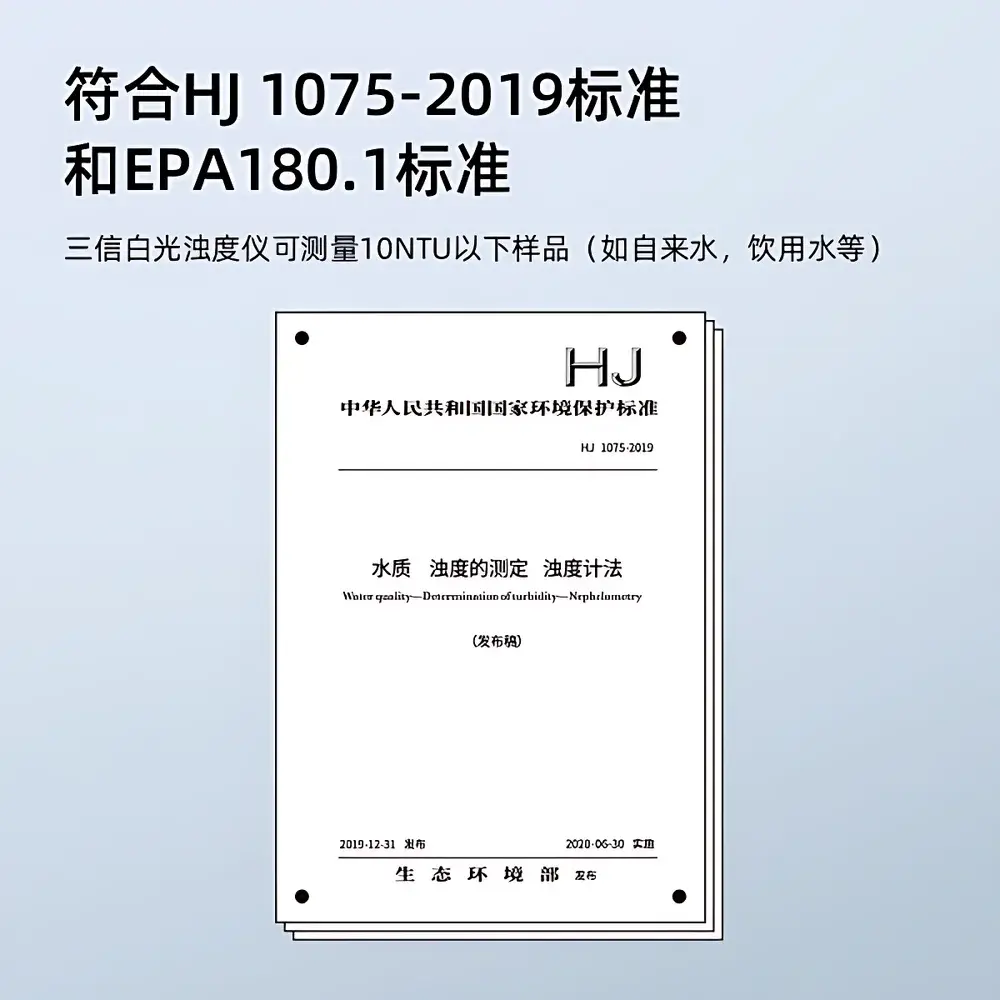
| Certifications | ISO 9001:2015, CE, compliant with HJ 1075–2019, ISO 7027:2016, DIN 27027 |
Overview
The SANXIN TN100 Portable Turbidimeter (Red LED Basic Model) is a field-deployable, ISO 7027:2016–compliant nephelometer engineered for reliable turbidity quantification in diverse aqueous matrices—including colored, low-transmittance, or rapidly settling suspensions. It operates on the 90° scattered light detection principle using a stable infrared LED source (860 ± 30 nm), minimizing interference from sample chromaticity—making it uniquely suitable for applications involving fruit juices, wine, wastewater effluents, and pharmaceutical process streams where visible-light turbidimeters exhibit spectral bias. Unlike white-light or blue-LED instruments, the TN100’s red-wavelength optical path ensures robust performance across samples with significant absorbance below 600 nm, aligning with regulatory requirements outlined in HJ 1075–2019 (China’s Environmental Monitoring Standard) and U.S. EPA Method 180.1. Its compact, ruggedized architecture supports both laboratory benchtop use and unattended field deployment under ambient conditions ranging from 0 to 50 °C.
Key Features
- ISO 7027–compliant 90° nephelometric measurement with 860 nm infrared LED—eliminates color-induced error in non-clear liquids
- Auto-ranging capability across three resolution tiers: 0.01 NTU (0–19.99 NTU), 0.1 NTU (20.0–99.9 NTU), and 1 NTU (100–1000 NTU)
- Integrated averaging mode: captures and displays mean of up to 10 consecutive readings—critical for unstable or flocculating suspensions
- IP67-rated enclosure with reinforced polymer housing—fully dust-tight and submersible to 1 m for 30 minutes
- TFT color display with intuitive multilingual interface (English, Chinese, Spanish) and real-time graphical guidance
- Pre-calibrated, EPA- and ASTM-certified polymer standard set (0, 20, 100, 400, 800 NTU)—non-toxic, shelf-stable for 12 months, zero reconstitution required
- Onboard diagnostics including battery voltage monitoring, auto-shutdown after 10 min inactivity, and zero-drift compensation
Sample Compatibility & Compliance
The TN100 accommodates standard Φ25 × 60 mm borosilicate glass sample vials (18 mL capacity), ensuring optical homogeneity and thermal stability across repeated measurements. Its red-light detection system delivers high fidelity for samples with strong UV–visible absorption—such as grape must, tea extracts, dyed industrial effluents, and colloidal silica dispersions—where conventional 400–600 nm turbidimeters underestimate true particle load. The instrument conforms to multiple international regulatory frameworks: HJ 1075–2019 (China’s Ministry of Ecology and Environment), ISO 7027:2016 (Water quality — Determination of turbidity), DIN 27027 (German standard for turbidity measurement), and ASTM D6708 (Standard Practice for Statistical Assessment of Turbidimeter Performance). While not FDA 21 CFR Part 11–enabled out-of-box, audit-trail–capable data export (via optional USB-C adapter) supports GLP/GMP-aligned documentation workflows.
Software & Data Management
The TN100 operates autonomously without external software; all calibration, measurement, and configuration logic resides in embedded firmware. Calibration routines support multi-point verification (up to five points) using factory-certified polymer standards traceable to NIST SRM 2000 series. Measurement data—including timestamp, operator ID (user-defined), range mode, and raw detector output—is stored internally (up to 500 records) and exportable via micro-USB to CSV-compatible spreadsheets. Firmware updates are delivered via encrypted .bin files through SANXIN’s authorized service portal—ensuring version control and regulatory traceability. No cloud connectivity or proprietary drivers are required; raw output adheres to ISO/IEC 17025–recommended metadata fields for metrological integrity.
Applications
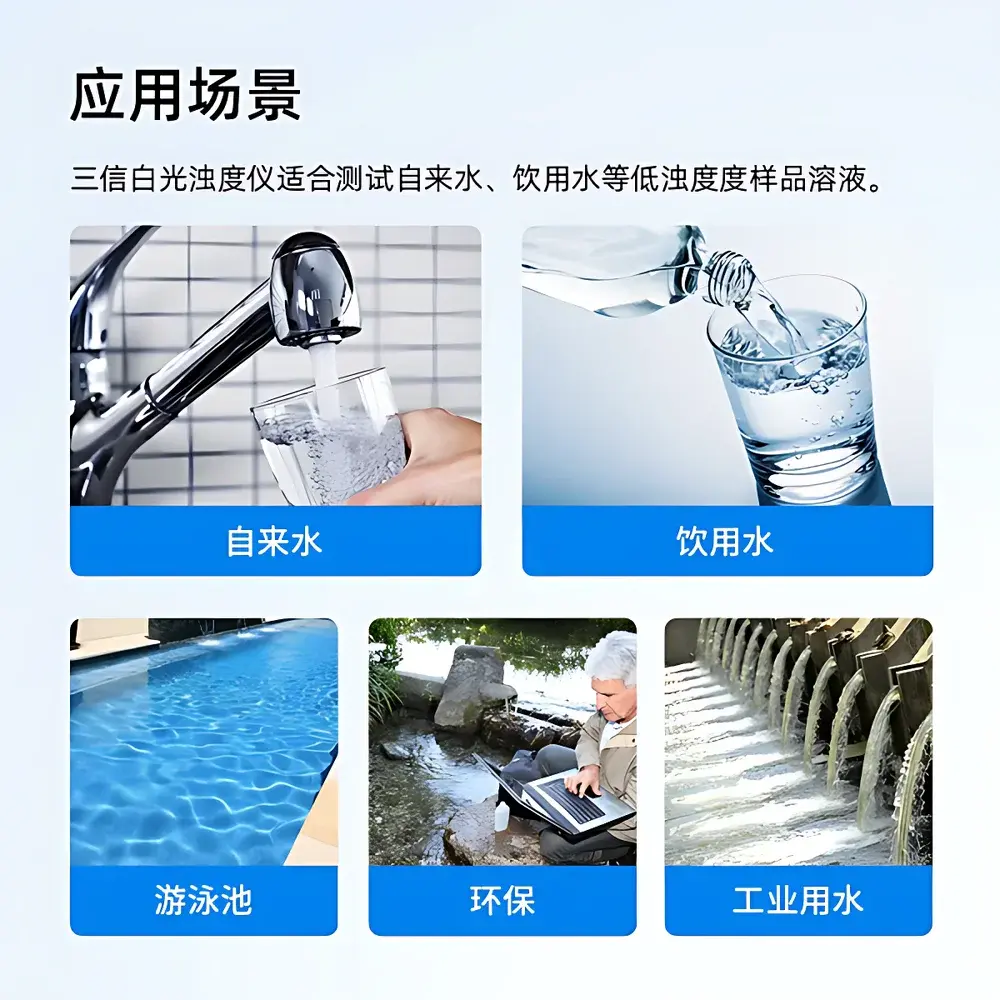
- Environmental monitoring: Surface water, drinking water distribution systems, wastewater treatment plant influent/effluent
- Food & beverage QC: Juice clarity assessment, wine stabilization verification, dairy processing stream monitoring
- Pharmaceutical manufacturing: Sterile filtration validation, suspension homogeneity checks, excipient dispersion analysis
- Academic research: Colloidal stability studies, coagulation–flocculation kinetics, nanoparticle dispersion characterization
- Field service: Emergency response teams assessing floodwater contamination, municipal utility technicians verifying filter backwash efficiency
FAQ
Does the TN100 require recalibration before each use?
No—factory calibration remains valid for 12 months under normal operating conditions. However, daily verification using the 0 NTU and 20 NTU standards is recommended per ISO/IEC 17025 Clause 7.7.
Can the TN100 measure samples with high absorbance, such as black tea or iodine solutions?
Yes—the 860 nm infrared source minimizes absorption-related signal attenuation, enabling accurate turbidity quantification where visible-light instruments fail.
Is the included calibration set traceable to national standards?
Yes—each polymer standard vial carries individual certification referencing NIST SRM 2000 and is accompanied by a CoA listing uncertainty (k = 2) < ±2.5%.
What is the maximum allowable particulate size for reliable measurement?
The TN100 is optimized for particles between 0.1 µm and 100 µm. For aggregates >200 µm, settle-time correction protocols (per ISO 7027 Annex B) should be applied.
How does the instrument handle condensation or moisture ingress during outdoor use?
The IP67-rated housing, combined with hydrophobic lens coating and sealed optical chamber, prevents internal fogging—even after rapid thermal transitions from air-conditioned labs to humid field environments.




