
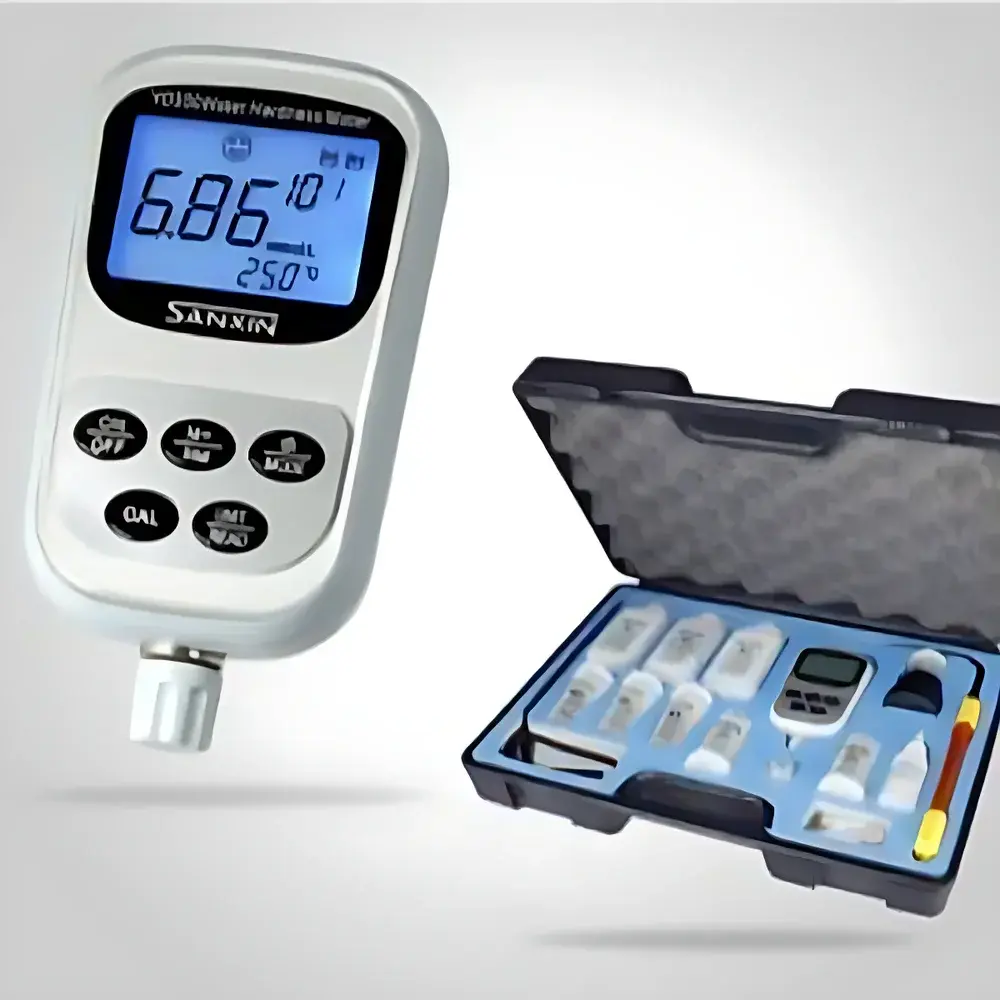
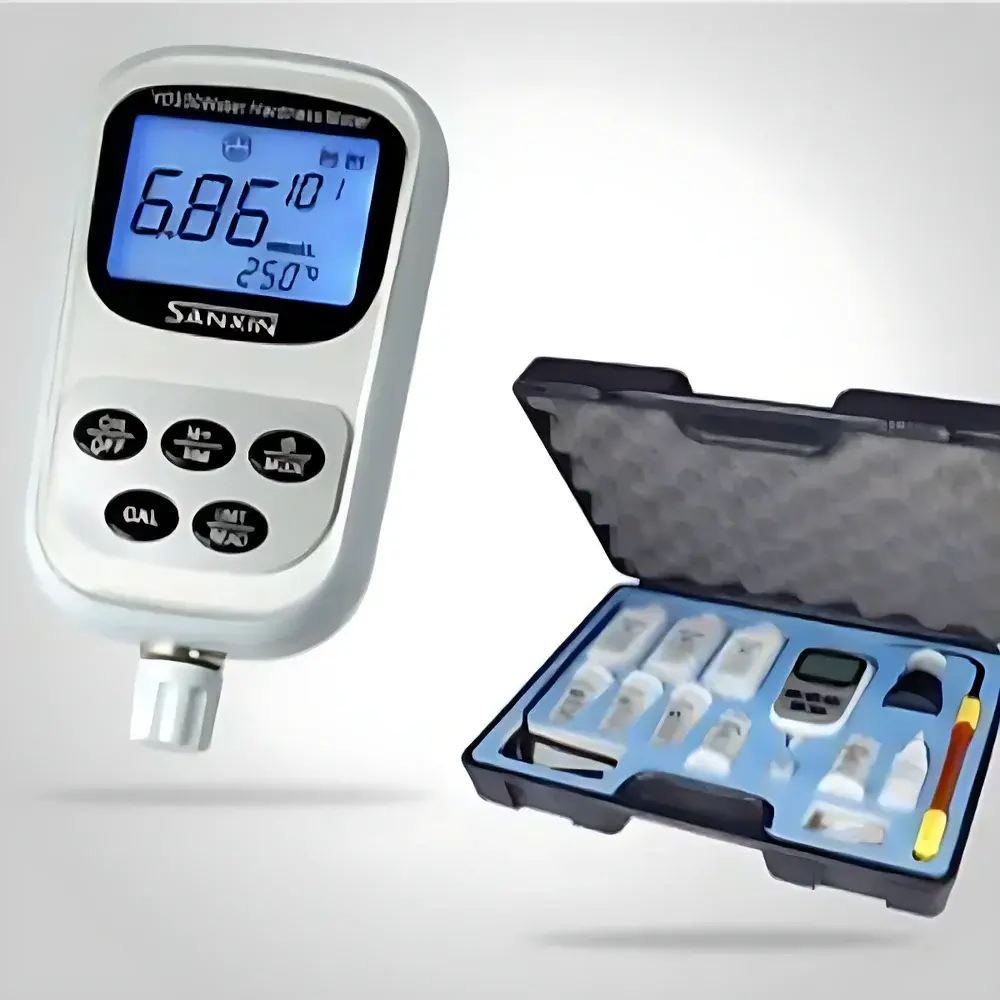
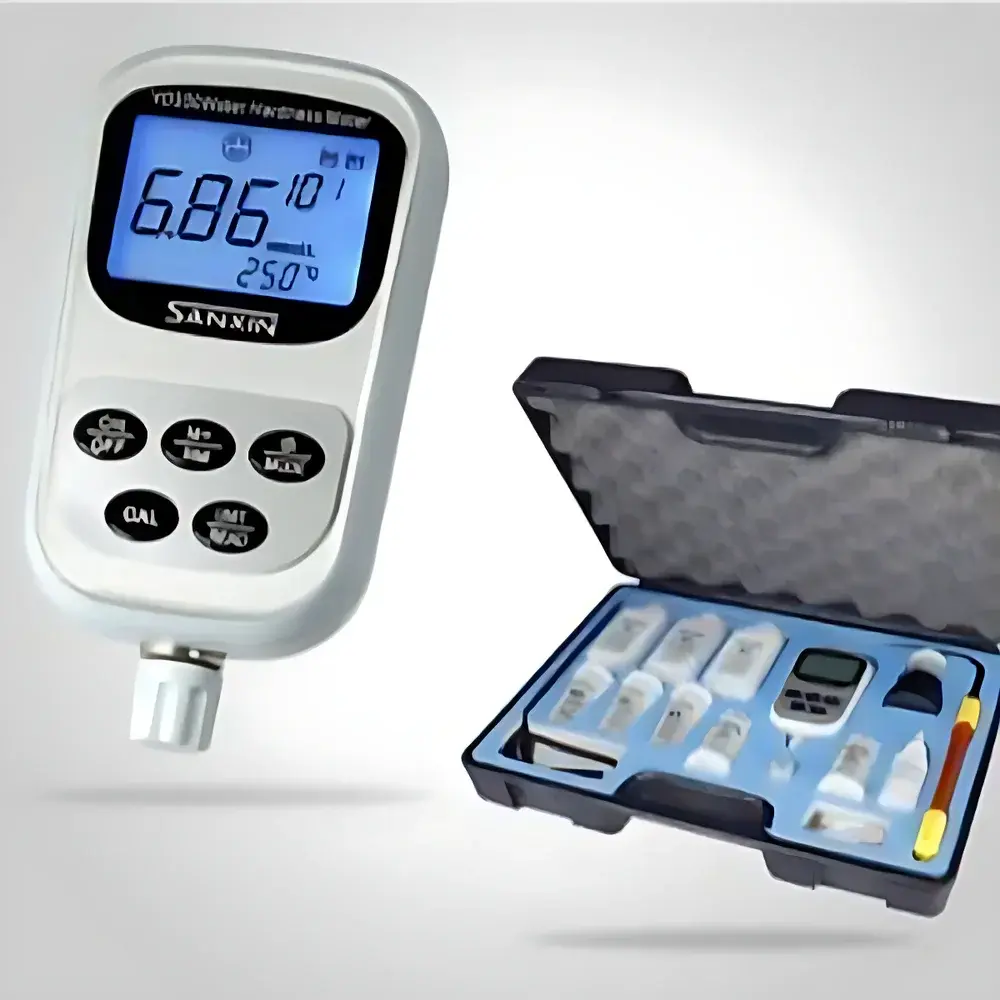
SANXIN YD300 Portable Water Hardness Analyzer
| Brand | SANXIN Peirui |
|---|---|
| Origin | Shanghai, China |
| Manufacturer Type | Authorized Distributor |
| Regional Classification | Domestic (China) |
| Model | YD300 |
| Instrument Type | Portable / Handheld Water Quality Analyzer |
| Measurement Principle | Spectrophotometric Method (Colorimetric Determination via Calcium/Magnesium Complex Formation) |
| Measured Parameter | Total Calcium and Magnesium Ion Concentration (as Total Hardness) |
| Measurement Range | 0–10 mmol/L (as CaCO₃ equivalent) |
| Repeatability | ≤ ±5% FS |
| IP Rating | IP67 |
| Display | Backlit LCD with Blue Illumination |
| Temperature Compensation | Automatic, 5–50 °C |
| Temperature Range | 0–60.0 °C (±0.5 °C accuracy) |
| Resolution | 0.01 / 0.1 unit (user-selectable per hardness scale) |
| Units Supported | mmol/L, mg/L (CaCO₃), mg/L (CaO), mmol/L (Boiler), mg/L (Ca), °fH (French), °dH (German), °eH (English) |
| Calibration Solutions | B1, B2, B3 standard kits included |
| Power | Battery-operated (low-voltage indicator) |
| Auto Functions | Auto-calibration, auto-zero, auto-hold, auto-shutdown, real-time temperature compensation |
Overview
The SANXIN YD300 Portable Water Hardness Analyzer is a field-deployable, spectrophotometric instrument engineered for rapid, on-site quantification of total water hardness—defined as the combined molar concentration of calcium (Ca²⁺) and magnesium (Mg²⁺) ions in aqueous samples. Unlike classical EDTA titration methods, which rely on subjective endpoint detection and are prone to interference from turbidity, color, or complexing agents, the YD300 employs a validated colorimetric assay based on the formation of stable, chromogenic complexes between divalent cations and a proprietary reagent (e.g., Eriochrome Black T or Calmagite analog). Absorbance is measured at a fixed wavelength (typically 525–560 nm), and concentration is derived via a pre-programmed calibration curve stored in the device’s embedded microcontroller. The analyzer operates under ISO 9001–certified manufacturing protocols and complies with core principles outlined in ASTM D1126–22 (Standard Test Method for Hardness in Water) and ISO 6059:1984 (Water quality — Determination of hardness — Titrimetric method), ensuring metrological traceability for routine environmental monitoring, boiler feedwater assessment, and municipal drinking water verification.
Key Features
- Intelligent microprocessor-based electronics with auto-calibration routines and non-volatile memory for up to 200 measurement records with timestamp and temperature metadata.
- Eight selectable hardness units—including mmol/L, mg/L as CaCO₃, °dH, °fH, and °eH—enabling seamless data exchange across international regulatory frameworks and industrial reporting standards.
- Integrated automatic temperature compensation (ATC) across 5–50 °C, eliminating manual correction factors and improving inter-laboratory reproducibility.
- IP67-rated enclosure ensures operational reliability in humid, dusty, or splash-prone environments—ideal for wastewater treatment plants, cooling tower inspections, and rural well surveys.
- Backlit blue LCD display with high-contrast characters supports readability under low-light conditions and prolonged outdoor use.
- Battery-powered operation (4 × AA alkaline cells) with low-power mode and voltage warning; typical runtime exceeds 1,000 measurements per set.
Sample Compatibility & Compliance
The YD300 is validated for use with clear to moderately turbid freshwater, surface water, groundwater, and treated municipal supplies. It is not recommended for seawater, highly colored industrial effluents, or samples containing >50 mg/L suspended solids without prior filtration (0.45 µm membrane). All factory calibrations are performed using NIST-traceable reference standards (B1/B2/B3 series), and user recalibration follows documented SOPs aligned with GLP requirements. While the instrument does not provide full 21 CFR Part 11 compliance out-of-the-box (e.g., electronic signatures or audit trails), its data export capability (via optional USB interface) supports integration into validated LIMS environments when paired with appropriate documentation controls.
Software & Data Management
Data storage is internal and non-editable: each entry includes hardness value, temperature, unit code, date/time stamp, and calibration status flag. Export functionality requires optional PC connectivity (USB-to-serial adapter). Raw data files (.csv) retain full metrological context and are compatible with Excel, LabChart, or custom Python/Pandas analysis pipelines. Firmware updates are distributed via SANXIN’s secure technical portal and require authenticated access—ensuring version control and cybersecurity alignment with IEC 62443-3-3 guidelines for embedded industrial devices.
Applications
- Field validation of softening system performance in residential and commercial water treatment facilities.
- Routine monitoring of boiler feedwater and cooling loop chemistry to prevent scale deposition per ASME PTC 19.11 and EN 12952-12 standards.
- Regulatory compliance checks for drinking water utilities operating under EU Directive 98/83/EC or China’s GB 5749–2022.
- Educational laboratories requiring robust, low-maintenance instrumentation for undergraduate water chemistry modules.
- Environmental field surveys assessing watershed mineralization trends and anthropogenic impact on aquifer quality.
FAQ
What is the primary measurement principle used by the YD300?
It uses spectrophotometric detection of a colorimetric reaction between Ca²⁺/Mg²⁺ ions and a metallochromic indicator under controlled pH conditions.
Can the YD300 measure hardness in seawater or brackish samples?
No—high ionic strength and chloride interference compromise accuracy; it is validated only for freshwater matrices with TDS < 1,000 mg/L.
Is temperature compensation mandatory during measurement?
Yes—the built-in ATC algorithm is active by default and cannot be disabled; measurements outside 5–50 °C trigger a warning and suspend result calculation.
How often should calibration be performed?
Before each sampling session or after every 20 measurements—whichever occurs first—using certified B1/B2/B3 standards per manufacturer’s SOP.
Does the device meet FDA or EPA regulatory requirements for reporting?
The YD300 satisfies analytical performance criteria referenced in EPA Method 130.1 (hardness by titration) but is not EPA-listed; users must validate its equivalence per their site-specific QA/QC plan.







