
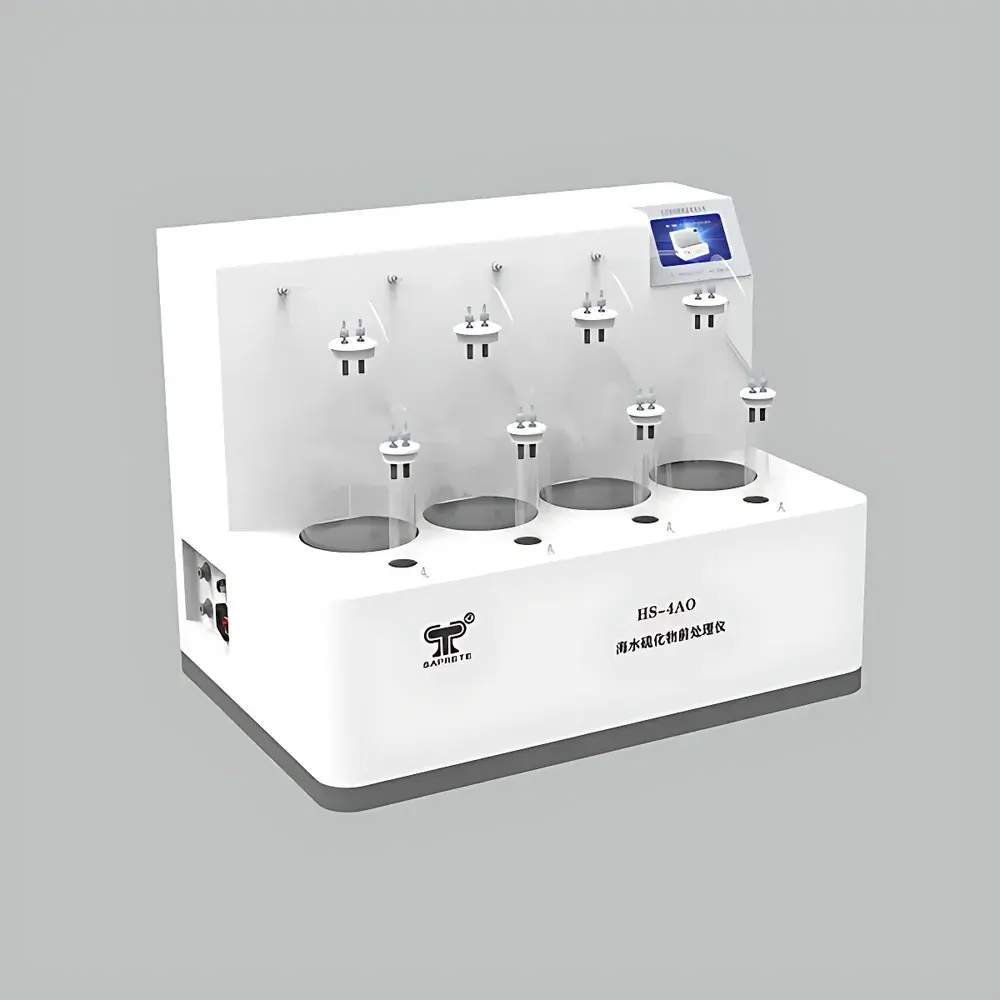
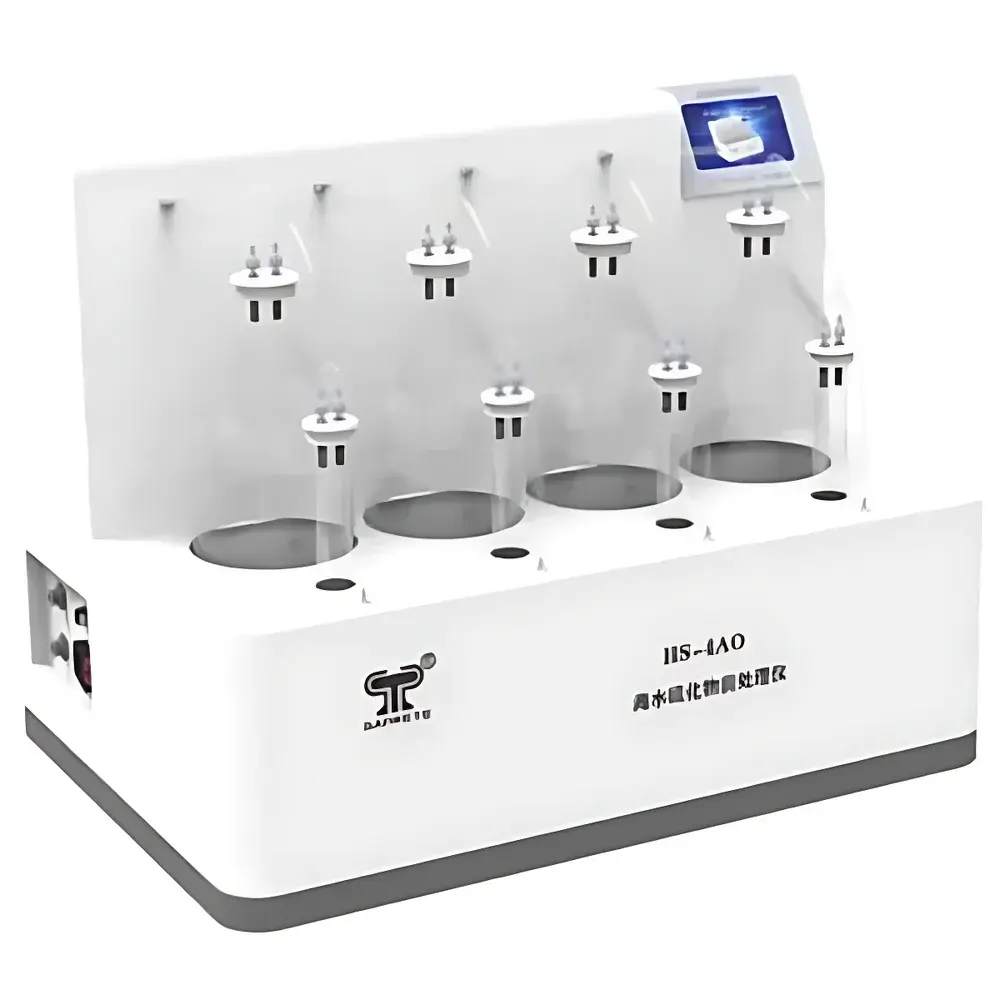
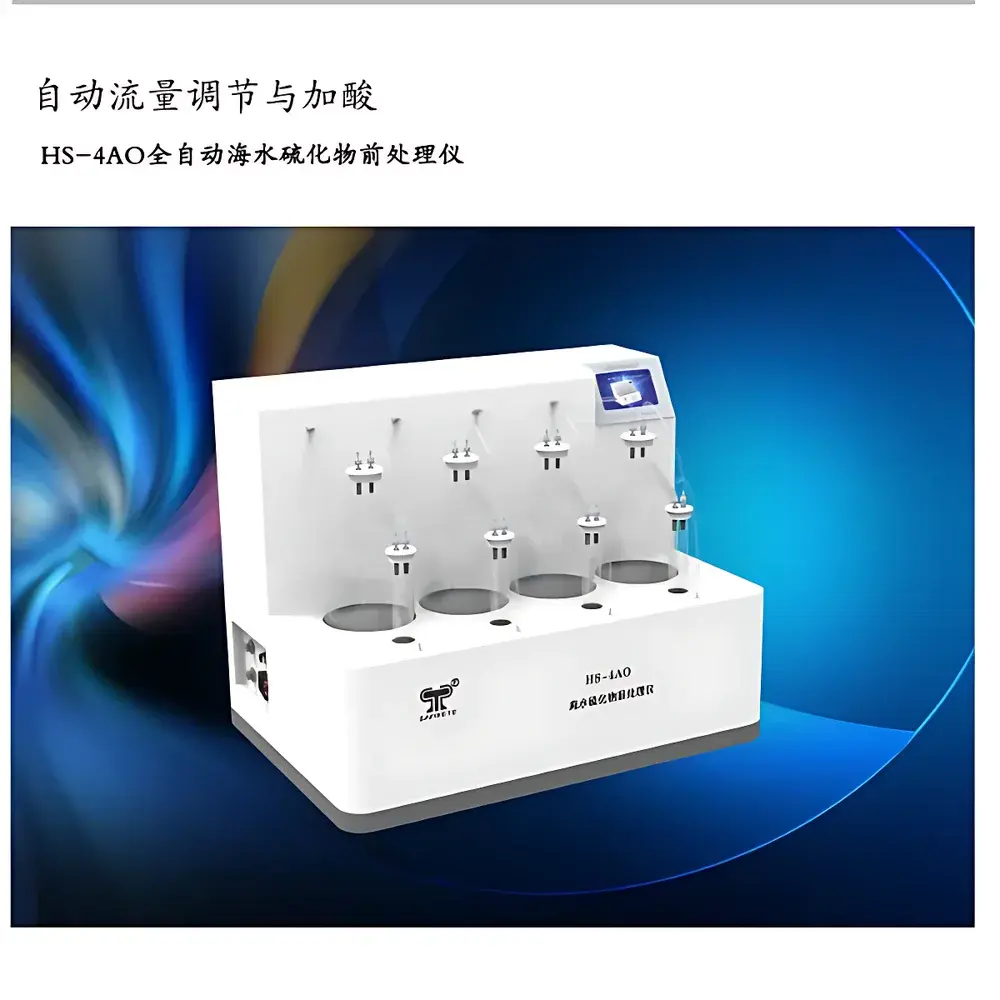
Saprete HS-4AO Fully Automated Seawater Sulfide Analyzer
| Brand | Saprete |
|---|---|
| Origin | Beijing, China |
| Manufacturer Type | Original Equipment Manufacturer (OEM) |
| Product Category | Domestic |
| Model | HS-4AO |
| Price Range | USD 7,000–14,000 |
| Instrument Type | Laboratory Benchtop Analyzer |
Overview
The Saprete HS-4AO Fully Automated Seawater Sulfide Analyzer is a dedicated benchtop analytical system engineered for precise, reproducible quantification of total sulfide (H₂S, HS⁻, S²⁻) in complex aqueous and semi-solid environmental matrices. It implements the standardized acidification–gas-diffusion–colorimetric principle, compliant with multiple national and method-defined protocols including GB/T 16489–1996 (methylene blue spectrophotometry), HJ/T 60–2000 (iodometric titration), HJ 833–2017 (for soils and sediments), and GB 17378.4–2007 (marine monitoring). The instrument automates critical manual steps—acid addition, nitrogen purging, gas transfer, reagent dosing, and absorbance measurement at 665 nm—minimizing operator intervention while ensuring strict adherence to method-defined reaction kinetics and stoichiometry. Its architecture integrates corrosion-resistant fluidic pathways, temperature-stabilized reaction chambers, and dual-wavelength photometric detection to mitigate interferences from turbidity, nitrite, thiosulfate, and suspended solids commonly encountered in seawater, estuarine, wastewater, and sediment pore-water samples.
Key Features
- Fully automated sample processing: integrated peristaltic pumps, solenoid valves, and programmable acid/reagent dispensing modules ensure repeatable reagent addition volumes and timing sequences per regulatory method requirements.
- Dual-mode operation support: configurable workflows for both methylene blue spectrophotometry (GB/T 16489, GB 17378.4, HJ 833) and iodometric titration (HJ/T 60), with method-specific calibration curves and endpoint detection logic.
- Corrosion-resistant wetted materials: PTFE, borosilicate glass, and EPDM-free fluidic components withstand aggressive acidic conditions and high-chloride marine matrices without degradation or memory effects.
- Onboard temperature control: maintains reaction chamber and distillation zone within ±0.5 °C of setpoint to stabilize H₂S liberation kinetics and color development consistency.
- Integrated photometer: fixed-wavelength (665 nm) and reference (700 nm) detection with auto-zero compensation, achieving linear dynamic range of 0.005–2.00 mg/L S²⁻ (as sulfide) with R² > 0.999 across calibration standards.
- Method-locked software interface: preloaded, non-editable method templates aligned with Chinese EPA standard operating procedures; audit-trail enabled for GLP-compliant data integrity.
Sample Compatibility & Compliance
The HS-4AO accepts liquid samples (seawater, surface water, wastewater effluent, pore water) and homogenized solid-phase matrices (marine sediments, soils, sludge) following standardized pretreatment (e.g., ultrasonic dispersion, centrifugation, filtration per HJ 833–2017). It meets functional equivalence to ISO 11077:2015 (water quality — determination of sulfide — spectrophotometric method) and supports traceability under CNAS-CL01:2018 (equivalent to ISO/IEC 17025). All operational parameters—including acid concentration, purge duration, reaction time, and blank subtraction protocol—are locked to match the specified tolerance windows defined in GB/T 16489–1996 and HJ/T 60–2000. System validation reports include spike recovery (85–115%), method detection limit (MDL ≤ 0.002 mg/L), and inter-laboratory precision (RSD < 5% at 0.1 mg/L level).
Software & Data Management
The HS-4AO operates via Saprete Analytical Suite v3.2—a Windows-based application supporting 21 CFR Part 11–ready user authentication, electronic signatures, and immutable audit trails. Raw absorbance values, calibration logs, QC check results (blanks, duplicates, spikes), and final concentration outputs are stored in encrypted SQLite databases with automatic daily backup. Export formats include CSV, PDF analytical reports (with embedded metadata: analyst ID, instrument ID, timestamp, method version), and LIMS-compatible XML. Software enforces mandatory QC flagging: automatic rejection of calibrations failing linearity criteria or blanks exceeding 0.020 AU, requiring supervisor override with justification.
Applications
- Marine environmental monitoring programs: routine analysis of dissolved and acid-volatile sulfide (AVS) in coastal seawater, aquaculture discharge, and deep-sea sediment cores per GB 17378.4–2007.
- Municipal and industrial wastewater compliance: quantification of sulfide in influent/effluent streams to meet discharge limits under China’s Integrated Wastewater Discharge Standard (GB 8978–1996).
- Ecotoxicology and benthic health assessment: AVS/SEM (simultaneously extracted metals) ratio determination in sediments for predictive toxicity modeling.
- Environmental impact assessments (EIA): baseline and post-construction monitoring of sulfide in dredged material, landfill leachate, and geothermal effluents.
- Research laboratories: method development studies on sulfide speciation kinetics, oxidation state transitions, and interference mitigation strategies in high-salinity media.
FAQ
Does the HS-4AO comply with international standards such as ISO or ASTM?
Yes — while designed to fulfill Chinese national standards (GB, HJ), its measurement principle and performance specifications demonstrate functional equivalence to ISO 11077:2015 and ASTM D4129–18 (Standard Test Method for Total Sulfide in Water). Validation data packages are available upon request.
Can it analyze sediment or soil samples without external digestion equipment?
Yes — the HS-4AO includes an integrated sample homogenization and acid-volatile sulfide (AVS) extraction module compatible with HJ 833–2017. Solid samples require prior drying, grinding, and sieving per standard procedure; no separate digestion furnace is needed.
Is remote operation or integration with LIMS supported?
Yes — the instrument supports TCP/IP communication and provides a documented API for bidirectional LIMS integration (e.g., Thermo Fisher SampleManager, LabVantage). Remote monitoring and basic control are enabled via secure HTTPS web interface.
What maintenance intervals are recommended for long-term reliability?
Per manufacturer guidelines: daily rinse cycle, weekly calibration verification, quarterly replacement of peristaltic pump tubing and gas-diffusion membranes, and annual photometer wavelength validation using NIST-traceable filters.
How does the system handle chloride interference in seawater samples?
Chloride interference is mitigated through optimized acid concentration control, precise nitrogen purge flow rate (preventing co-distillation), and dual-wavelength photometric correction (700 nm reference channel), validated per GB 17378.4–2007 Annex B.
Related Products







