
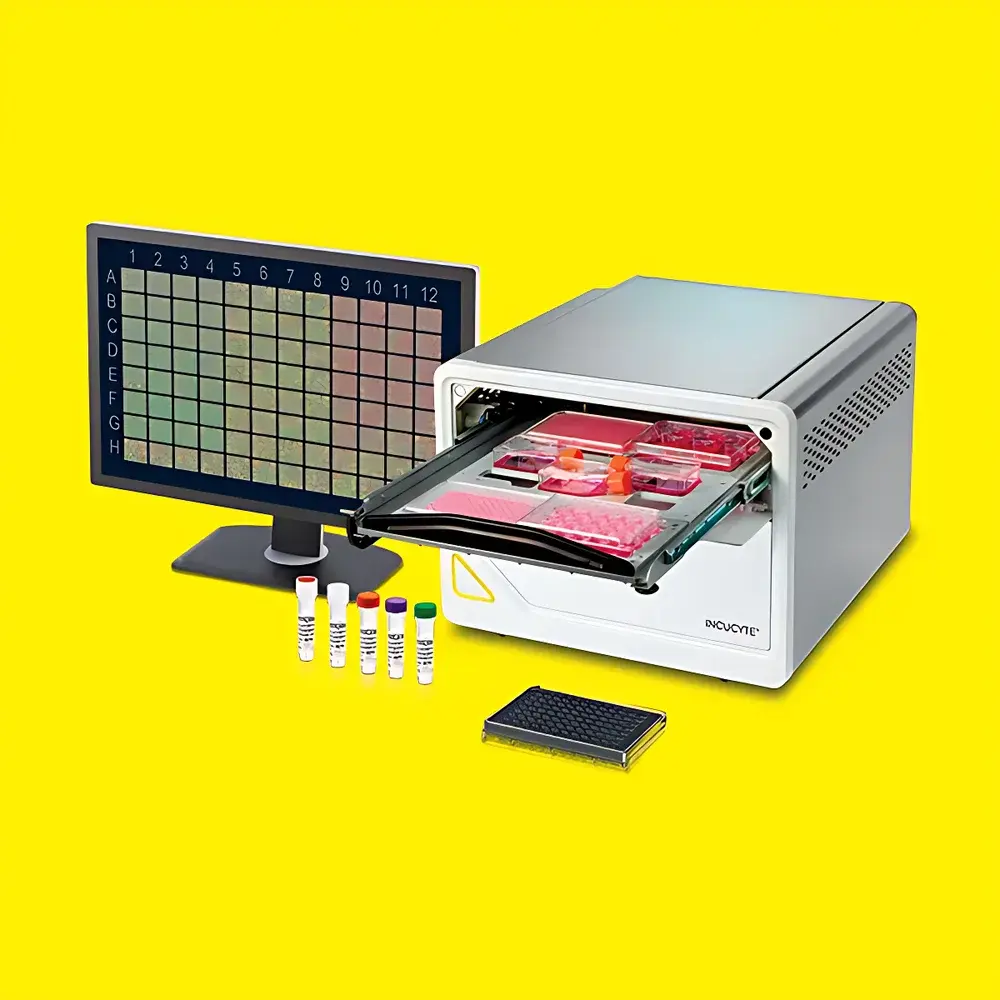
Sartorius Incucyte® SX5 Live-Cell Analysis System
| Brand | Sartorius |
|---|---|
| Origin | USA |
| Manufacturer Type | Authorized Distributor |
| Product Origin | Imported |
| Model | Incucyte® SX5 |
| Pricing | Available Upon Request |
| Temperature Control | 37 °C |
| Humidity Control | >90% RH |
| Imaging Throughput | Application-Dependent |
Overview
The Sartorius Incucyte® SX5 Live-Cell Analysis System is an integrated, incubator-compatible platform engineered for label-free and fluorescent kinetic monitoring of mammalian cells under physiologically relevant conditions. Based on widefield fluorescence and high-definition phase-contrast microscopy, the system enables non-invasive, quantitative imaging of adherent and suspension cultures directly inside standard CO₂ incubators—eliminating manual handling, environmental perturbation, and endpoint sampling artifacts. Its core architecture centers on time-lapse acquisition across multiple optical channels with precise environmental regulation (37 °C, >90% RH, 5% CO₂ compatibility), ensuring cellular homeostasis throughout experiments lasting hours to weeks. Unlike endpoint assays or single-timepoint imaging systems, the Incucyte SX5 captures dynamic biological processes—including proliferation, morphological remodeling, cytotoxicity, and intercellular interactions—as continuous, high-temporal-resolution datasets. This principle of longitudinal, context-preserving observation forms the foundation of modern phenotypic screening, mechanistic cell biology, and translational assay development.
Key Features
- Five-channel optical architecture supporting simultaneous excitation/emission detection across blue, green, orange, far-red, and near-infrared (NIR) spectra—with up to three fluorescent channels plus HD phase contrast operable in parallel per acquisition cycle
- Patented tri-color optical module featuring a low-phototoxicity NIR channel (700–800 nm), optimized for long-term viability studies and deep-tissue compatible probes (e.g., IRDye® 800CW, VivoTag® series)
- Automated turret-mounted objective system with 4×, 10×, and 20× air objectives—each calibrated for uniform focus, field flatness, and chromatic correction across all channels
- High-throughput sample handling: accommodates up to six standard microplates (6–384-well), chambered slides, or custom culture vessels on a motorized stage with barcode recognition
- Multi-user enabled software licensing: unlimited concurrent users with role-based access control, audit trail logging, and secure remote access via encrypted HTTPS
- Integrated environmental monitoring: real-time logging of temperature, humidity, and CO₂ levels within the imaging chamber; deviation alerts configurable per experiment
Sample Compatibility & Compliance
The Incucyte SX5 supports diverse sample formats including standard tissue-culture-treated plates, ultra-low attachment surfaces, spheroid-optimized round-bottom plates, hydrogel-embedded 3D cultures, and primary neuron co-cultures on multi-electrode arrays. It is validated for use with FDA-registered reagents (e.g., Incucyte® Annexin V, Caspase-3/7, Cytotox Green), ISO 13485-manufactured consumables, and GLP-compliant workflows requiring full traceability. Data integrity meets 21 CFR Part 11 requirements through electronic signatures, immutable audit trails, and version-controlled analysis protocols. All optical calibrations are NIST-traceable; system performance verification follows Sartorius’ IQ/OQ/PQ documentation packages aligned with ISO/IEC 17025 laboratory accreditation standards.
Software & Data Management
The Incucyte® Software v2023.x provides end-to-end workflow automation—from experimental design and schedule-driven acquisition to AI-assisted segmentation, multiparametric feature extraction, and statistical modeling. Built-in algorithms support confluence-based proliferation tracking, object-level classification (e.g., spheroid vs. monolayer), neurite outgrowth quantification, phagocytosis scoring, and kinetic EC₅₀ determination. Export options include FAIR-compliant HDF5 datasets, CSV tables with metadata headers, publication-ready TIFF/PNG stacks, and interactive HTML reports embeddable in ELN systems. Integration with third-party platforms (e.g., Spotfire®, GraphPad Prism®, Python via REST API) enables reproducible computational pipelines compliant with MIAME and MIAPE reporting guidelines.
Applications
- Cell health & kinetics: real-time confluence, mitotic index, cell cycle phase distribution (via FUCCI reporters), mitochondrial membrane potential (TMRM), ATP metabolism (CellTiter-Glo® Live)
- Immunooncology: tumor spheroid killing by NK/T cells, antibody-dependent cellular cytotoxicity (ADCC), immune synapse formation, checkpoint inhibitor response profiling
- Neuroscience: neuronal network activity (Ca²⁺ flux reporters), synaptic puncta dynamics, axon guidance, microglial phagocytosis of Aβ plaques
- 3D & organoid models: spheroid growth/fragmentation metrics, invasion into Matrigel®, vascular sprouting, organoid size heterogeneity, QC pass/fail thresholds
- Mechanistic toxicology: kinetic LDH release, lysosomal permeabilization, oxidative stress (DCFDA), ferroptosis progression
- Cell motility & morphology: chemotaxis trajectory mapping, wound closure velocity, mesenchymal–amoeboid transition quantification
FAQ
Does the Incucyte SX5 require external CO₂ regulation?
No—the system operates inside user-provided CO₂ incubators and does not integrate gas control hardware. Environmental stability relies on the host incubator’s performance.
Can I use third-party fluorescent dyes or antibodies?
Yes—provided they are compatible with the instrument’s excitation/emission filters and do not induce phototoxicity at acquisition frequencies. Validation data for common reagents (e.g., Hoechst 33342, CellTracker™ dyes) are available in the Sartorius Application Note Library.
Is remote experiment initiation and monitoring supported?
Yes—web-based interface allows scheduling, live preview, manual focus adjustment, and result download from any location with network access and proper authentication.
How is data backup and long-term archival handled?
Raw image stacks and processed metrics are stored in configurable network locations (SMB/NFS). Optional cloud archiving via Sartorius Connect adheres to ISO 27001-certified infrastructure and GDPR-compliant data residency policies.
What maintenance is required for optical calibration?
Annual factory-scheduled calibration is recommended; daily automated focus and illumination uniformity checks are performed during startup. Calibration certificates include uncertainty budgets per ISO/IEC 17025.



