
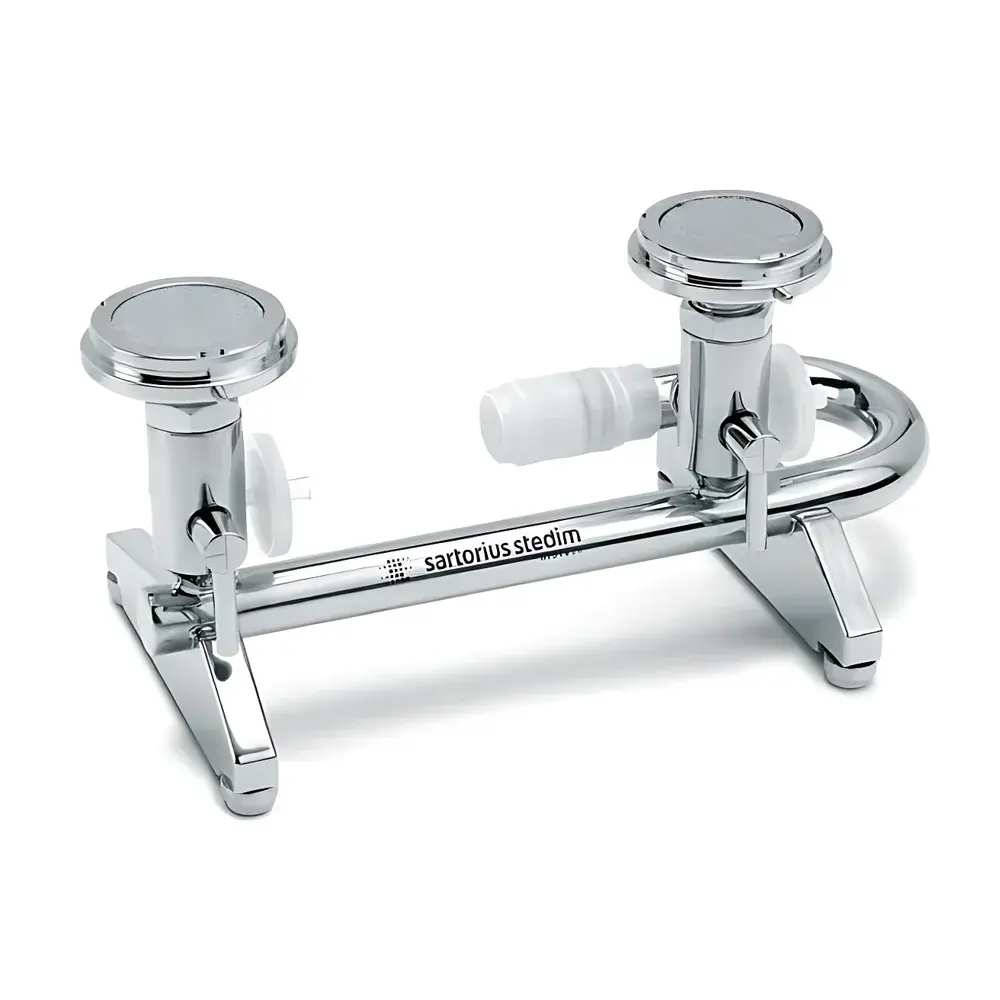
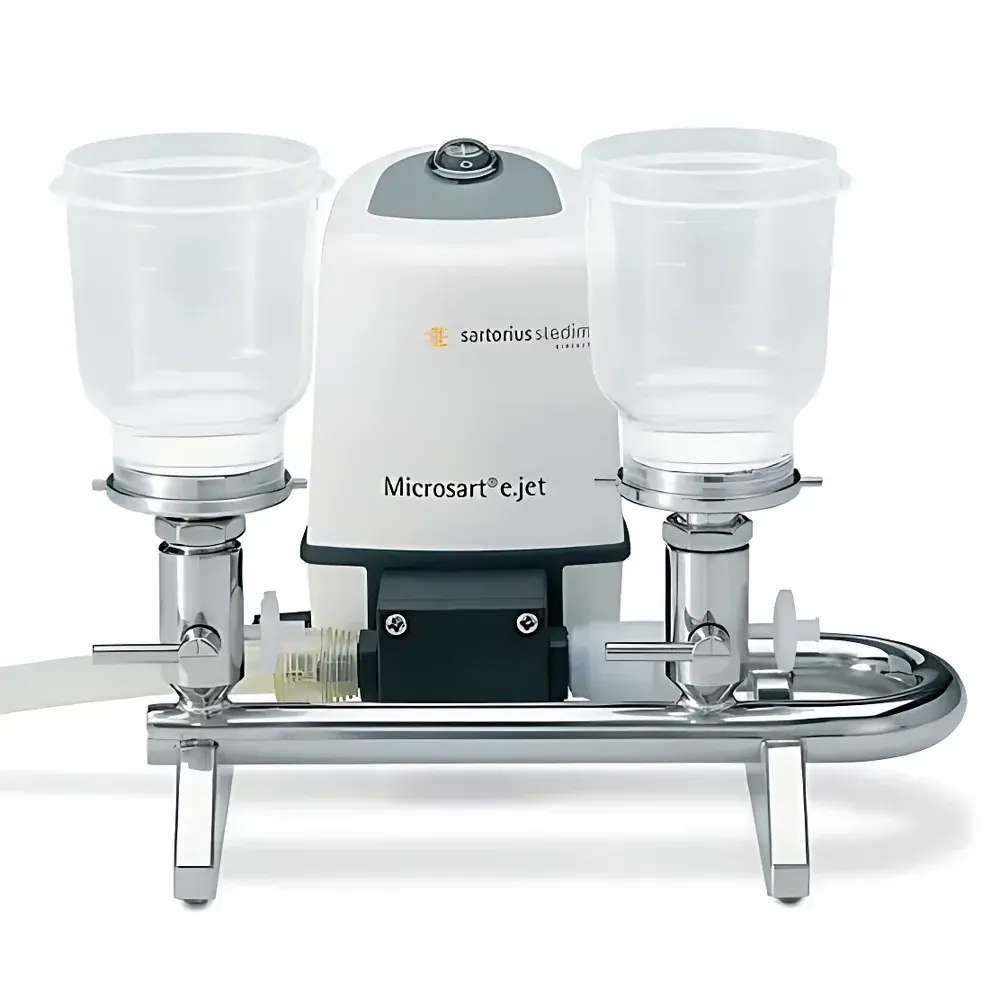
Sartorius Microsart® Combi.jet Dual-Position Stainless Steel Filtration Stand
| Brand | Sartorius |
|---|---|
| Origin | Germany |
| Model | SMB01-201 |
| Instrument Type | Microbial Limit Testing System |
| Filter Cup Compatibility | Bacteria, Yeast, Molds |
| Membrane Diameter Support | 47 mm |
| Assembly Time | ≤2 min per sample |
| Sterile Venting | Integrated stainless steel 3-way valve |
| Material | Electropolished AISI 316L stainless steel |
| Compliance | Designed for ISO 8573-1 (compressed air purity), ISO 13408-1 (aseptic processing), and USP <61>/<62> microbiological testing workflows |
| Regulatory Alignment | Supports GLP/GMP documentation requirements via traceable system setup and operator-intervention logs |
Overview
The Sartorius Microsart® Combi.jet is a dual-position, electropolished stainless steel filtration stand engineered specifically for regulatory-compliant microbial limit testing in pharmaceutical, biotechnology, and medical device quality control laboratories. Unlike conventional vacuum filtration systems requiring separate flasks, tubing manifolds, pump protectors, and Wolf bottles, the Combi.jet integrates structural rigidity, sterile gas management, and rapid modular assembly into a single compact platform. Its operational principle relies on controlled negative pressure applied across standardized 47 mm diameter membrane filters—enabling quantitative retention of viable microorganisms (bacteria, yeasts, and molds) from aqueous or low-viscosity liquid samples per USP , Ph. Eur. 2.6.12, and ISO 8573-1 Annex C protocols. The system operates as a core hardware component within aseptic sample preparation workflows, not as a standalone analyzer; it interfaces directly with Sartorius Microsart® e.jet diaphragm vacuum pumps and pre-sterilized consumables to ensure reproducible filtration kinetics and minimal operator-induced contamination risk.
Key Features
- Compact dual-position design reduces laboratory footprint by up to 70% versus traditional multi-component vacuum setups.
- Electropolished AISI 316L stainless steel construction ensures corrosion resistance, cleanability, and compatibility with autoclaving (121°C, 20 min) and VHP (vaporized hydrogen peroxide) decontamination cycles.
- Integrated three-way sterile venting valve enables independent, operator-initiated positive-pressure air exchange post-filtration—eliminating backflow contamination of filter surfaces and supporting ISO 13408-1 aseptic integrity requirements.
- Tool-free, push-to-connect fluidic interface with reinforced PTFE-sealed threaded couplings allows full system assembly or disassembly in under 120 seconds per sample position.
- No requirement for intermediate collection flasks, pump protection traps, or secondary condensate vessels—reducing consumable cost, cleaning validation burden, and potential failure points.
- Modular compatibility with multiple pre-sterilized, ready-to-use filtration formats including Microsart® @filter (100/250 mL), Microsart® Funnel (100/250 mL), Biosart® 100/250 pre-assembled grid-membrane units, and reusable sterilizable options (stainless steel funnels, borosilicate glass filters, polycarbonate filters).
Sample Compatibility & Compliance
The Microsart® Combi.jet supports filtration of pharmacopeial test samples—including purified water, buffers, ophthalmic solutions, non-sterile APIs, and finished dosage forms—as defined in USP , EP 2.6.12, JP 4.07, and ISO 11731. It accommodates both hydrophilic (e.g., mixed cellulose ester, nylon) and hydrophobic (e.g., PVDF, PTFE) 47 mm membranes rated for bacterial retention (≥0.45 µm) or mycoplasma-grade filtration (≤0.1 µm). All contact surfaces meet FDA 21 CFR Part 11–aligned traceability standards when used with Sartorius-certified accessories and electronic pump controllers. System validation documentation (DQ/IQ/OQ templates) and material certificates of conformance (CoC) are provided per batch for GMP-regulated environments.
Software & Data Management
While the Combi.jet itself is a mechanical filtration platform without embedded electronics, its operational consistency contributes directly to data integrity in regulated workflows. When paired with the Microsart® e.jet pump (equipped with integrated pressure monitoring and runtime logging), users can record filtration duration, vacuum stability, and start/stop timestamps—exportable via USB or Ethernet to LIMS or ELN platforms. Audit trails comply with ALCOA+ principles (Attributable, Legible, Contemporaneous, Original, Accurate) and support 21 CFR Part 11 compliance when implemented with appropriate electronic signature controls and access management policies.
Applications
- Microbial enumeration testing of non-sterile pharmaceutical products per USP .
- Specified organism testing (e.g., E. coli, S. aureus, P. aeruginosa, C. albicans) per USP .
- Water system monitoring (PW, WFI) in accordance with EU GMP Annex 1 and WHO TRS 970.
- Bioburden assessment of raw materials, excipients, and process intermediates.
- Environmental monitoring sample concentration prior to membrane filtration or pour-plate analysis.
- Pre-filtration conditioning for subsequent MALDI-TOF or molecular identification steps.
FAQ
Is the Microsart® Combi.jet compatible with non-Sartorius vacuum pumps?
Yes—provided the pump delivers stable vacuum ≥600 mbar and features a compatible 8 mm or 10 mm inlet port with standard NPT or BSP threading. However, full sterile venting functionality and pressure-based alarm integration require use of the Sartorius Microsart® e.jet series.
Can the stainless steel stand be autoclaved repeatedly without performance degradation?
Yes—electropolished AISI 316L construction withstands ≥500 autoclave cycles at 121°C, 20 min, with no measurable surface roughness increase (Ra < 0.4 µm) or gasket compression set when using certified silicone or EPDM seals.
Does the system support 25 mm membrane filters?
No—the Combi.jet is engineered exclusively for 47 mm diameter filters to maintain laminar flow profiles, uniform pressure distribution, and validated microbial recovery rates per pharmacopeial guidelines.
How is operator training documented for GMP audits?
Sartorius provides standardized SOP templates and competency assessment checklists aligned with ISO/IEC 17025 and ICH Q5A. Training records must be maintained internally per site-specific quality procedures.
What maintenance intervals are recommended for long-term reliability?
Visual inspection before each use; quarterly verification of valve actuation torque and seal integrity; annual calibration of connected e.jet pump pressure sensors against NIST-traceable references.




