
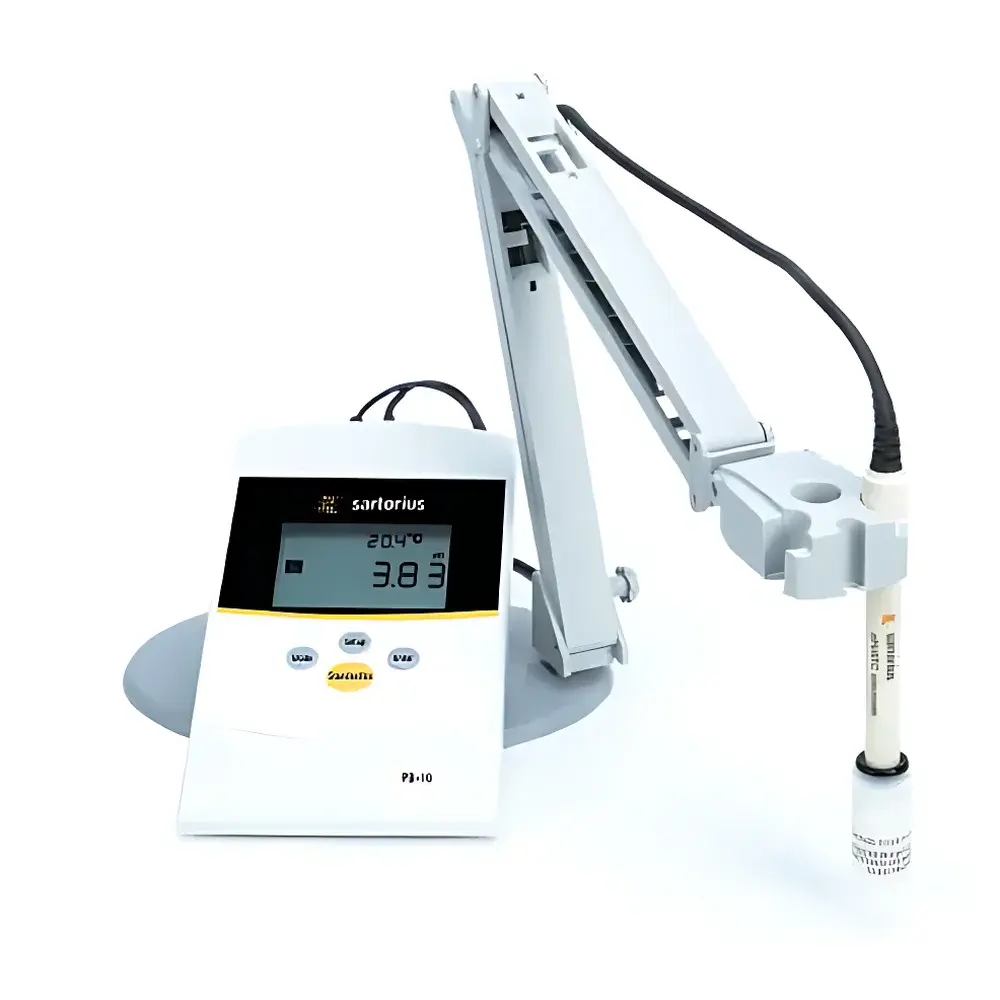
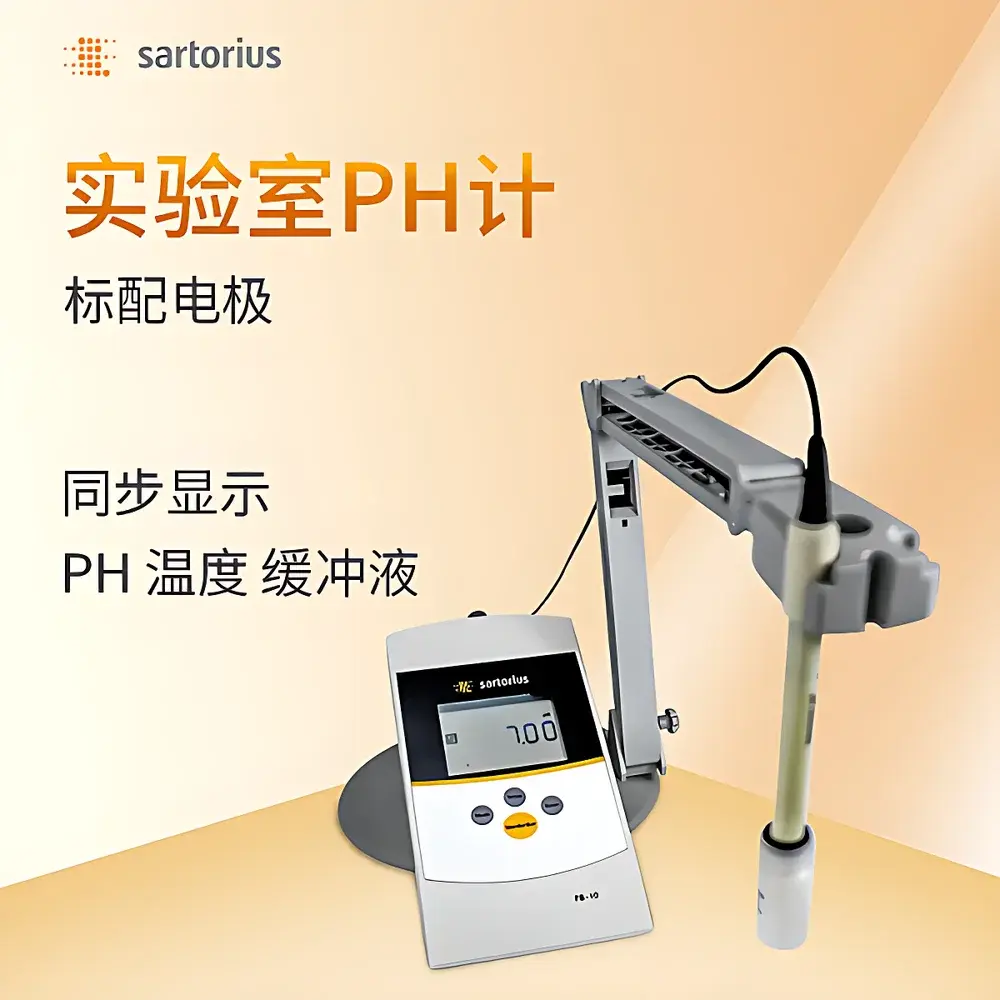
Sartorius PB-10 Portable pH Meter
| Brand | Sartorius |
|---|---|
| Model | PB-10 |
| Type | Portable pH/mV/Temperature Meter |
| pH Range | 0.00–14.00 |
| pH Resolution | 0.01 |
| pH Accuracy | ±0.01 |
| mV Range | ±1500 mV |
| mV Resolution | 0.1 mV |
| mV Accuracy | ±0.4 mV |
| Temperature Range | −5.0 to 105.0 °C |
| Temperature Resolution | 0.1 °C |
| Temperature Accuracy | ±0.2 °C |
| Calibration Points | Up to 3-point |
| Buffer Recognition | Auto-detection of up to 16 standard buffers (including ASTM, DIN, NIST, and JIS sets) |
| ATC | Integrated Automatic Temperature Compensation |
| Electrode Status Monitoring | Real-time slope and offset diagnostics |
| Display | Backlit LCD with simultaneous pH/mV/°C/buffer ID readout |
| Input | BNC electrode interface |
| Power | AC adapter (no battery option) |
| Dimensions | 230 × 120 × 80 mm |
Overview
The Sartorius PB-10 is a benchtop-portable pH/mV/temperature meter engineered for precision electrochemical measurement in quality control laboratories, academic teaching environments, and routine industrial process verification. It operates on the fundamental principle of potentiometric measurement: the potential difference between a pH-sensitive glass electrode and a stable reference electrode is converted into a logarithmic pH value via the Nernst equation (−59.16 mV/pH unit at 25 °C). Designed for robustness and operational simplicity, the PB-10 integrates automatic temperature compensation (ATC) using a built-in thermistor probe or external Pt100 sensor, ensuring accurate pH readings across variable sample temperatures without manual correction. Its dual-parameter capability—simultaneous display of pH and mV—supports both direct acidity quantification and redox potential (Eh) assessment, making it suitable for applications ranging from titration endpoint verification to corrosion monitoring and buffer validation.
Key Features
- Three-point calibration with automated buffer recognition across 16 standardized buffer sets (NIST, DIN 19266, ASTM D1293, JIS Z 8802), eliminating manual buffer selection errors.
- Real-time electrode diagnostics: continuous calculation and on-screen display of electrode slope (%), asymmetry potential (mV), and status indicator (e.g., “OK”, “Clean”, “Replace”) based on calibration data.
- Stability-driven measurement logic: numeric reading freezes only after signal drift falls below 0.01 pH/min for ≥3 seconds, confirmed by a dedicated stability icon (●).
- Simultaneous multi-parameter readout: LCD displays pH (or mV), temperature (°C), active buffer ID, and electrode slope—all in real time without menu navigation.
- One-touch calibration initiation and auto-accept functionality reduce operator dependency and minimize procedural variability.
- BNC input interface ensures compatibility with all industry-standard combination pH electrodes, including double-junction, gel-filled, and refillable designs.
Sample Compatibility & Compliance
The PB-10 is validated for aqueous and low-ionic-strength samples typical of pharmaceutical water testing (Purified Water, WFI), food extract analysis, environmental surface water screening, and educational lab experiments. It supports ISO/IEC 17025-compliant documentation workflows when paired with optional Sartorius LabX Lite software (not bundled). While the instrument itself does not include 21 CFR Part 11 audit trail functionality, its deterministic calibration logging (date/time-stamped slope, offset, buffer IDs) provides traceable records suitable for GLP-aligned environments. All electrical safety and EMC compliance adhere to IEC 61010-1:2010 and EN 61326-1:2013 standards.
Software & Data Management
The PB-10 stores up to three complete calibration records—including date/time stamp, buffer identities, measured mV values, calculated slope (%), and offset (mV)—directly in non-volatile memory. Data export requires manual transcription or optional RS-232 connectivity (via third-party cable and terminal emulator). For regulated environments requiring electronic records, integration with Sartorius LabX Lite enables automated data capture, user access control, and PDF report generation. The device supports CSV-compatible output formatting for downstream statistical process control (SPC) analysis in Excel or Minitab.
Applications
- Pharmaceutical QC: USP pH verification of excipients, APIs, and purified water systems.
- Food & Beverage: Acidification control in dairy fermentation, juice pH profiling, and HACCP critical limit monitoring.
- Environmental Labs: Field-deployable verification of surface water pH per EPA Method 150.1 and ISO 10523.
- Academic Instruction: Hands-on demonstration of Nernstian behavior, electrode aging effects, and temperature dependence of pH.
- Industrial Maintenance: Routine calibration checks of inline pH sensors using portable reference verification.
FAQ
Does the PB-10 support battery operation?
No—the PB-10 is powered exclusively via included AC adapter; it lacks internal batteries or USB power capability.
Can I use a separate temperature probe with this meter?
Yes—while the integrated ATC uses the electrode’s built-in temperature sensor, an external Pt100 probe may be connected via the auxiliary port for independent thermal monitoring.
Is the PB-10 compliant with ISO 17025 calibration requirements?
The instrument meets metrological requirements for accuracy and repeatability; however, formal ISO/IEC 17025 accreditation applies to the calibration laboratory—not the device—and requires documented uncertainty budgets and traceable standards.
What happens if the electrode slope falls below 85%?
The display shows “SLOPE LOW” and disables further measurement until recalibration or electrode maintenance is performed—enforcing analytical integrity.
How often should the PB-10 be recalibrated?
Per ISO 7870-2 and internal SOPs, recalibration is required before each analytical batch, after electrode cleaning, following temperature shifts >5 °C, or at intervals not exceeding 2 hours during continuous use.





