
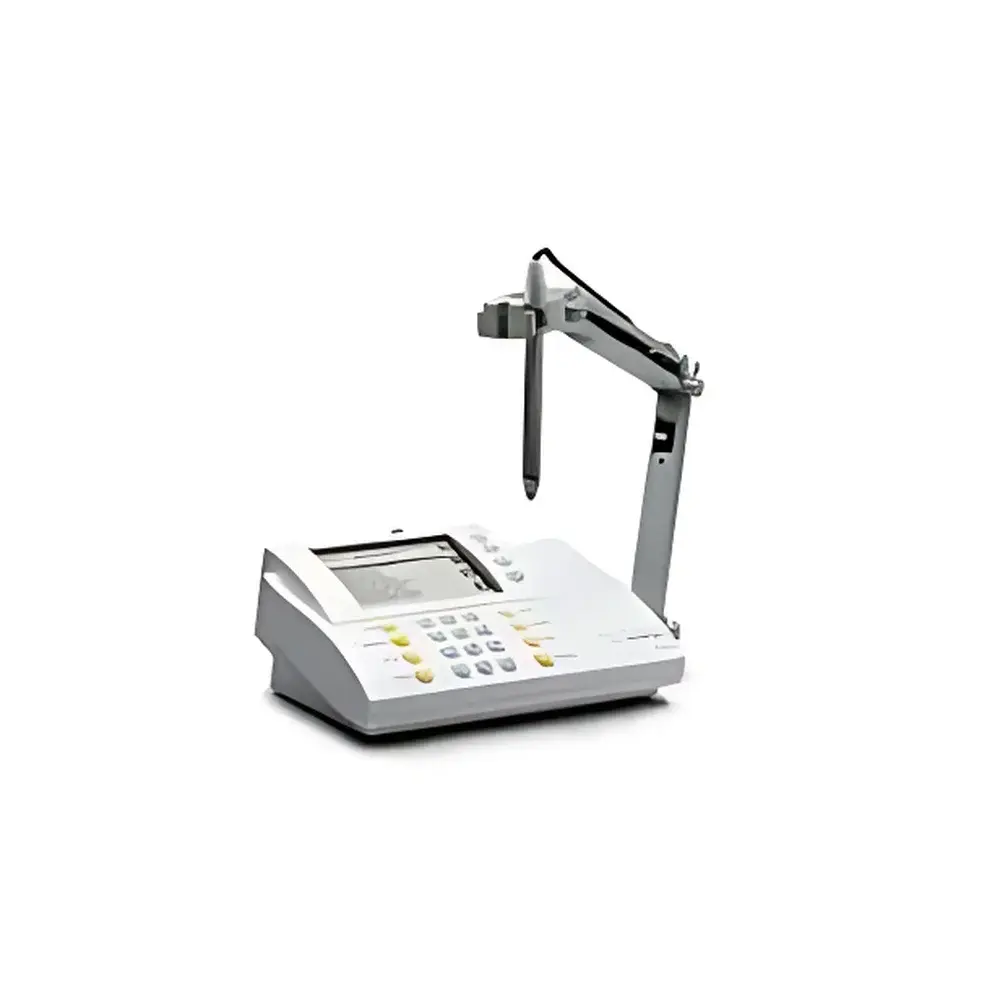
Sartorius PP-50 Professional pH/ION/Conductivity Meter
| Brand | Sartorius |
|---|---|
| Origin | Germany |
| Model | PP-50 |
| Measurement Modes | pH, mV, ISE (Ion Selective Electrode), Conductivity, TDS, Salinity, Resistivity |
| Temperature Compensation | Automatic (ATC) |
| Buffer Recognition | Auto-detection of DIN/ISO/NIST standard buffers |
| Electrode Check | Automated self-diagnostic function |
| Calibration Alerts | On-screen prompts for scheduled recalibration |
| Data Storage | 620 measurement records |
| Interface | RS232 bidirectional communication |
| Compliance | Designed for GLP-compliant environments |
Overview
The Sartorius PP-50 Professional pH/ION/Conductivity Meter is a modular, multi-parameter benchtop electrochemical analyzer engineered for precision and traceability in regulated laboratory environments. Based on potentiometric measurement principles for pH and ion activity (via Nernst equation response), and four-electrode conductivity measurement for enhanced accuracy across wide salinity ranges, the PP-50 delivers metrologically sound results under ISO/IEC 17025-aligned operating conditions. Its architecture integrates dual high-impedance input channels capable of simultaneous pH/mV and conductivity/resistivity acquisition — eliminating sequential instrument switching and reducing inter-measurement variability. The device complies with fundamental requirements of pharmacopeial standards (USP , EP 2.2.3) and environmental testing protocols (e.g., ASTM D1125, ISO 10523), making it suitable for QC release testing, raw material verification, and stability-indicating method development.
Key Features
- Triple-mode operation: pH measurement (0.00–14.00 pH, ±0.01 pH resolution), direct ISE quantification (0.001–19999 ppm or mol/L, logarithmic response), and conductivity analysis (0.00 µS/cm to 2000 mS/cm, auto-ranging with temperature compensation)
- Intelligent buffer recognition: Automatically identifies and applies calibration parameters for DIN, ISO, and NIST-certified pH buffer sets (e.g., pH 4.01, 7.00, 9.21, 10.01) without manual selection
- Real-time electrode diagnostics: Performs automatic impedance and asymmetry potential checks prior to each measurement cycle, flagging degraded or contaminated electrodes before data acquisition
- GLP-ready data integrity: Timestamped records include operator ID, electrode serial number, calibration history, ambient temperature, and measurement uncertainty estimates per IUPAC guidelines
- Rugged industrial-grade housing: IP54-rated enclosure with chemical-resistant front panel; designed for continuous use in analytical labs handling aggressive solvents, buffers, and biological matrices
Sample Compatibility & Compliance
The PP-50 accommodates standard 12-mm diameter combination pH electrodes, refillable double-junction reference electrodes, and dedicated conductivity cells (K = 0.1, 1.0, 10 cm⁻¹). It supports aqueous samples, buffered solutions, cell culture media, fermentation broths, and low-conductivity ultrapure water (with resistivity mode up to 18.2 MΩ·cm). All measurement functions adhere to ISO 3696 (water purity), ISO 7888 (conductivity of natural waters), and ASTM E70 (pH of aqueous solutions). The firmware implements electronic signature support and user-access level control (admin/operator/readonly), satisfying FDA 21 CFR Part 11 requirements for electronic records when paired with Sartorius LabX software (optional).
Software & Data Management
Data export occurs via RS232 serial interface to external PCs or LIMS systems using ASCII-based protocol (no proprietary drivers required). Each stored record includes full metadata: date/time stamp, measurement mode, electrode type, calibration status, temperature reading, and raw sensor output (mV or µS). Internal memory retains 620 entries with overwrite protection enabled by default. For centralized lab management, the PP-50 is compatible with Sartorius LabX™ Lite — a free desktop application enabling automated report generation (PDF/CSV), trend analysis over time, and integration into enterprise quality management systems (QMS). Audit trails are generated for all critical events: calibration, electrode replacement, parameter modification, and data export.
Applications
- Pharmaceutical manufacturing: Final product pH verification per USP monographs; conductivity testing of Water for Injection (WFI) and Purified Water (PW)
- Biotechnology: Monitoring pH and conductivity during upstream bioreactor runs and downstream diafiltration steps
- Environmental laboratories: Field-deployable validation of wastewater effluent compliance with EPA Method 120.1 and ISO 11885
- Academic research: Teaching potentiometric titration fundamentals; calibrating custom ISEs for heavy metal ion detection (e.g., Pb²⁺, Cd²⁺, F⁻)
- Food & beverage QA: Batch consistency checks for acidic beverages (pH 2.5–4.5), brine conductivity in canned goods, and salt content estimation via TDS conversion
FAQ
Does the PP-50 support automatic temperature compensation for all measurement modes?
Yes — ATC is applied independently to pH, ISE, and conductivity readings using either integrated Pt1000 probe input or optional external temperature sensor (Sartorius TFK-100 series).
Can calibration data be exported separately from measurement records?
Calibration logs are embedded within each measurement entry but can be filtered and extracted as standalone reports using LabX Lite’s “Calibration History” module.
Is the RS232 interface compatible with modern Windows/macOS systems?
Yes — the meter uses standard null-modem RS232 signaling; connection requires only a USB-to-serial adapter (e.g., FTDI chipset) and terminal emulation software or LabX Lite.
What electrode maintenance routines does the PP-50 recommend?
The device prompts users to perform storage solution immersion checks and junction cleaning reminders based on cumulative measurement duration and sample matrix exposure history.
How is measurement uncertainty estimated and displayed?
Uncertainty values (k=2, 95% confidence) are calculated in real time using combined standard uncertainties from electrode slope deviation, temperature sensor tolerance, and calibration buffer certificate uncertainty — shown adjacent to each result.




