
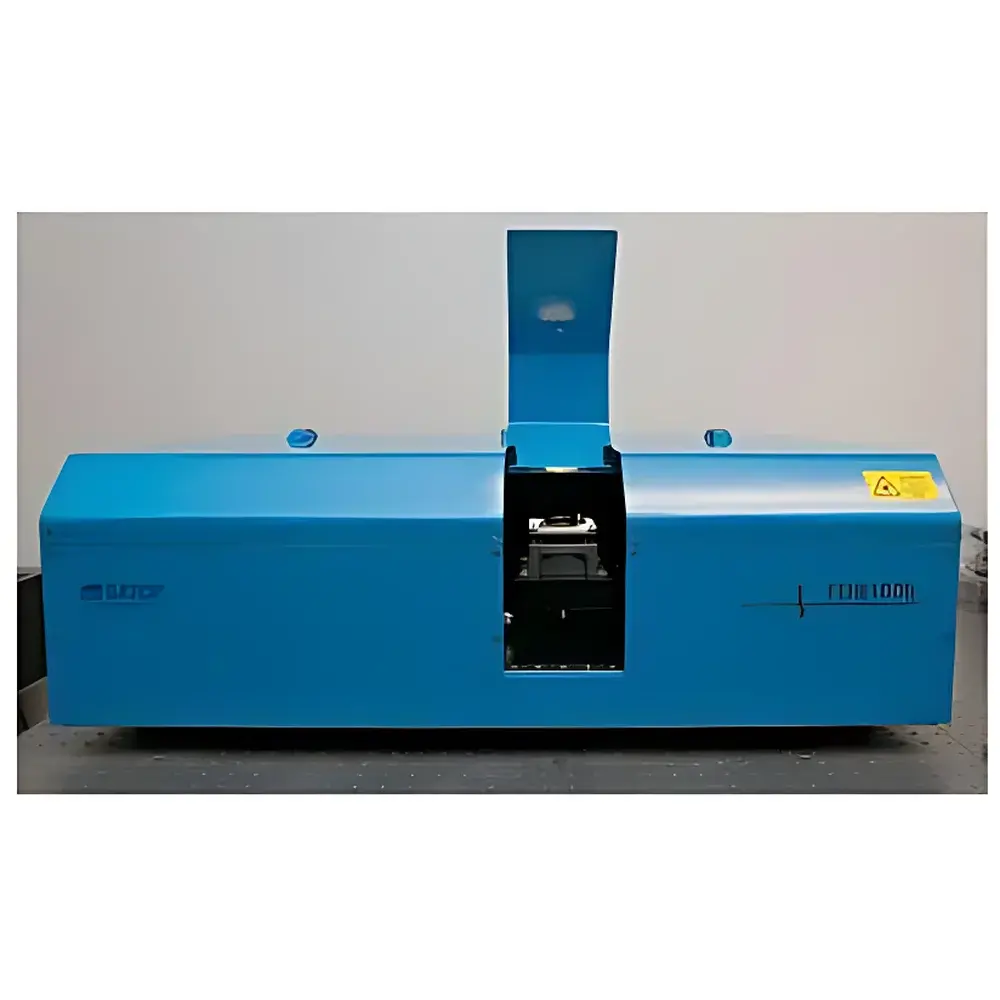
BATOP TDS10XX Benchtop Terahertz Time-Domain Spectrometer
| Brand | BATOP |
|---|---|
| Origin | Germany |
| Model | TDS10XX |
| Spectral Range | 0–3.5 THz (free-space configuration) / 0.1–1.5 THz (fiber-coupled configuration) |
| Spectral Resolution | 2 GHz |
| Dynamic Range | >60 dB (up to >70 dB in Z3 variant) |
| SNR at 0.4 THz | 1000 |
| THz Beam Diameter | 12–22 mm |
| Focused Spot Size | 1–2 mm |
| Delay Line Range | 1 ns (standard), up to 1.3 ns (Z3) |
| Minimum Scan Time | 0.5 s |
| Sample Chamber | Purgeable with N₂ |
| Weight | 50 kg |
| Dimensions | 60 cm × 60 cm × 25 cm |
| Laser Wavelength Options | 1550 nm, 1060 nm, 780 nm |
| THz Emitter/Detector | Photoconductive Antenna with Parabolic THz Lenses |
| Data Acquisition | Lock-in Amplifier + Pulse Generator |
| Control Software | T3DS (Windows-based, customizable API) |
Overview
The BATOP TDS10XX is a modular, benchtop terahertz time-domain spectrometer (THz-TDS) engineered for high-fidelity spectral acquisition and time-resolved characterization of dielectric, semiconductor, and organic materials. Operating on the principle of optical rectification and electro-optic sampling—driven by synchronized femtosecond laser pulses—the system generates and detects broadband THz pulses in either free-space or fiber-coupled configurations. Its core architecture supports multiple laser excitation wavelengths (780 nm, 1060 nm, and 1550 nm), enabling compatibility with both Ti:sapphire and Yb- or Er-doped fiber laser sources. The TDS10XX delivers a maximum spectral bandwidth of 0–3.5 THz in free-space mode, with resolution fixed at 2 GHz—determined by the temporal scan range and Fourier transform fidelity. Designed for laboratory-grade reproducibility, the system integrates precision-machined optomechanics, vacuum-compatible sample enclosures (10⁻³ Torr optional for SPS-300 variants), and N₂-purged beam paths to suppress atmospheric water vapor absorption lines below 1 THz.
Key Features
- Modular platform supporting interchangeable THz generation/detection schemes: photoconductive antennas (PCA), electro-optic crystals (ZnTe, GaP), or air-plasma emitters
- Configurable delay line with 1 ns standard range (extendable to 1.3 ns) for sub-picosecond temporal resolution
- Dual-mode operation: transmission and reflection geometry with manual or motorized XYZ sample positioning
- Fiber-coupled variant (1550 nm pump) enables compact integration into OEM systems and reduced alignment sensitivity
- Optimized THz optics: parabolic off-axis reflectors with RMS surface accuracy < λ/10 @ 1 THz; focal spot diameter 1–2 mm
- Real-time waveform acquisition at up to 500 Hz (Micro-Z handheld variant); standard benchtop scanning at 2–5 Hz
- Industrial-grade lock-in detection electronics with programmable time constants and dual-phase demodulation
Sample Compatibility & Compliance
The TDS10XX accommodates solid, liquid, and powder samples within its purgable sample chamber. Transmission measurements require thin (< 1 mm) low-absorption substrates (e.g., HR-Si, quartz, polyethylene), while reflection mode enables non-contact analysis of opaque or layered structures—including paints, composites, pharmaceutical tablets, and semiconductor wafers. Optional vacuum enclosures (SPS-300 series) meet ISO 14644-1 Class 5 cleanroom specifications and support in-situ cryogenic or high-humidity environmental control. All configurations comply with electromagnetic compatibility standards IEC 61326-1 and safety directives IEC 61010-1. For regulated environments, T3DS software supports audit-trail logging and user-access controls aligned with FDA 21 CFR Part 11 requirements when deployed under GLP/GMP workflows.
Software & Data Management
T3DS is a native Windows application built on LabVIEW and C++ with open-source Python bindings (via PyTDS SDK). It provides real-time oscilloscope-style waveform visualization, FFT-based spectral extraction, complex refractive index calculation (n, κ), and thickness deconvolution using transfer matrix modeling. Raw time-domain data are stored in HDF5 format with embedded metadata (laser power, delay step, ambient humidity, purge gas flow rate). Batch processing pipelines support automated baseline correction (scattering compensation), water-vapor line removal (HITRAN-based fitting), and multivariate calibration (PLS, PCA). Export options include CSV, MATLAB .mat, and SDF (Spectral Data Format) compliant with ASTM E1421-22 for inter-laboratory spectral exchange.
Applications
- Non-destructive evaluation (NDE) of polymer coatings, carbon-fiber laminates, and battery electrode layers
- Pharmaceutical solid-state analysis: polymorph identification, crystallinity quantification, and tablet coating uniformity mapping
- Carrier dynamics in 2D materials (graphene, TMDCs) via pump–probe THz spectroscopy (ZAP and Z3 variants)
- Security screening: concealed substance identification using spectral fingerprinting in 0.3–2.5 THz band
- Far-infrared vibrational spectroscopy of molecular crystals and hydrogen-bonded networks
- Thickness metrology of multi-layer dielectrics with ±1 µm axial resolution (limited by coherence length)
FAQ
What laser sources are compatible with the TDS10XX?
The system supports commercial femtosecond fiber lasers at 1550 nm (Er-doped), 1060 nm (Yb-doped), and 780 nm (Ti:sapphire or frequency-doubled fiber), with pulse durations < 100 fs and repetition rates between 50–100 MHz.
Can the TDS10XX operate under vacuum or controlled atmosphere?
Yes—standard models feature N₂-purge ports; optional vacuum chambers (10⁻³ Torr) are available for SPS-300 and Z3 configurations to eliminate rotational water vapor lines below 0.5 THz.
Is T3DS software validated for regulated QA/QC environments?
T3DS includes configurable electronic signatures, change logs, and data integrity safeguards; full 21 CFR Part 11 compliance requires site-specific validation per internal SOPs.
What is the typical measurement uncertainty for refractive index extraction?
Under controlled lab conditions (temperature-stabilized, dry N₂ purge), relative uncertainty in n(ω) is ≤ 0.5% across 0.2–2.0 THz for homogeneous samples ≥ 100 µm thick.
Does BATOP offer OEM integration support?
Yes—mechanical, electrical, and software interfaces (RS-232, USB, TCP/IP) are documented in the TDS Integration Manual; custom firmware and API extensions are available under NDA.






