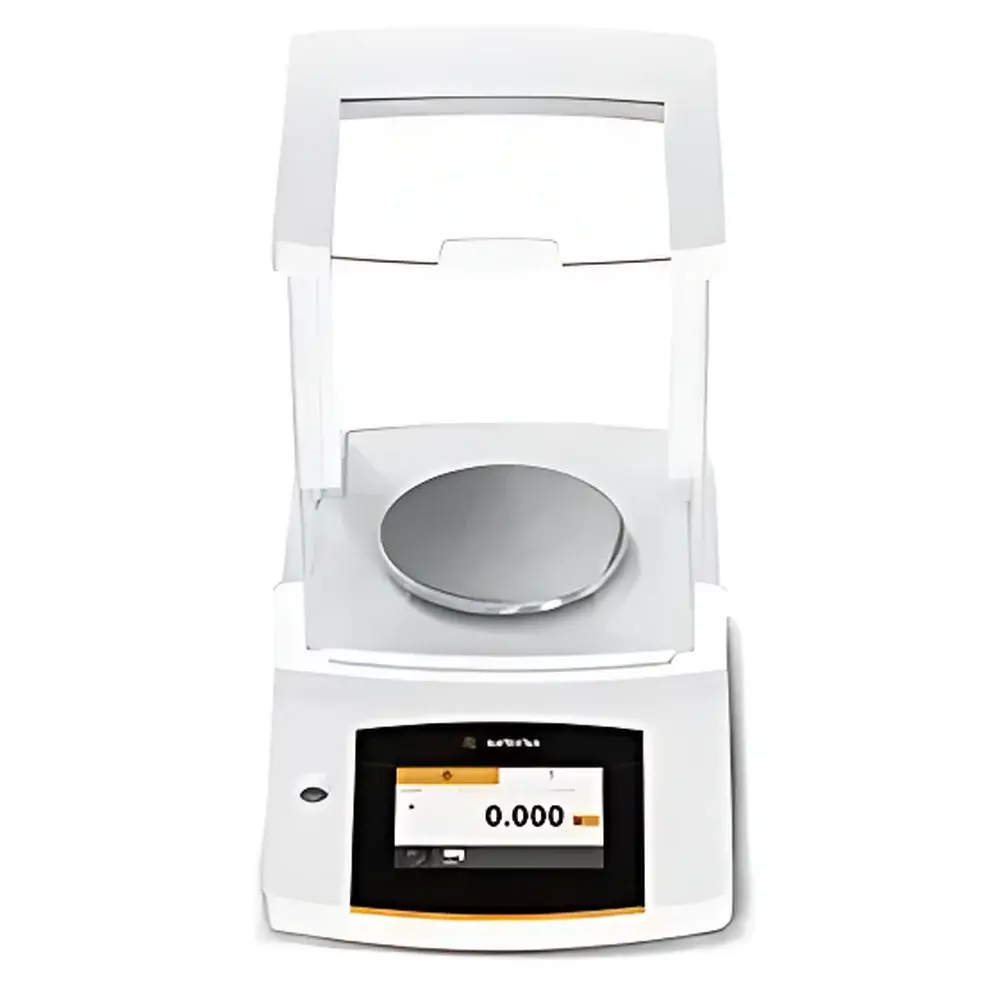
Sartorius PRACTUM224-1CN Analytical Balance
| Origin | Germany |
|---|---|
| Type | Analytical Balance |
| Maximum Capacity | 220 g |
| Readability | 0.1 mg |
| Repeatability | 0.1 mg |
| Weighing Pan Diameter | 90 mm |
| Draft Shield | Integrated, Robust Sliding Doors |
| Leveling | Large Front-Mounted Leveling Knobs with Integrated Bubble Indicator |
| Connectivity | Mini-USB (Direct Export to Microsoft® Excel®) |
| Compliance | Designed for GLP/GMP Environments with Audit-Trail-Ready Data Output |
Overview
The Sartorius PRACTUM224-1CN is a high-precision analytical balance engineered for routine laboratory applications requiring traceable accuracy, operational robustness, and regulatory readiness. Based on electromagnetic force compensation (EMFC) technology, it delivers stable, drift-free measurements under standard ambient conditions—ideal for quantitative analysis in pharmaceutical QC, academic research, chemical synthesis, and quality assurance workflows. Its 0.1 mg readability and 220 g maximum capacity meet the performance criteria defined in ISO 17025 for accredited testing laboratories and align with USP requirements for analytical weighing. Manufactured in Germany, the instrument integrates a hermetically sealed EMFC sensor, precision-machined stainless-steel weighing pan, and an optically balanced draft shield system to minimize convective interference and ensure measurement reproducibility across varying environmental conditions.
Key Features
- Electromagnetic force compensation (EMFC) transducer with thermal drift compensation—ensures long-term stability and minimal warm-up time (≤4 s stabilization).
- Integrated internal calibration mechanism compliant with ISO 8655-6; automatic recalibration triggered by temperature shift (>1.5 °C) or user-defined schedule.
- Dual-mode draft shield: sliding glass doors with low-friction linear guides and optimized airflow geometry to suppress turbulence without compromising ergonomics.
- Below-balance hook assembly (standard) enables density determination (ASTM D792, ISO 1183), magnetic susceptibility testing, and buoyancy-corrected weighing of suspended samples.
- Front-access leveling system featuring oversized knurled knobs and integrated dual-axis bubble level—enables rapid, tool-free horizontal alignment even on shared lab benches.
- Regulatory lock function: password-protected menu restriction mode prevents unauthorized configuration changes—critical for student labs, GxP environments, and multi-user facilities.
- Mini-USB interface supporting direct data streaming to Microsoft® Excel® without proprietary drivers; supports timestamped, comma-delimited output with optional interval-based auto-printing (via YDP40 printer compatibility).
Sample Compatibility & Compliance
The PRACTUM224-1CN accommodates diverse sample forms—including powders, granules, viscous liquids, solid monoliths, and fragile biological specimens—within its 90 mm diameter stainless-steel pan and 209 mm vertical clearance. Its draft shield design complies with ISO 9001:2015 clause 7.6 regarding monitoring and measuring equipment control. For regulated industries, the balance supports ALCOA+ data integrity principles: all weight events are timestamped, operator-ID–capable (via external authentication integration), and exportable in raw format for 21 CFR Part 11–compliant review. Optional density kit (Sartorius Order No. YDK01) extends functionality to solid density measurement per ISO 1183-1 and ASTM D792 Method A.
Software & Data Management
Data acquisition operates via native USB CDC (Communication Device Class) protocol—eliminating dependency on vendor-specific software. Each measurement record includes: date/time stamp, gross/net/tare value, unit, stability indicator, and optional operator ID (when integrated with LDAP or local credential database). Export formats include .csv and .txt, compatible with LIMS, ELN, and statistical process control platforms. Interval-triggered output (e.g., every 5 s) facilitates kinetic mass-change monitoring during desiccation, solvent evaporation, or hydration studies. All firmware updates are delivered via Sartorius’ validated release cycle, documented under change control procedures aligned with ISO/IEC 17025:2017 Annex A.3.
Applications
- Quantitative gravimetric analysis: Preparation of standard solutions, titrant standardization, and residual solvent quantification per ICH Q2(R2).
- Density determination: Solid material characterization using hydrostatic weighing with integrated hook and density kit.
- Checkweighing: Batch verification against upper/lower tolerance limits (e.g., tablet weight uniformity per USP ).
- Percent deviation calculation: Relative comparison of sample masses against reference standards—used in formulation consistency audits.
- Parts counting: High-speed enumeration of uniform components (e.g., screws, capsules, microcentrifuge tubes) with statistical confidence reporting.
- Peak-hold mode: Capture of transient maxima during dynamic processes—e.g., animal weighing in behavioral assays or moisture loss during thermal gravimetric profiling.
- Unstable condition weighing: Adaptive filtering algorithm mitigates vibration-induced noise (EN 61326-1 compliant) and air current artifacts—validated per OIML R 76-1 Annex C.
FAQ
What calibration standards does the PRACTUM224-1CN support?
It performs internal calibration using built-in reference masses traceable to national metrology institutes (PTB, NIST). External calibration with certified weights (Class E2 or better) is recommended annually per ISO/IEC 17025.
Is the balance compliant with 21 CFR Part 11 for electronic records?
While the hardware supports audit-trail–ready data export, full Part 11 compliance requires implementation of complementary procedural controls (e.g., electronic signatures, access logs) via integrated LIMS or ELN systems.
Can the draft shield be removed for oversized samples?
No—the shield is non-removable but features wide-opening sliding doors (180° lateral access) and 209 mm internal height to accommodate tall containers and volumetric flasks.
Does the USB interface support real-time data streaming to custom software?
Yes—using standard CDC ACM protocol; developers can implement serial communication handlers in Python, LabVIEW, or MATLAB without proprietary SDKs.
What is the service life expectancy of the EMFC sensor?
Rated for ≥100,000 weighing cycles at full capacity; typical field service life exceeds 10 years with routine preventive maintenance per Sartorius Service Bulletin SB-PRAC-2023-01.