
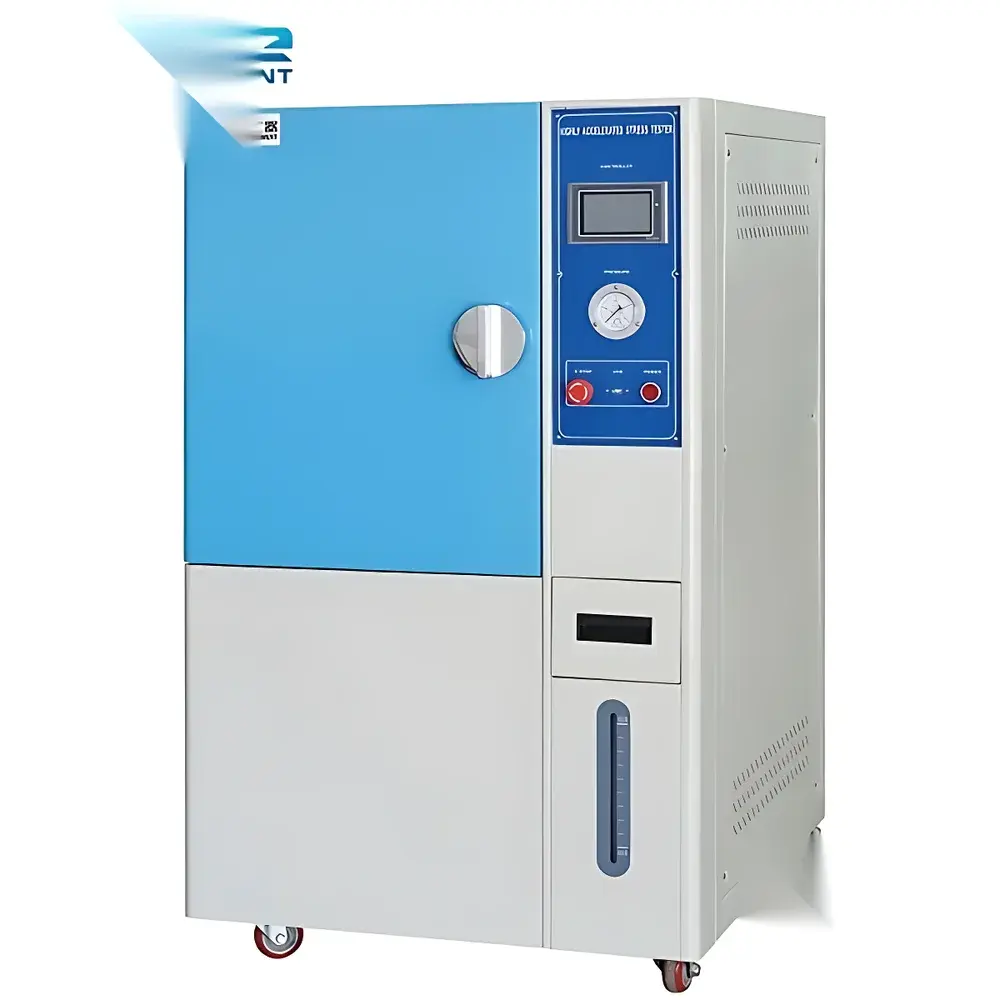
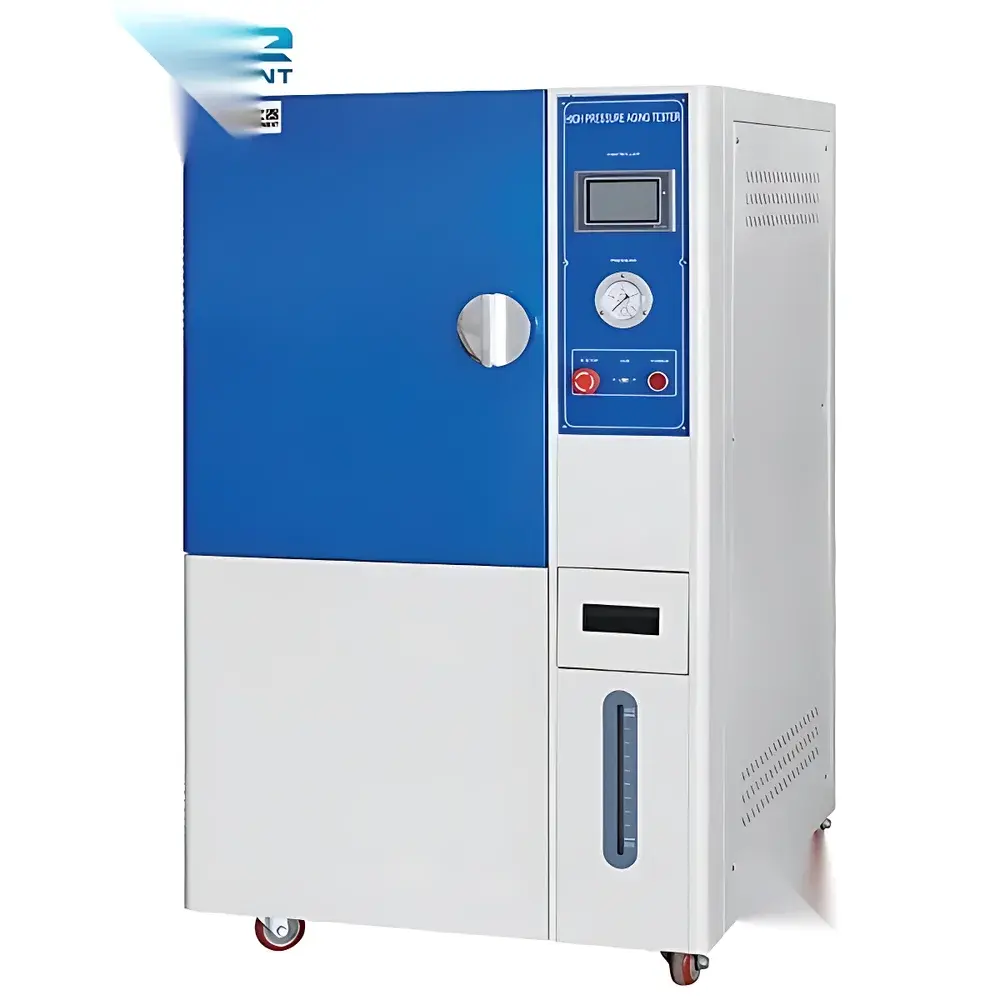
Non-Saturated High-Pressure Accelerated Life Aging Test Chamber
| Key | Temperature Range: +100°C to +132°C (saturated steam temperature) |
|---|---|
| Humidity Range | 75–100% RH (saturated steam) |
| Pressure Control | 0–6 kgf/cm² (PID-controlled, computer-integrated) |
| Operating Pressure | 2.0 kgf/cm² (rated for ≥6 atm burst pressure) |
| Pressure Ramp Time | ≤45 min (0 → 2.0 kgf/cm²) |
| Temperature Control | PID microprocessor-based (VT-4810 controller), RT+10°C to 200°C, K-type thermocouple input, SSR solid-state relay output |
| Steam Circulation | Natural convection of saturated water vapor |
| Test Duration | 0.00–999.99 hr |
| Safety Interlocks | Dual-pressure/temperature sensing, vacuum-assisted air purge, auto-depressurization, auto-vacuum break, auto-refill (up to 1000 hr continuous operation) |
| Compliance | ASTM D2247, DIN 50017, ISO 6270-2, IEC 60068-2-30, NACE TM0177, UL 746C, JIS Z 2243, MIL-STD-810H Method 507.6 |
| Sample Access | Horizontal cylindrical chamber with radial door latch, self-sealing under internal pressure |
Overview
The Non-Saturated High-Pressure Accelerated Life Aging Test Chamber is an engineered environmental stress screening system designed to simulate and accelerate moisture-driven degradation mechanisms in sealed or semi-sealed components under controlled elevated temperature, humidity, and pressure conditions—without maintaining full saturation equilibrium. Unlike conventional saturated steam autoclave testers, this chamber operates in a non-saturated regime, enabling precise control over partial vapor pressure and relative humidity while sustaining super-atmospheric pressure. It leverages the thermodynamic principle that elevated partial pressure of water vapor at elevated temperature significantly accelerates hydrolytic degradation, intermetallic diffusion, corrosion initiation (e.g., chloride-induced pitting), delamination in laminated substrates, and polymer chain scission—particularly in electronics packaging, conformal coatings, adhesives, and hermetic seals. Its operational envelope (+100°C to +132°C, 75–100% RH, up to 2.0 kgf/cm²) aligns with industry-standard accelerated aging protocols where Arrhenius–Eyring modeling is applied for failure rate extrapolation.
Key Features
- Horizontal cylindrical test chamber with radial door sealing geometry—designed to eliminate condensate pooling and prevent direct steam jet exposure during loading/unloading.
- Integrated dual-loop PID control architecture: independent regulation of chamber temperature (RT+10°C to 200°C, ±0.5°C accuracy) and absolute pressure (0–6 kgf/cm², ±0.05 kgf/cm² resolution), both synchronized via VT-4810 microprocessor controller with PV/SV digital display and keypad programming.
- Automated safety sequence logic: real-time monitoring of internal pressure and temperature triggers automatic depressurization, vacuum break, and chamber venting prior to door unlock; mechanical interlock ensures door remains physically sealed until internal pressure drops below ambient reference.
- Vacuum-assisted air purification cycle: pre-test evacuation removes ambient oxygen and contaminants, followed by filtered dry-air or nitrogen backfill—critical for evaluating oxidation-sensitive materials or preventing false-positive corrosion artifacts.
- Self-contained water management: programmable auto-refill system supports uninterrupted operation up to 1000 hours; optional integration with deionized water reservoir and level-sensing feedback loop for GLP-compliant long-duration qualification runs.
- Robust structural design rated for ≥6 atm burst pressure, exceeding standard operating requirements per ASME BPVC Section VIII Division 1 design criteria.
Sample Compatibility & Compliance
This chamber accommodates heterogeneous sample configurations—including PCB assemblies, multi-layer ceramic capacitors (MLCCs), hermetically sealed optoelectronic modules, automotive connectors, medical device housings, and pharmaceutical blister packaging—without requiring custom fixtures. Its cylindrical interior permits uniform thermal and vapor distribution via natural convection of saturated steam, minimizing thermal gradients across sample arrays. The system complies with internationally recognized standards for accelerated moisture resistance testing, including ASTM D2247 (water immersion), ISO 6270-2 (condensation testing), IEC 60068-2-30 (damp heat cyclic), NACE TM0177 (sulfide stress cracking), and MIL-STD-810H Method 507.6 (humidity). All control parameters—including setpoints, ramp rates, dwell times, and safety events—are timestamped and logged in accordance with FDA 21 CFR Part 11 requirements when paired with validated audit-trail software.
Software & Data Management
Equipped with RS-485/Modbus RTU and optional Ethernet interface, the chamber integrates seamlessly into centralized laboratory data acquisition networks. Raw sensor data (temperature, pressure, elapsed time, valve status, water level) are streamed at 1 Hz resolution and stored locally on embedded flash memory (≥32 GB). Optional PC-based software provides graphical trend analysis, alarm configuration (e.g., deviation >±1.0°C from setpoint for >60 sec), CSV export, and automated report generation compliant with ISO/IEC 17025 documentation frameworks. Audit trails record all user actions—including parameter edits, manual overrides, and emergency stops—with operator ID, timestamp, and reason code—enabling full traceability for GMP/GLP audits.
Applications
- Accelerated life validation of conformal coatings (e.g., acrylic, silicone, parylene) on printed circuit boards under combined thermal-moisture stress.
- Evaluation of seal integrity and outgassing behavior in MEMS packages and wafer-level chip-scale packages (WLCSP).
- Qualification of adhesive bond strength retention in automotive battery module enclosures exposed to high-humidity tropical environments.
- Screening for electrochemical migration (ECM) susceptibility in high-density interconnect substrates using bias-humidity testing protocols.
- Reliability assessment of medical-grade silicone elastomers used in implantable device housings per ISO 10993-12 extraction protocols.
- Failure mode identification during early-stage design verification—enabling root-cause analysis of latent defects such as void formation, interfacial debonding, or electrolyte leakage in lithium-ion battery cells.
FAQ
What distinguishes “non-saturated” operation from standard saturated steam autoclave testing?
Non-saturated operation maintains controlled partial vapor pressure below full saturation at a given temperature—enabling independent modulation of RH and pressure to replicate field-relevant stress states (e.g., humid tropical climates with barometric variation), rather than forcing equilibrium saturation which may over-accelerate certain failure modes.
Can the chamber perform cyclic humidity profiles?
Yes—the VT-4810 controller supports up to 99 programmable segments per test profile, allowing sequential ramps in temperature, pressure, and dwell duration to emulate real-world diurnal or seasonal cycling.
Is third-party calibration certification available?
Calibration certificates traceable to NIST or DAkkS-accredited laboratories are provided upon request, covering temperature (±0.3°C), pressure (±0.03 kgf/cm²), and timebase (±0.1 sec/hr) verification points.
What maintenance intervals are recommended?
Quarterly inspection of steam generator electrodes, annual replacement of O-ring seals and pressure transducer calibration, and biannual verification of vacuum pump oil and filter integrity—documented in the included maintenance logbook.
Does the system support remote monitoring via cloud platform?
When configured with the optional IoT gateway module, real-time telemetry and alarm notifications (SMS/email) can be routed to enterprise SCADA or cloud-based CMMS platforms via TLS 1.2–secured MQTT protocol.



