
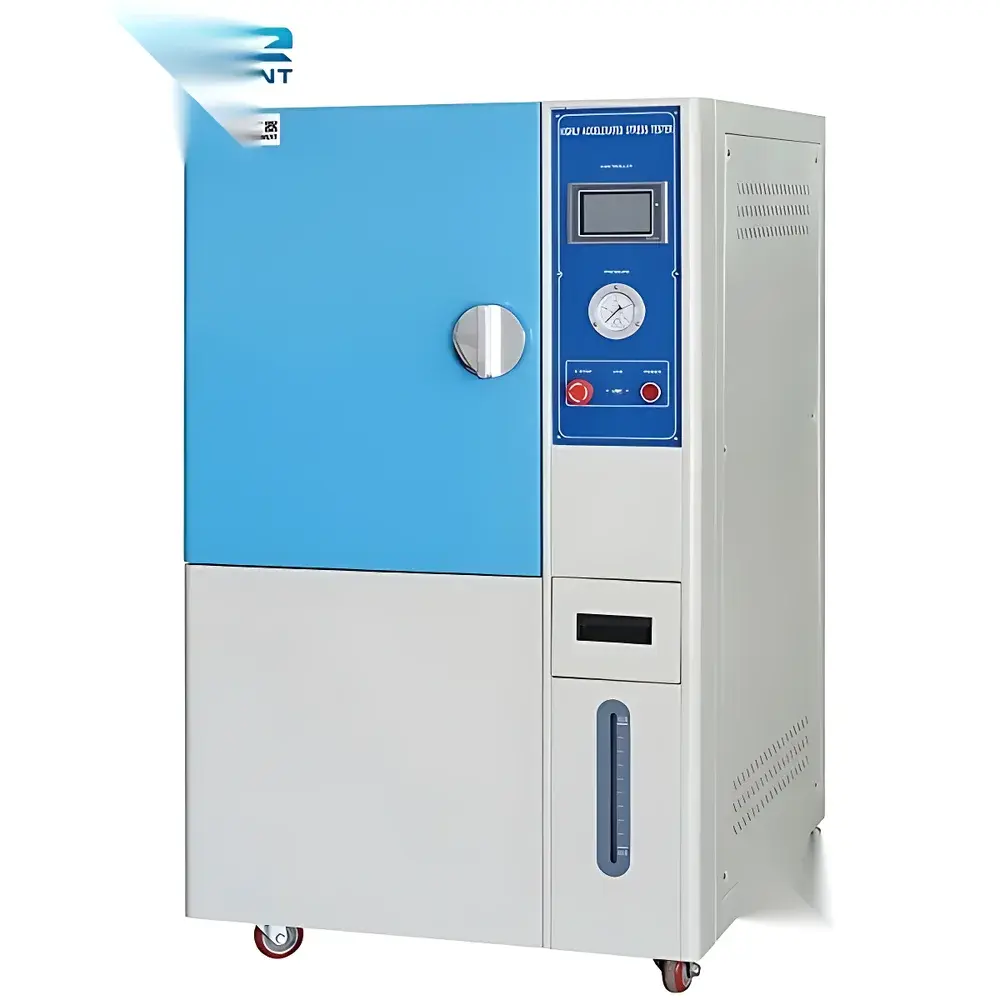
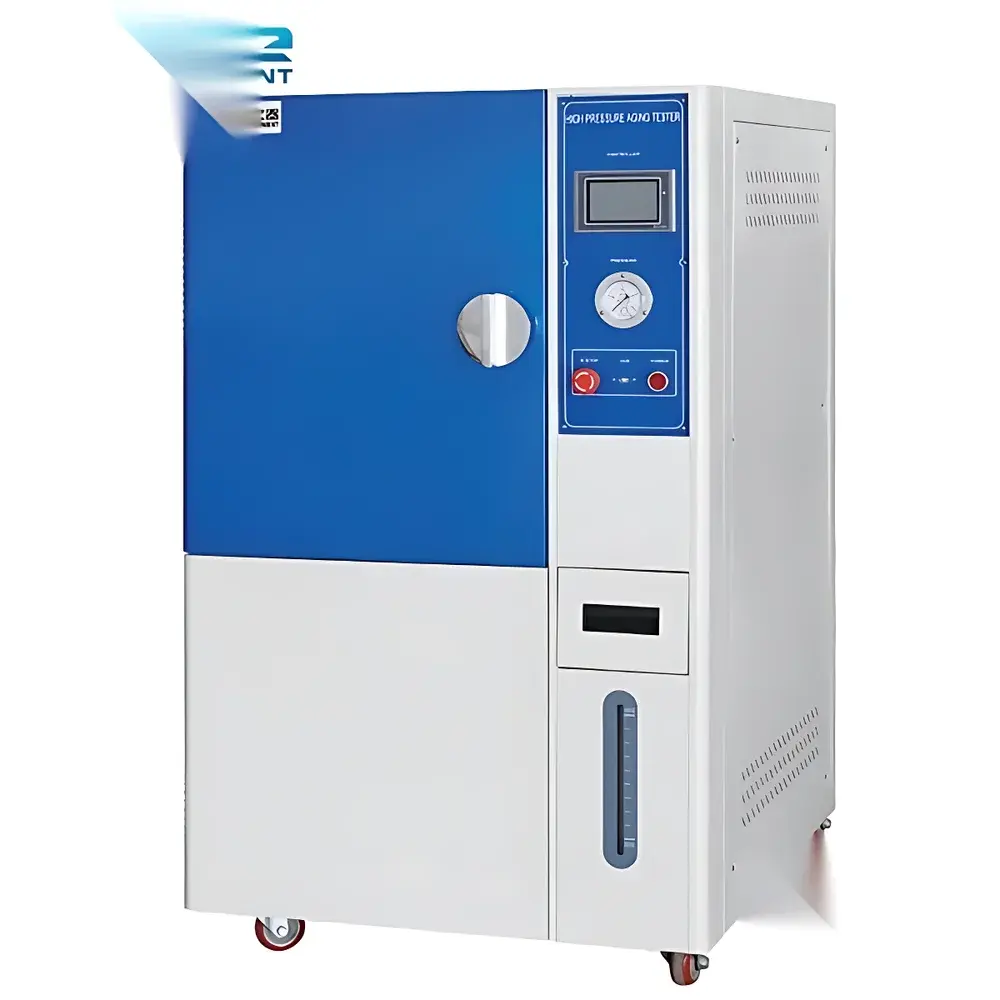
Non-Saturated High-Pressure Life Aging Test Chamber
| Key | Temperature Range: +100°C to +132°C (saturated steam temperature) |
|---|---|
| Humidity Range | 75–100% RH (saturated steam) |
| Pressure Control | 0–6 kg/cm² via PID-based digital pressure controller |
| Operating Pressure | 2.0 kg/cm² (≥6 atm burst rating) |
| Pressure Ramp Time | ≤45 min (0 → 2.0 kg/cm²) |
| Temperature Control | PID microprocessor with PV/SV dual display, K-type thermocouple input, SSR solid-state relay output, RT+10°C to 200°C range |
| Steam Circulation | Natural convection of saturated steam |
| Timer Range | 0.00–999.99 hr |
| Chamber Geometry | Horizontal cylindrical inner chamber with vacuum-sealed door interlock |
| Safety System | Dual-locking pressure/temperature interlock, automatic depressurization, vacuum purge, and auto-refill (up to 1000 hr continuous operation) |
| Compliance | ASTM D2247, DIN 50017, ISO 6270-2, IEC 60068-2-30, UL 746C, MIL-STD-810H, JIS Z 2243, NACE TM0177, BS EN 60068-2-30 |
Overview
The Non-Saturated High-Pressure Life Aging Test Chamber is an engineered environmental stress screening system designed for accelerated life testing of hermetic and semi-hermetic components under controlled high-pressure saturated steam conditions. Unlike conventional autoclave-style aging chambers that operate exclusively at full saturation equilibrium, this chamber maintains a precisely regulated non-saturated vapor phase—enabling controlled partial pressure of water vapor while sustaining elevated thermal and mechanical stress. It operates on the principle of accelerated moisture diffusion under elevated partial pressure gradients, facilitating rapid penetration of water vapor into micro-defects, interfaces, and encapsulated voids. This methodology is particularly effective for identifying latent failure mechanisms in electronic packaging, molded polymers, laminated PCBs, and coated metallic assemblies—where early-stage delamination, corrosion initiation, or seal integrity degradation may remain undetectable under standard humidity cycling.
Key Features
- Horizontal cylindrical test chamber with seamless stainless-steel inner liner and vacuum-tight gasketed door—optimized for uniform steam distribution and safe operator access without vertical condensate drip risk.
- Integrated dual-loop control architecture: independent PID-regulated temperature (RT+10°C to 200°C) and pressure (0–6 kg/cm²) systems, each with real-time digital feedback and programmable ramp/soak profiles.
- Automated safety sequence logic: pressure-dependent door interlock prevents opening below ambient reference pressure; vacuum purge cycle removes residual oxygen and contaminants prior to steam introduction per ISO 6270-2 Annex B.
- Self-sustaining water management: integrated reservoir with level sensor and solenoid-controlled refill—capable of uninterrupted operation up to 1000 hours without manual intervention.
- Natural-convection saturated steam circulation eliminates forced-air turbulence, reducing thermal shock and ensuring consistent exposure across heterogeneous sample geometries—including multi-layer flex circuits and stacked IC packages.
- Comprehensive event logging: timestamped records of pressure, temperature, elapsed time, vacuum status, and safety interlock states—exportable in CSV format for GLP/GMP audit compliance.
Sample Compatibility & Compliance
This chamber accommodates samples ranging from discrete surface-mount devices (SMDs) and ceramic capacitors to assembled automotive ECUs, LED modules, and medical-grade sealed housings. Its cylindrical geometry supports horizontal placement of large-format PCB panels (up to 450 mm × 350 mm) and vertically oriented cable harnesses. All operational parameters align with internationally recognized standards for accelerated moisture resistance testing, including ASTM D2247 (Standard Practice for Testing Water Resistance of Coatings), ISO 6270-2 (Paints and varnishes — Determination of resistance to humidity — Part 2: Condensation method), and IEC 60068-2-30 (Environmental testing — Part 2-30: Tests — Test Db: Damp heat, cyclic). The system meets traceability requirements under ISO/IEC 17025 for accredited laboratories and supports FDA 21 CFR Part 11-compliant electronic record generation when paired with validated software modules.
Software & Data Management
The chamber integrates with optional PC-based control software supporting multi-step test program definition, remote monitoring via Ethernet/IP, and automated report generation compliant with internal QA templates. All process data—including setpoints, actual values, alarm events, and safety-triggered actions—are stored with cryptographic hash integrity verification. Audit trails include user ID, timestamp, parameter change history, and electronic signatures for critical operations such as pressure ramp initiation or emergency vent activation. Data export conforms to ASTM E2500-22 Annex A4 for regulatory submission readiness.
Applications
- Accelerated reliability validation of conformal-coated PCBAs during design verification (DVT) and production qualification (PQ).
- Evaluation of moisture barrier performance in OLED encapsulation layers and flexible hybrid electronics.
- Corrosion susceptibility screening of tin-plated connectors and aluminum alloy housings per NACE TM0177.
- Seal integrity assessment of MEMS sensors, hermetically sealed relays, and implantable device casings.
- Material compatibility testing for adhesives, potting compounds, and underfill resins exposed to high-humidity thermal stress.
- Failure mode acceleration for solder joint intermetallic growth, polymer hydrolysis, and electrochemical migration (ECM) pathways.
FAQ
What distinguishes “non-saturated” high-pressure aging from standard autoclave testing?
Non-saturated operation maintains a defined vapor-phase partial pressure below full saturation—enabling controlled moisture ingress kinetics without boiling-point constraint. This allows precise decoupling of thermal and hygric stress variables.
Can the chamber perform vacuum-desiccation preconditioning before steam exposure?
Yes—the integrated vacuum pump and HEPA-filtered air reintroduction system enables programmable pre-test degassing per IEC 60068-2-30 Clause 6.2.
Is pressure calibration traceable to national standards?
All pressure transducers are supplied with NIST-traceable calibration certificates valid for 12 months; field recalibration ports support in-house verification.
How is door safety interlock verified during routine maintenance?
The system performs automatic interlock self-check at power-on and after each depressurization cycle, logging pass/fail status with diagnostic codes.
Does the chamber support custom test profiles required by internal reliability standards?
Yes—up to 99 programmable steps per profile, including conditional branching based on real-time pressure deviation thresholds.



