
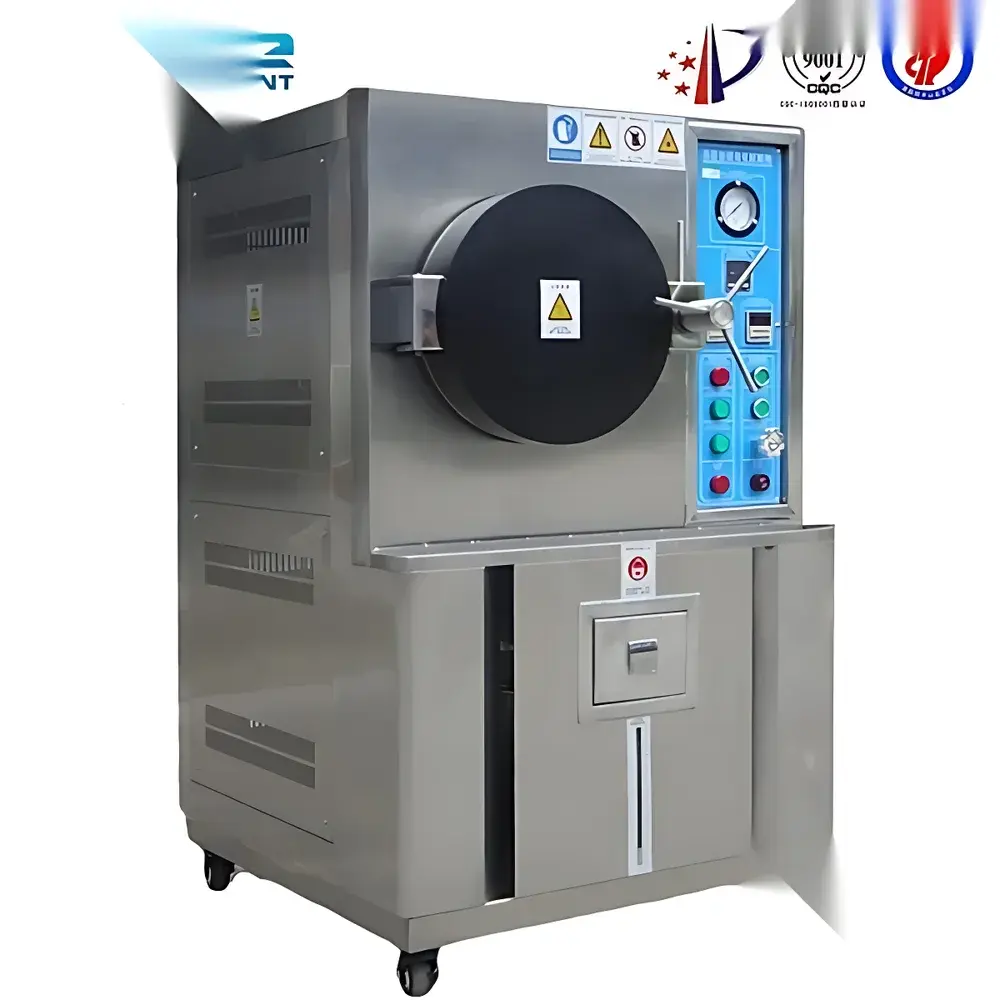
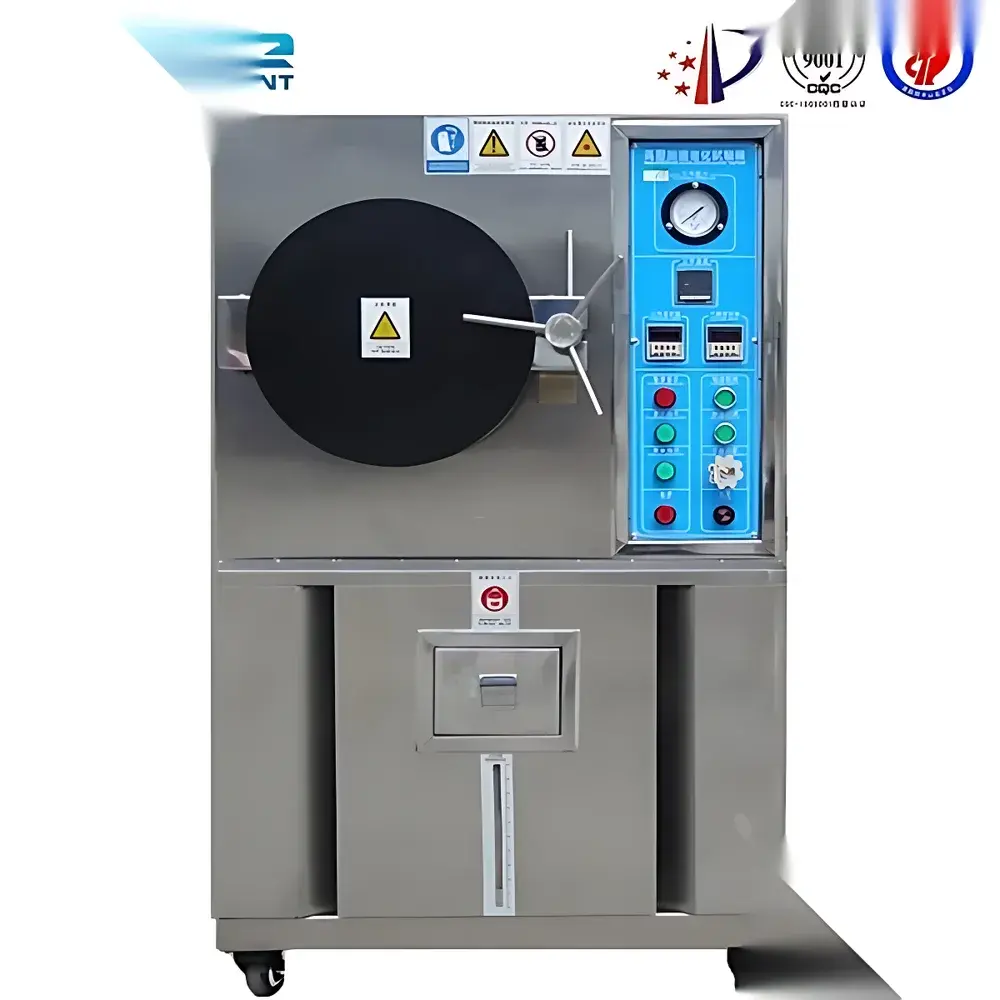
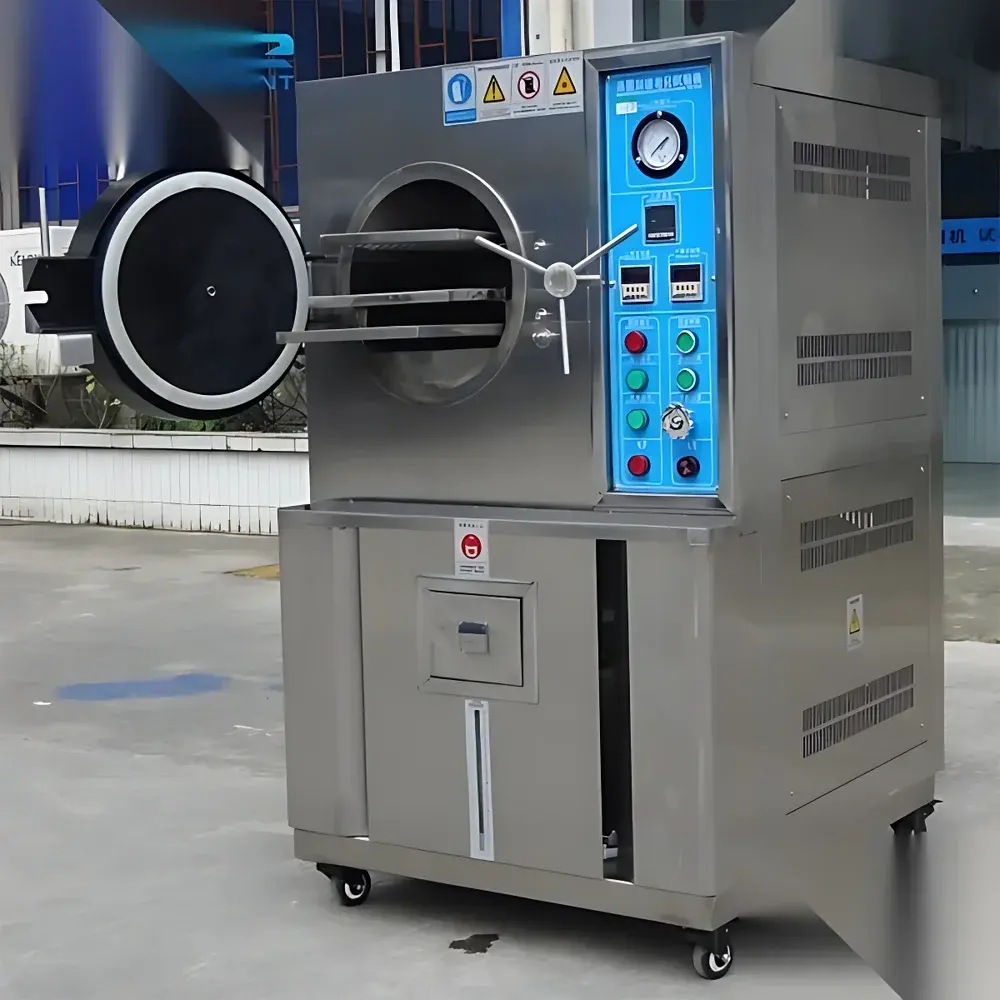
Non-Saturated High-Temperature High-Pressure Autoclave Chamber
| Brand | Other Brands |
|---|---|
| Origin | Imported |
| Manufacturer Type | Authorized Distributor |
| Price | USD 13,500 (FOB) |
| Temperature Range | +105°C to +132°C |
| Temp. Uniformity | ±1.5°C |
| Temp. Stability | ±0.5°C |
| Humidity Range | 75–100% RH (adjustable) |
| Humidity Uniformity | ±3.0% RH |
| Humidity Stability | ±1.5% RH |
| Pressure Range (gauge) | 0–2 kg/cm² (adjustable) |
| Max. Operating Pressure | 3.0 kg/cm² |
| Safety Pressure Capacity | 4.0 kg/cm² (1 atm + 3 kg/cm²) |
| Vacuum Preconditioning | Yes (with <1 µm particulate-filtered air intake) |
| Test Duration | 0–999 h |
| Pressurization Time | ~30 min (0 → 2 kg/cm²) |
| Heating Time (ambient to +132°C, no-load) | ~30 min |
| Internal Volume | Configurable |
| Power Supply | AC 220 V / 380 V, 50/60 Hz |
Overview
The Non-Saturated High-Temperature High-Pressure Autoclave Chamber is an engineered environmental stress test system designed for accelerated reliability evaluation of hermetic and semi-hermetic components under combined thermal, humid, and pressurized conditions—without full saturation. Unlike saturated steam autoclaves used for sterilization, this chamber maintains a controlled non-saturated vapor atmosphere by regulating steam injection, air exchange, and condensate management. It operates on the principle of controlled water-vapor partial pressure equilibrium within a sealed stainless-steel cylindrical cavity, enabling precise replication of high-humidity, elevated-pressure aging environments relevant to moisture ingress failure modes (e.g., popcorning, wire bond corrosion, delamination). Its architecture complies with industrial pressure vessel safety standards (ASME BPVC Section VIII Div. 1 design principles applied in structural validation), and supports deterministic acceleration of failure mechanisms governed by Arrhenius-Hall and Peck-type models for humidity-dependent degradation.
Key Features
- Cylindrical stainless-steel inner chamber with reinforced hemispherical end caps—designed to ASTM E2877-compliant geometry for uniform stress distribution and elimination of condensate pooling.
- Annular stainless-steel liner surrounding the chamber wall to diffuse latent heat transfer, preventing direct steam impingement on test specimens and minimizing thermal shock.
- Hermetic sealing system utilizing self-reinforcing elastomeric gasket technology: internal pressure induces radial compression against the flange surface, improving seal integrity with increasing pressure—distinct from static compression seals and extending gasket service life by ≥3× compared to conventional designs.
- Integrated vacuum preconditioning cycle prior to pressurization: evacuates ambient air and replaces it with filtered (<1 µm particle retention) conditioned air to ensure baseline purity and eliminate oxygen-mediated oxidation artifacts during long-duration tests.
- Dual-mode safety interlock: temperature- and pressure-synchronized door locking mechanism prevents opening when internal pressure exceeds atmospheric by >0.1 kg/cm²; mechanical overpressure relief valve rated at 4.0 kg/cm² provides redundant protection.
- Low-water-consumption operation: optimized steam generation and condensate recovery enable continuous operation up to 200 hours per fill, reducing maintenance frequency and operational variability.
- Microprocessor-based controller with real-time limit monitoring: configurable alarm thresholds for temperature, pressure, humidity, and water level; fault codes displayed via LED indicators with root-cause categorization (e.g., “P-Over”, “H-Drift”, “Vac-Fail”).
Sample Compatibility & Compliance
This chamber accommodates PCBs, IC packages (QFN, BGA, WLCSP), multilayer ceramic capacitors, optical sensors, automotive ECUs, and aerospace-grade connectors—mounted on standard 304 stainless-steel shelves (two included). All materials in contact with the test environment meet USP Class VI and ISO 10993-5 biocompatibility requirements where applicable. The system is validated to meet and exceed the environmental profile requirements of MIL-STD-810G Method 502.6 (Humidity), MIL-STD-883 Method 1004.2 (Temperature-Humidity-Pressure Cycling), JEDEC JESD22-A102B (Pressure Cooker Test), IEC 60068-2-66 (Damp Heat, Forced Condensation), and GB/T 2423.40–1997. Calibration traceability follows ISO/IEC 17025 guidelines, with sensor placement per GB/T 5170.2 and GB/T 5170.5 for temperature/humidity uniformity verification.
Software & Data Management
Equipped with embedded Ethernet interface and optional PC-based control software (Windows 10/11 compatible), the system supports time-stamped data logging at user-defined intervals (1 s to 60 min), CSV export, and trend visualization. Audit trails record all parameter changes, alarm events, and manual interventions—fully compliant with FDA 21 CFR Part 11 requirements when configured with electronic signature modules and role-based access control. Data integrity safeguards include cyclic redundancy check (CRC) on stored logs and automatic backup to external USB storage. Optional integration with LIMS platforms via Modbus TCP or OPC UA enables automated test reporting in GLP/GMP-regulated laboratories.
Applications
Primary use cases include: accelerated moisture resistance testing of conformal-coated electronics; evaluation of package hermeticity in MEMS and RF devices; qualification of adhesives and encapsulants under thermo-hygro-mechanical stress; lifetime modeling of polymer-based insulators in high-humidity power electronics; and reliability screening of medical device housings per ISO 14971 risk management protocols. The non-saturated condition specifically targets failure mechanisms associated with vapor-phase diffusion rather than liquid-phase immersion—making it ideal for simulating field-relevant stresses in tropical or sealed-enclosure applications.
FAQ
What distinguishes “non-saturated” operation from conventional steam autoclaving?
Non-saturated operation maintains sub-boiling-point vapor partial pressure without condensate formation on samples—enabling study of vapor-phase moisture diffusion kinetics, not bulk water exposure.
Can the chamber perform pressure ramping profiles (e.g., linear or stepwise)?
Yes—the controller supports programmable pressure ramps with dwell times, synchronized with temperature and humidity setpoints.
Is third-party calibration certification available?
Yes—NIST-traceable calibration certificates (temperature, pressure, humidity) are provided upon request, with annual recalibration recommended.
How is condensate managed during extended tests?
A gravity-fed condensate collection sump with level sensor and auto-drain function prevents re-evaporation and maintains stable RH control.
Does the system support remote monitoring via cloud platform?
Optional IoT gateway module enables secure HTTPS-based status monitoring and alert notifications via web dashboard or mobile app.



