
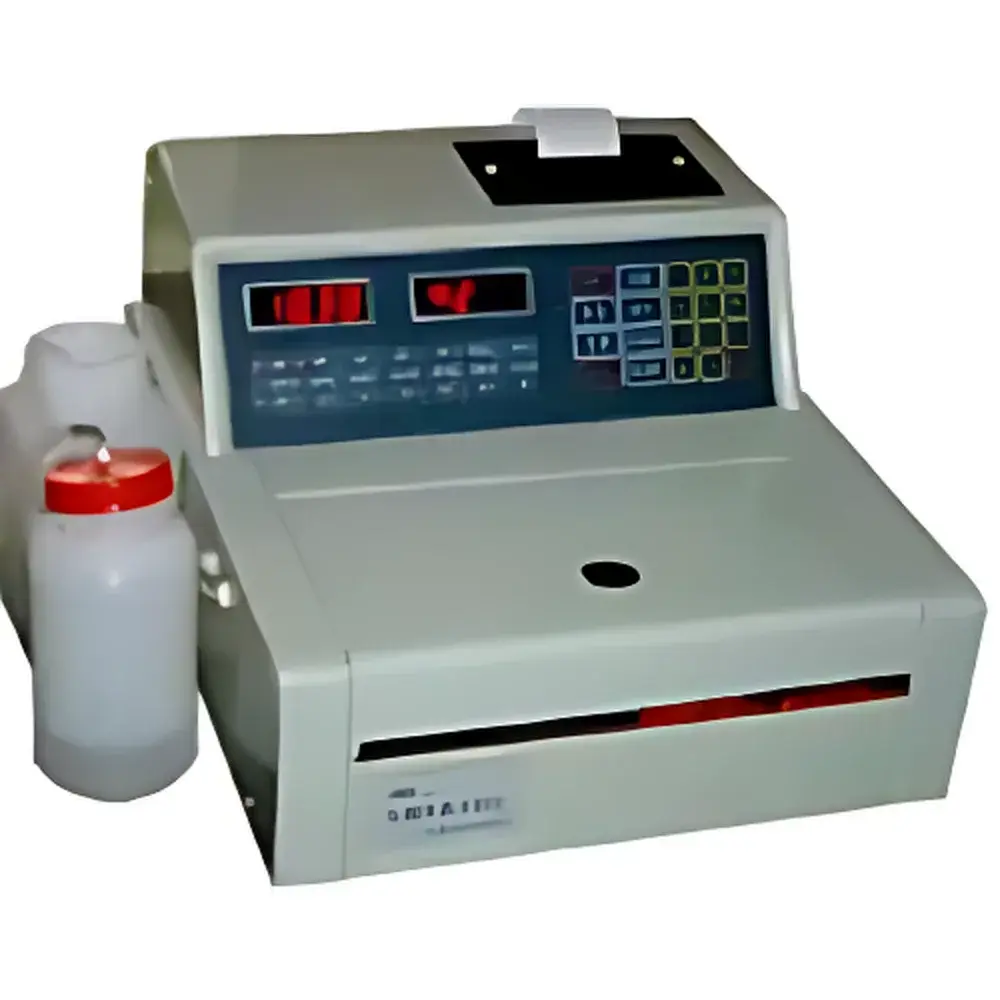
SBA-40C Dual-Channel Biosensor Analyzer with Immobilized Enzyme Transducers
| Origin | Shandong, China |
|---|---|
| Manufacturer Type | Authorized Distributor |
| Origin Category | Domestic (PRC) |
| Model | SBA-40C |
| Pricing | Upon Request |
Overview
The SBA-40C Dual-Channel Biosensor Analyzer is a dedicated, microprocessor-controlled biochemical measurement system engineered for rapid, selective, and quantitative analysis of two co-measured analytes in liquid biological matrices. It operates on the principle of amperometric detection via immobilized enzyme transducers—each channel integrates a proprietary enzyme membrane (e.g., glucose oxidase, lactate oxidase, glutamate oxidase, lysine decarboxylase, or alcohol oxidase) immobilized onto a platinum-based working electrode. Substrate-specific enzymatic reactions generate stoichiometric hydrogen peroxide or other electroactive products, yielding current signals linearly proportional to analyte concentration within defined dynamic ranges. Designed for process analytical technology (PAT) integration, the SBA-40C delivers real-time data for bioprocess monitoring without chromatographic separation or reagent-intensive protocols. Its architecture complies with fundamental requirements for GLP-compliant routine testing in fermentation QA/QC environments, supporting traceable calibration, operator-defined assay protocols, and automated cleaning cycles.
Key Features
- Dual-channel independent measurement capability: Simultaneously quantifies any two analytes from the validated panel—glucose, lactate, glutamic acid, lysine, ethanol, blood glucose, or blood lactate—by swapping pre-characterized enzyme membranes.
- High-speed assay cycle: 20-second measurement time followed by a 25-second automatic electrode rinsing sequence; total cycle ≤60 seconds.
- Minimal sample consumption: Requires only 25 µL per assay, compatible with micro-volume fermentation broth sampling and clinical whole-blood/serum specimens.
- Robust interference rejection: Unaffected by sample turbidity, coloration, or particulate content due to enzyme specificity and electrochemical signal isolation.
- Calibration traceability: Integrated standardization routine using certified reference solutions; supports multi-point calibration verification per ISO 17511 principles.
- Low operational cost: Consumables—including buffer packets, enzyme membranes, and standards—are optimized for extended shelf life and batch consistency; average assay cost is <USD 0.05 per dual-parameter test under continuous operation.
Sample Compatibility & Compliance
The SBA-40C accepts aqueous-phase samples including microbial fermentation broths, tissue homogenates, ion-exchange eluates, hydrolysates, clarified sugar syrups, whole blood, serum, plasma, cerebrospinal fluid (CSF), and industrial process streams. It meets essential functional criteria for use in regulated biomanufacturing settings: instrument logs retain timestamped calibration events, measurement records, and membrane usage history—enabling audit-ready documentation per FDA 21 CFR Part 11 when paired with compliant LIMS integration. While not formally certified to ISO/IEC 17025, its performance characteristics align with ASTM E2587 (Standard Practice for Use of Control Charts in Statistical Process Control) and USP guidelines for analytical instrument qualification. Enzyme membrane storage at 0–8 °C ensures stability per manufacturer’s shelf-life specifications (≥9 months for lactate; >12 months for glucose/glutamate membranes).
Software & Data Management
The embedded firmware provides a menu-driven interface with seven preconfigured assay programs, user-defined parameter thresholds, and auto-print output (thermal printer included). All measurements are timestamped and stored internally (up to 1,000 records); data export is supported via RS-232 serial interface to external PCs running optional CSV-compatible logging software. Audit trail functionality captures operator ID (via manual entry), calibration timestamps, membrane lot numbers, and error flags—including low-signal detection, rinse failure, or out-of-range response deviation (>±5% from prior baseline). Raw current outputs (nA) and converted concentration values (mg/dL or mM) are both accessible for secondary validation. No cloud connectivity or remote access capabilities are implemented—ensuring data sovereignty and compliance with internal IT security policies.
Applications
- Industrial biotechnology: Real-time monitoring of glucose and lactate during fed-batch Corynebacterium glutamicum fermentations for monosodium glutamate (MSG) production; dual tracking of ethanol and residual sugar in yeast-based bioethanol processes.
- Pharmaceutical manufacturing: In-process control of penicillin G titers via β-lactamase-coupled indirect assays; lysine quantification in Bacillus subtilis cultures producing therapeutic enzymes.
- Clinical research: Point-of-care assessment of blood lactate dynamics in sepsis models or exercise physiology studies; parallel glucose/lactate profiling in tumor metabolism assays.
- Food & flavor industry: Rapid quality release testing of hydrolyzed vegetable protein for free glutamate content; ethanol verification in vinegar and soy sauce maturation tanks.
- Agricultural bioprocessing: Monitoring lysine enrichment in fermented feed supplements; quantifying reducing sugars in corn steep liquor prior to microbial inoculation.
FAQ
What sample types require pretreatment before analysis?
Clarification via centrifugation (10,000 × g, 5 min) or filtration (0.45 µm PVDF) is recommended for viscous or particulate-laden samples such as unclarified fermentation broth or tissue homogenates.
How often must the enzyme membrane be replaced?
Typical functional lifespan is 30 days under continuous operation at 25 °C; membrane activity decay is monitored via daily calibration slope drift—replacement is indicated when sensitivity drops >15% relative to initial lot calibration.
Is the SBA-40C compliant with FDA 21 CFR Part 11?
The device itself does not provide electronic signature capability or system-level audit trail encryption; however, its data output format and metadata structure support integration into Part 11–compliant LIMS environments when deployed with validated interface software.
Can the instrument measure analytes beyond the listed six?
No—cross-reactivity has been rigorously excluded for the specified analytes only; extension to new substrates would require full revalidation of enzyme membrane specificity, linearity, LOD/LOQ, and interferences per ICH Q2(R2).
What environmental conditions affect measurement reproducibility?
Ambient temperature fluctuations >±2 °C/hour induce thermal drift in baseline current; optimal operation requires stable 20–25 °C ambient with relative humidity <85% non-condensing to prevent condensation on optical/electrochemical components.




