
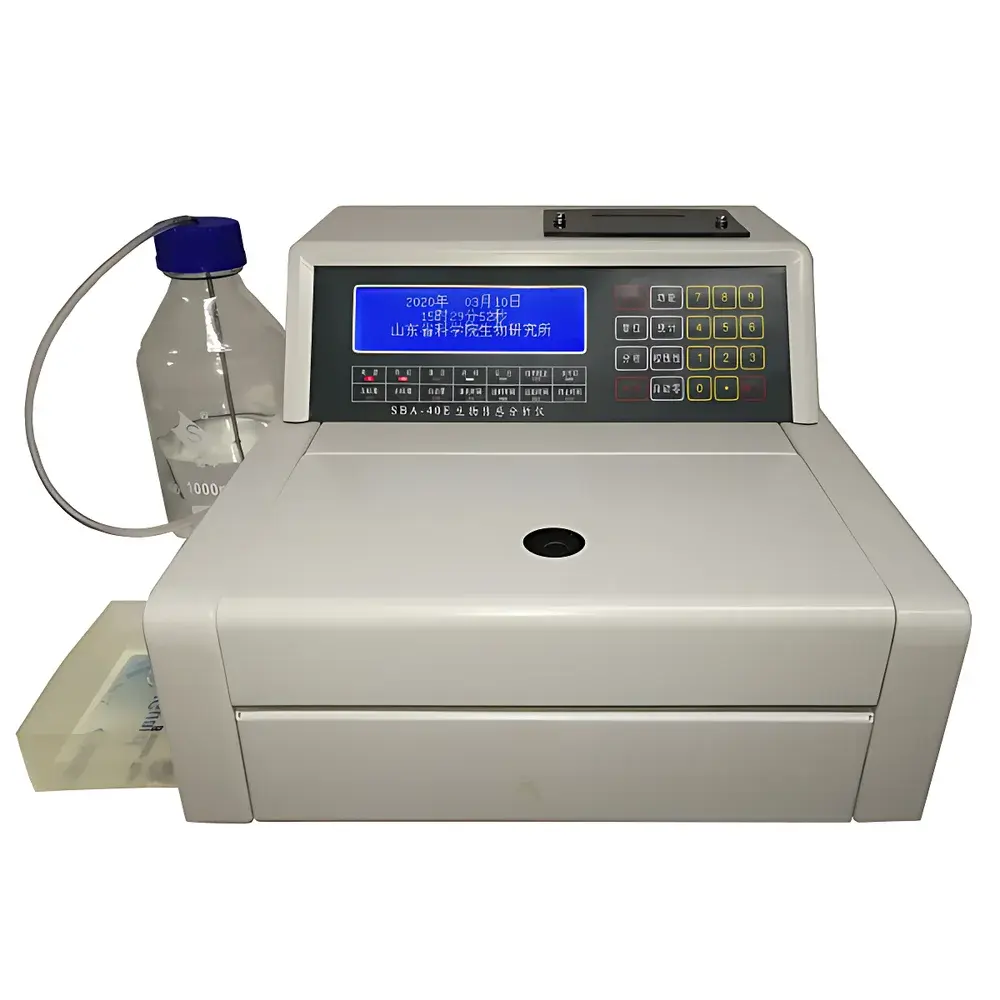
SBA-40E Bioanalytical Sensor Analyzer
| Origin | Shandong, China |
|---|---|
| Manufacturer Type | Authorized Distributor |
| Origin Category | Domestic (PRC) |
| Model | SBA-40E |
| Pricing | Available Upon Request |
Overview
The SBA-40E Bioanalytical Sensor Analyzer is a dedicated enzymatic amperometric biosensor system engineered for rapid, selective, and quantitative determination of key metabolites in complex biological and industrial matrices. It operates on the principle of enzyme-immobilized membrane transduction: analyte-specific enzymes (e.g., glucose oxidase, glutamate oxidase, lactate oxidase, alcohol oxidase) are covalently immobilized on a permselective polymer membrane adjacent to a platinum working electrode. Upon sample introduction, enzymatic catalysis generates hydrogen peroxide (H₂O₂) stoichiometrically proportional to analyte concentration; the electrochemical oxidation of H₂O₂ at +0.6 V vs. Ag/AgCl yields a current signal linearly correlated with analyte concentration. This architecture ensures high molecular specificity, minimal interference from turbidity, color, or particulates, and robust performance in undiluted, unfiltered samples—making it particularly suited for real-time process monitoring in biomanufacturing, clinical point-of-care screening, and food quality control.
Key Features
- Rapid analysis cycle: Complete measurement in ≤20 seconds per sample, enabling high-throughput batch testing.
- Low operational cost: Reagent consumption per assay is minimized; typical cost per test is under USD $0.03, driven by reusable sensor modules and optimized enzyme membrane longevity.
- Micro-volume sampling: Requires only 25 µL of sample—critical for precious clinical specimens (e.g., capillary blood, cerebrospinal fluid) or small-scale fermentation broths.
- High analytical accuracy: Relative standard error <2% across validated concentration ranges, confirmed against reference methods (e.g., hexokinase assay for glucose, enzymatic colorimetry for lactate).
- Matrix resilience: Immune to optical interference—no calibration drift due to sample coloration, turbidity, or suspended solids.
- Wide dynamic range: Simultaneously supports multiple analytes with calibrated linear spans: Glucose (0–100 mg/dL), L-Glutamic acid (0–100 mg/dL), L-Lactic acid (0–50 mg/dL), L-Lysine (0–100 mg/dL), Ethanol (0–100 mg/dL), Blood glucose (0–100 mg/dL), Blood lactate (0–100 mg/dL).
- Enhanced hardware interface: Equipped with a 128×64-pixel blue-backlit LCD display with intuitive Chinese-language menu navigation—designed for operator independence without technical documentation.
- Upgraded fluidic actuation: Features a next-generation peristaltic pump assembly with >10× extended service life and improved flow consistency over prior-generation SBA-40C units, reducing maintenance frequency and enhancing long-term reproducibility.
Sample Compatibility & Compliance
The SBA-40E accepts direct injection of raw, unprocessed samples including microbial fermentation broths, cell culture supernatants, fruit juice extracts, ion-exchange column eluates, whole blood (anticoagulated), serum, cerebrospinal fluid, soft drink formulations, and enzymatic hydrolysates. Its design conforms to fundamental principles outlined in ISO 15197:2013 (in vitro diagnostic devices — Requirements for blood-glucose monitoring systems) for accuracy and precision in clinical applications. While not FDA 510(k)-cleared as a standalone IVD device, its measurement methodology aligns with CLSI EP9-A3 protocol for method comparison and bias estimation. Data integrity supports GLP-compliant workflows when paired with audit-trail-enabled PC software (see Software section).
Software & Data Management
The SBA-40E integrates seamlessly with Windows-based host software via RS-232 serial interface. The proprietary communication suite enables full remote configuration—including calibration curve selection, unit conversion (mg/dL ↔ mM), sample ID assignment, and instrument diagnostics. All measurements are timestamped and stored internally (up to 1,000 records); data export is supported in a structured binary format (.sba) convertible to CSV via included utility. The software enforces user-level access control (operator/admin modes) and maintains an immutable audit trail of parameter changes and data deletion events—facilitating compliance with 21 CFR Part 11 requirements when deployed in regulated environments under appropriate validation protocols.
Applications
- Bioprocess development: Real-time monitoring of glucose, lactate, and glutamate in CHO or E. coli fed-batch cultivations to optimize feeding strategies and detect metabolic shifts.
- Clinical research labs: Rapid quantification of blood lactate in exercise physiology studies or ethanol in forensic toxicology screening.
- Food & beverage QA/QC: Verification of sugar profiles in fruit juices, residual ethanol in non-alcoholic beverages, and lysine enrichment in fortified dairy products.
- Academic enzymology: Kinetic characterization of immobilized enzyme activity under varied pH/temperature conditions using continuous-flow mode.
- Bioremediation studies: Tracking organic acid production during anaerobic digestion or bioleaching processes.
FAQ
What types of enzyme sensor cartridges are available for the SBA-40E?
The instrument supports interchangeable, factory-calibrated cartridges for glucose, L-glutamate, L-lactate, L-lysine, ethanol, and blood-specific variants—each featuring lot-specific calibration coefficients stored in onboard EEPROM.
Can the SBA-40E be integrated into automated liquid handling platforms?
Yes—its RS-232 command set supports external triggering and data polling; TTL-level I/O ports allow synchronization with robotic samplers or fraction collectors.
Is routine recalibration required between sample batches?
No—calibration is stable for ≥8 hours under continuous operation; daily verification with a single-point standard (e.g., 50 mg/dL glucose) is recommended per ISO 17511:2020 guidelines.
Does the system support regulatory audit trails for GMP environments?
When used with the validated PC software package and documented SOPs, the complete system meets baseline requirements for electronic record retention and change control per Annex 11 and 21 CFR Part 11—subject to site-specific qualification.
What is the expected lifetime of the enzyme membrane under standard operating conditions?
Typical functional lifespan exceeds 300 assays per cartridge at ambient temperature (25°C); storage at 4°C extends viability to ≥6 months.





