
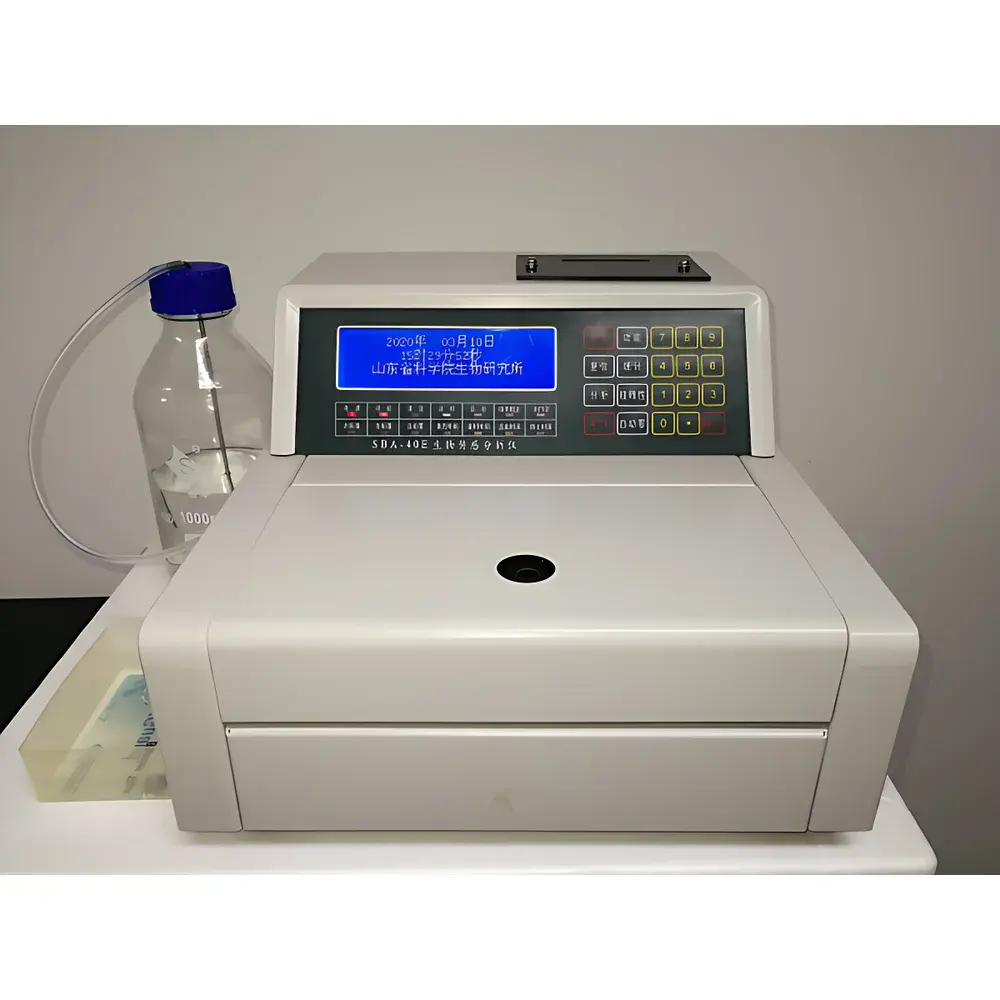
SBA-40E Dual-Analyte Biosensor Analyzer
| Origin | Shandong, China |
|---|---|
| Manufacturer Type | Authorized Distributor |
| Origin Category | Domestic (PRC) |
| Model | SBA-40E |
| Pricing | Available Upon Request |
Overview
The SBA-40E Dual-Analyte Biosensor Analyzer is an amperometric enzymatic biosensing platform engineered for rapid, simultaneous quantification of two biologically relevant analytes in a single 25 µL sample. Based on immobilized enzyme–electrode transduction architecture, the instrument employs dual working electrodes—each functionalized with a distinct, highly specific oxidase or dehydrogenase enzyme system (e.g., glucose oxidase, lactate oxidase, glutamate oxidase)—coupled with a shared reference/counter electrode configuration. Electrochemical detection occurs via measurement of hydrogen peroxide (H₂O₂) generated stoichiometrically during enzymatic oxidation, yielding linear current responses proportional to analyte concentration. This principle ensures high selectivity, minimal matrix interference, and robust performance across turbid, colored, or particulate-laden samples—including whole blood, fermentation broths, cell culture supernatants, and food extracts—without requiring centrifugation or filtration. Designed for routine laboratory and process monitoring environments, the SBA-40E delivers clinical- and industrial-grade reproducibility (±1–2% relative error) within a 20-second assay cycle, supporting real-time decision-making in bioprocess control, quality assurance, and biomedical research.
Key Features
- Simultaneous dual-analyte detection in ≤20 seconds per sample using a single 25 µL injection
- High specificity and selectivity: enzymatic recognition eliminates cross-reactivity from common interferents (e.g., ascorbic acid, uric acid, acetaminophen)
- Wide dynamic range: configurable for glucose (0–100 mg/dL), lactate (0–100 mg/dL), glutamate (0–100 mg/dL), lysine (0–100 mg/dL), ethanol (0–100 mg/dL), or blood lactate (0–100 mg/dL)
- Resolution: 0.1 mg/dL or 0.1 mM, traceable to NIST-traceable standard solutions
- Integrated automated fluidics: upgraded peristaltic pump system with ≥10× service life versus prior-generation models; fully programmable rinse, purge, and zero-calibration cycles
- Large backlit blue LCD display with intuitive Chinese-language menu interface and real-time on-screen prompts—no manual required for operation
- PC connectivity via RS-232 serial interface; Windows-compatible configuration software enables remote parameter setting, data export (CSV/proprietary binary), and internal memory management (read/delete)
Sample Compatibility & Compliance
The SBA-40E accepts liquid-phase samples without pretreatment across diverse matrices: microbial fermentation broths (e.g., Corynebacterium glutamicum, Saccharomyces cerevisiae), mammalian cell culture supernatants, serum, whole blood (anticoagulated), cerebrospinal fluid, fruit juices, hydrolysates, ion-exchange eluates, and detergent formulations. Its immunity to optical interference (turbidity, pigment content) eliminates reliance on spectrophotometric correction methods. While not FDA-cleared for IVD use, the system supports GLP-compliant workflows through audit-trail-capable data logging (timestamped measurements, calibration events, rinse logs) and meets ISO 17025-relevant requirements for analytical instrument validation when operated per manufacturer’s SOPs. All enzyme membranes are stored at 2–8 °C and retain activity for ≥6 months under refrigerated conditions.
Software & Data Management
Instrument firmware includes embedded data storage for ≥1,000 test records with full metadata (date/time, operator ID, sample ID, calibration status). The PC-side application provides secure configuration management—including electrode sensitivity calibration, rinse interval scheduling, unit conversion (mg/dL ↔ mM), and report template customization. Exported datasets include raw current values, calculated concentrations, and QC flags. Software supports integration into LIMS environments via delimited text import; no proprietary database runtime is required. Firmware updates are delivered via serial download and verified via CRC checksum.
Applications
- Biopharmaceutical fermentation: real-time monitoring of glucose and lactate in penicillin, cephalosporin, and natamycin production
- Food & flavor industry: glutamate quantification in monosodium glutamate (MSG) manufacturing and lysine analysis in fortified seasonings
- Biofuel process control: ethanol and glucose tracking during cellulose-to-ethanol saccharification and fermentation
- Clinical research labs: point-of-care–adjacent blood lactate and glucose profiling in metabolic studies and toxicology assays
- Animal nutrition R&D: lysine content verification in feedstock hydrolysates and cereal-based supplements
- Academic research: teaching laboratories in biochemistry, bioprocess engineering, and analytical biosensors
FAQ
What sample types are compatible with the SBA-40E?
Whole blood (EDTA/K₂-anticoagulated), serum, plasma, cerebrospinal fluid, fermentation broth, cell culture medium, fruit juice, enzymatic hydrolysates, and buffer-diluted extracts—all without centrifugation or clarification.
How often must enzyme membranes be replaced?
Typical membrane lifetime is 300–500 assays under continuous operation; replacement frequency depends on sample matrix complexity and daily throughput—recommended replacement after 2 weeks of active use or upon observed signal drift >5%.
Is the SBA-40E compliant with 21 CFR Part 11?
The instrument itself does not provide electronic signature or audit-trail features required for full Part 11 compliance; however, exported CSV data files may be incorporated into validated, Part 11–compliant LIMS or ELN systems.
Can the analyzer be calibrated with user-prepared standards?
Yes—calibration is performed using two-point (zero and span) input with certified reference materials; the system accepts custom standard concentrations entered directly via keypad or PC interface.
What maintenance is required beyond membrane replacement?
Monthly cleaning of the flow cell and electrode chamber with 0.1 M NaOH followed by deionized water rinse; quarterly inspection of peristaltic pump tubing tension and waste line integrity; annual verification of temperature sensor accuracy (15–35 °C operating range).
Related Products





