
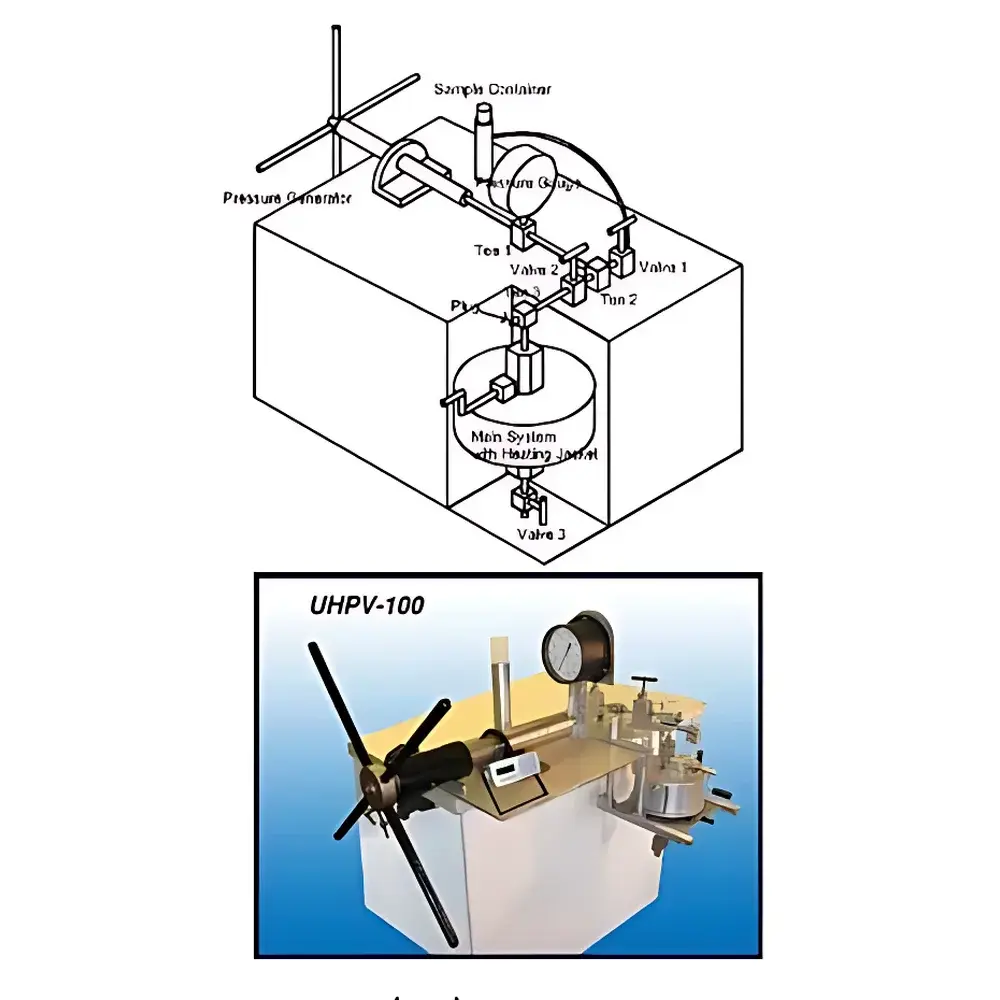
SBS UHPV-100 Ultra High Pressure Capillary Viscometer
| Brand | SBS |
|---|---|
| Origin | USA |
| Manufacturer Type | Authorized Distributor |
| Origin Category | Imported |
| Model | UHPV-100 |
| Price | Upon Request |
| Viscosity Range | 0.7–20,000 cP (mPa·s) |
| Pressure Range | Up to 60,000 psi |
| Temperature Range | −40 to +150 °C |
| Accuracy & Repeatability | < ±2% |
| Sample Volume | ~10 cm³ |
| Needle Material | Aluminum, Titanium, or Stainless Steel |
| Needle Density | 7 g/cm³ |
| Instrument Weight | 68.0 kg (150 lbs) |
| Dimensions (H×W×D) | 61 × 107 × 61 cm |
Overview
The SBS UHPV-100 Ultra High Pressure Capillary Viscometer is a precision-engineered instrument designed for the absolute measurement of dynamic viscosity under extreme thermobaric conditions. Unlike rotational or oscillatory rheometers, the UHPV-100 operates on the principle of falling-body viscometry—specifically, the terminal velocity method in a confined cylindrical geometry. A precisely machined, hemispherically tipped metal needle (with controlled density and surface finish) descends vertically through the test fluid under gravity within a pressure-rated cylindrical cell. At terminal velocity—achieved when gravitational, buoyant, and viscous drag forces reach equilibrium—the fluid’s dynamic viscosity is calculated directly from Stokes’ law extended for finite cylinder wall effects and non-Newtonian corrections where applicable. This first-principles approach eliminates reliance on calibration fluids or empirical correction factors, delivering traceable, SI-referenced viscosity data across pressures up to 60,000 psi and temperatures spanning −40 °C to +150 °C.
Key Features
- Integrated high-pressure generation system capable of sustained operation up to 60,000 psi without external hydraulic intensifiers
- Full-range temperature control via dual-zone Peltier and resistive heating modules, enabling stable thermal gradients and isothermal testing
- Microprocessor-based console with real-time data acquisition, RS-232 serial interface, and configurable trigger logic for automated start/stop
- Non-contact timing architecture using dual Hall-effect sensors and an embedded permanent magnet in the falling needle—achieving temporal resolution of 0.001 s
- Modular needle set (Al, Ti, SS) allowing density matching for low-viscosity or low-density fluids while maintaining Reynolds number validity
- Self-contained mechanical design with reinforced stainless-steel pressure vessel, ASME Section VIII Div. 2 certified containment, and integrated safety interlocks
- No factory calibration required: absolute viscosity derived from dimensional metrology (needle geometry), mass density, gravitational acceleration, and measured fall time
Sample Compatibility & Compliance
The UHPV-100 accommodates complex, multiphase, and shear-sensitive materials—including non-Newtonian suspensions, thermally labile biomaterials, and highly compressible hydrocarbon systems—without inducing artificial shear history or wall slip artifacts common in capillary or rotational geometries. Its 10 cm³ sample volume requirement supports statistically robust replicate measurements while minimizing material consumption for high-value formulations. The instrument complies with ASTM D1092 (Standard Test Method for Apparent Viscosity of Adhesives), ISO 2555 (Plastics — Resins in Liquid Form — Determination of Apparent Viscosity), and relevant sections of USP (Rheological Properties of Pharmaceutical Dosage Forms). All pressure and temperature transducers are NIST-traceable; audit trails, user access logs, and electronic signatures support 21 CFR Part 11 compliance when operated with validated software extensions.
Software & Data Management
The UHPV-100 console firmware supports raw timestamp export (CSV), real-time viscosity calculation (cP and Pa·s), and automatic temperature/pressure compensation per ISO 3104 Annex C. Optional PC-based software provides GLP-compliant reporting, batch metadata tagging (operator ID, lot number, environmental conditions), statistical process control (SPC) charting, and export to LIMS via ODBC. All measurement sessions include embedded digital signatures, immutable timestamps, and versioned firmware logs—enabling full traceability during GMP audits or regulatory submissions. Data integrity safeguards include write-once storage mode, cyclic redundancy checksums, and session-level encryption.
Applications
Validated use cases span upstream petroleum (heavy crude under reservoir conditions), aerospace lubricants at cryogenic startup, battery electrolyte formulations under compression, polymer melt rheology during injection molding simulation, and biopharmaceutical protein solutions under lyophilization-relevant stress states. Additional application domains include coal-water slurries for pipeline transport modeling, high-solids ceramic pastes for additive manufacturing, pressure-thickening surfactant systems, and deep-earth geothermal fluid analogs. The instrument serves R&D laboratories, quality control departments, and contract testing facilities requiring primary-standard-grade viscosity data under non-ambient conditions—where conventional viscometers fail due to seal extrusion, thermal drift, or pressure-induced phase separation.
FAQ
Does the UHPV-100 require periodic recalibration with reference oils?
No. As a primary-standard viscometer, it derives viscosity from fundamental physical constants and geometric parameters—not empirical calibration curves.
Can the system operate continuously at 60,000 psi and 150 °C?
Yes. The pressure vessel and thermal management subsystem are rated for indefinite static operation at maximum specified conditions, with redundant overpressure relief and thermal cutoffs.
Is needle wear or surface oxidation accounted for in measurement uncertainty?
Each needle undergoes pre- and post-run profilometry and density verification; deviations exceeding ±0.1% trigger replacement per SOP-VP-027.
What sample preparation steps are necessary before loading?
Degassing under vacuum is recommended for volatile or air-entrained samples; particulate filtration (≤5 µm) is required for slurries to prevent needle jamming.
How is compliance with ISO/IEC 17025 demonstrated for accredited labs?
SBS provides a full uncertainty budget (GUM-compliant), metrological traceability documentation, and on-site validation protocols aligned with ILAC-G8:2023.



