
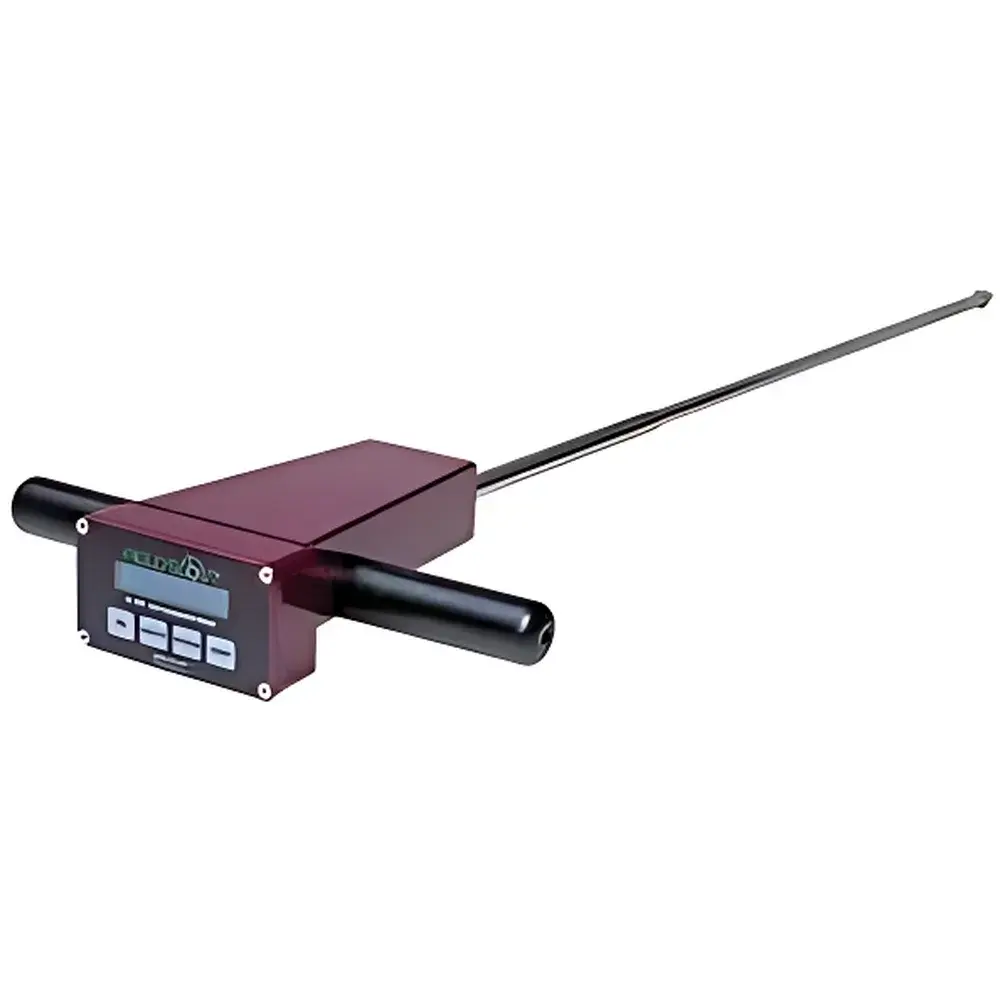
SC900 Field Soil Compaction Meter
| Origin | USA |
|---|---|
| Manufacturer Type | Authorized Distributor |
| Origin Category | Imported |
| Model | SC900 |
| Price | USD 3,500 (FOB) |
Overview
The SC900 Field Soil Compaction Meter is a handheld, field-deployable penetrometer engineered for quantitative assessment of soil mechanical resistance—commonly referred to as soil compaction or cone index. It operates on the principle of quasi-static cone penetration testing (CPT), where a standardized conical probe is driven vertically into undisturbed soil at controlled insertion speed. The instrument measures the axial force required per unit cross-sectional area of the cone tip, yielding real-time pressure values in either kPa or PSI. This metric directly correlates with root penetration resistance, water infiltration capacity, and gas diffusion rates—key physical indicators used in agronomic decision-making, conservation tillage planning, and precision agriculture workflows. Designed for repeated use across diverse soil textures—from sandy loam to clayey subsoils—the SC900 delivers field-validated data without requiring laboratory sample preparation or calibration drift correction between measurements.
Key Features
- Robust, weather-resistant housing rated IP65 for extended outdoor operation in rain, dust, and temperature fluctuations (–10 °C to +50 °C)
- ASAE S313.3-compliant conical probe with precisely machined 12.827 mm base diameter and 30° apex angle, ensuring repeatable contact geometry and minimal lateral soil displacement
- Real-time dual-unit display: selectable readout in kPa/cm or PSI/in, with auto-scaling resolution of 35 kPa (5 PSI) and depth increment of 2.5 cm
- Integrated audible over-speed alert triggered when insertion velocity exceeds 2 cm/s—preventing dynamic loading artifacts that compromise static compaction interpretation
- Onboard non-volatile memory stores up to 772 discrete depth-pressure pairs; capacity reduces to 579 entries when GPS metadata tagging is enabled
- Standard RS232 serial interface compliant with EIA/TIA-232-F specifications for direct connection to Windows-based data acquisition software
- Four AA alkaline batteries provide ≥12 months of typical field usage (based on 20 daily insertions), with low-battery indicator and voltage monitoring circuitry
Sample Compatibility & Compliance
The SC900 is validated for use in mineral soils with moisture content between 10% and 35% (gravimetric basis) and bulk density ranging from 1.1 to 1.7 g/cm³. It is not intended for saturated clays, gravel-rich horizons (>15% particles >2 mm), or frozen ground. Probe insertion depth is programmatically capped at 450 mm to maintain mechanical integrity and ensure consistent stress-state sampling within the plow layer and upper subsoil. All mechanical and electronic components conform to ASAE EP486.1 (Soil Penetrometer Performance Standards) and ISO 23785:2021 (Field measurement of soil mechanical impedance). Data logging routines support audit-ready timestamping and optional GPS georeferencing (NMEA 0183 v3.01 protocol), enabling compliance with USDA-NRCS Field Office Technical Guide (FOTG) Section IV requirements for spatial soil health documentation.
Software & Data Management
Data export occurs via ASCII-formatted text files (.txt) containing tab-delimited columns: UTC timestamp, latitude/longitude (WGS84), depth (cm), pressure (kPa), and probe speed flag. The included desktop application (Windows 10/11 compatible) enables visualization of vertical compaction profiles, statistical summary (mean, SD, CV%), and overlay with GIS shapefiles for zone-based management. Software supports FDA 21 CFR Part 11–compliant user authentication, electronic signature capture, and immutable audit trails for GLP/GMP-aligned soil monitoring programs. Raw data files are unencrypted and human-readable, facilitating third-party integration with platforms such as ArcGIS Pro, R (soilphysics package), or Farm Management Information Systems (FMIS).
Applications
- Identification of compacted layers (plow pans, traffic pans) affecting root growth and drainage in row-crop systems (corn, soybean, cotton)
- Evaluation of tillage efficacy pre- and post-operation to quantify depth-specific loosening effects
- Calibration of soil hydraulic property models (e.g., van Genuchten parameters) using empirical compaction–porosity relationships
- Long-term monitoring of soil structural recovery following cover cropping or reduced-traffic farming interventions
- Supporting NRCS Conservation Practice Standard Code 333 (Subsoil Tillage) and Code 345 (Critical Area Planting) implementation verification
- Academic research in soil physics, agroecology, and climate-smart agriculture field trials
FAQ
What is the maximum measurable compaction pressure, and how is it traceable to SI units?
The SC900 measures up to 7,000 kPa (1,000 PSI) with NIST-traceable factory calibration against dead-weight standards per ISO/IEC 17025-accredited procedures.
Can the instrument differentiate between biological and mechanical compaction?
No—compaction values reflect total mechanical resistance. Interpretation requires contextual soil survey data (texture, organic matter, structure) to infer origin.
Is the probe replaceable, and what is its certified service life?
Yes—the ASAE-certified probe is field-replaceable; recommended replacement after 5,000 insertions or visible wear on the cone surface.
Does the device meet requirements for USDA EQIP program reporting?
Yes—GPS-tagged datasets comply with NRCS CP-333 reporting templates when exported using the certified software module.
How does temperature affect measurement stability?
Internal temperature compensation corrects for piezoresistive sensor drift across the operational range; no user recalibration is required.
Related Products







