
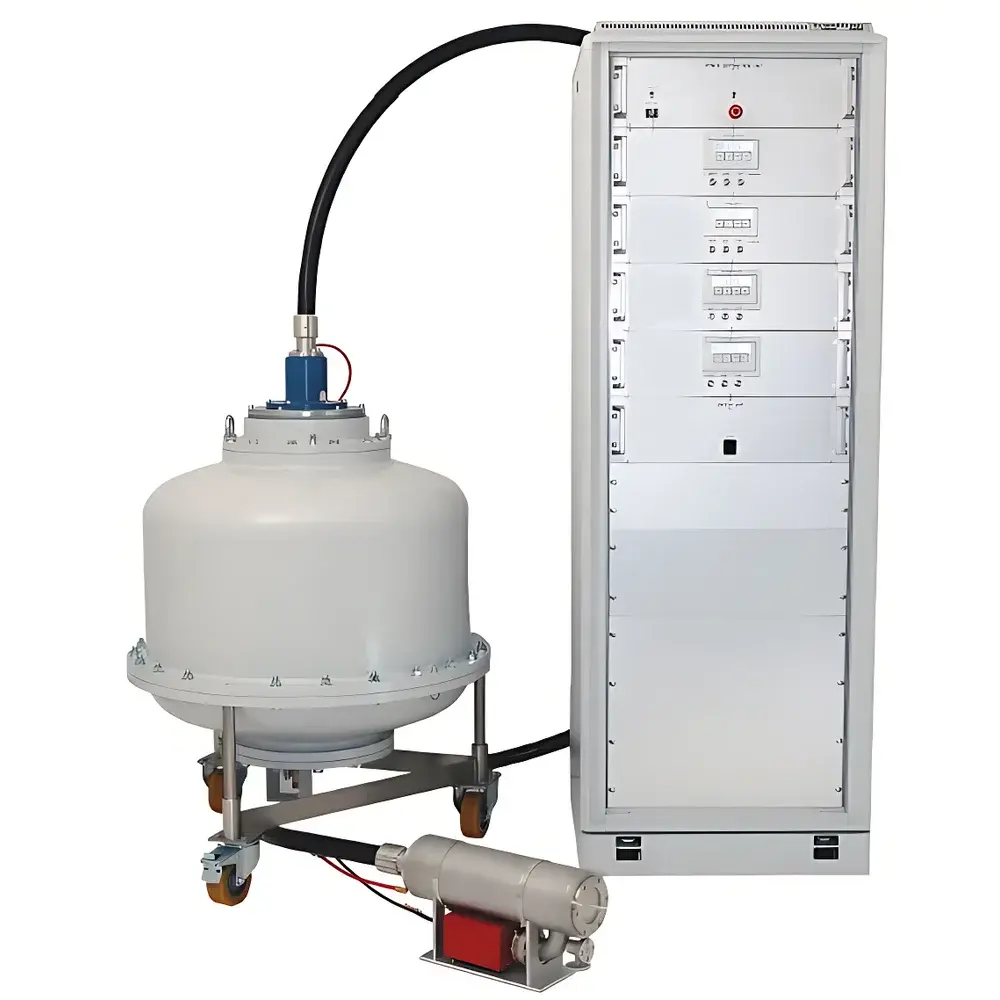
Scandiflash 450S Flash X-ray System
| Origin | Sweden |
|---|---|
| Distribution Model | Authorized Distributor |
| Origin Category | Imported |
| Model | 450S |
| Price Range | USD 13,500 – 27,000 (FOB) |
Overview
The Scandiflash 450S Flash X-ray System is a high-voltage, single-pulse radiographic imaging platform engineered for ultrafast, time-resolved internal inspection of dense or dynamically evolving objects. It operates on the principle of pulsed bremsstrahlung X-ray generation: a Marx-type impulse generator delivers a nanosecond-scale high-voltage pulse to a cold-cathode or thermionic X-ray tube, producing a sub-microsecond X-ray burst with peak energies up to 450 kV. This enables high-contrast, motion-free radiography of transient phenomena—such as explosive detonation fronts, projectile penetration, shockwave propagation, or fluid–structure interaction—in industrial R&D, defense testing, and academic shock physics laboratories. Unlike continuous or rotating anode X-ray sources, the 450S eliminates motion blur and thermal loading constraints, making it uniquely suited for single-event, high-reproducibility imaging under controlled experimental conditions.
Key Features
- Modular Marx generator architecture with scalable high-voltage modules; 450S configuration delivers adjustable output from 75 kV to 450 kV via regulated capacitor charging voltage and pressurized SF₆/dry air dielectric control.
- Low-inductance coaxial capacitor stack design ensures sub-50 ns pulse rise time (<30 ns typical), critical for temporal resolution in dynamic radiography.
- Integrated system monitoring unit samples six diagnostic points per channel—including trigger input, capacitor voltage, spark gap conduction, and output current—to enable real-time fault detection and post-pulse diagnostics.
- FXRC-4 control interface supports both short-circuit triggering (−12 V DC bias, <0.5 µs rise time) and external TTL-compatible pulse triggering (±5–50 V, −9 to +9 V offset range).
- Time-interval measurement resolution of 0.05 µs between trigger input and X-ray pulse output, displayed and logged in real time via laptop interface.
- Gas pressure regulation system with electro-pneumatic valves and digital pressure sensors; dry air or SF₆ pressure automatically optimized by software for given charging voltage and ambient temperature.
- Ion pump power supply integrated for X-ray tube vacuum maintenance; dual-tube configurations include redundant ion pump drivers; 1200 kV variants employ Pirani gauge-based vacuum monitoring.
Sample Compatibility & Compliance
The 450S accommodates objects ranging from small metallic components (e.g., munition casings, turbine blades) to large-scale test assemblies (up to 1.5 m source-to-detector distance). Its high-energy photon spectrum (effective mean energy ~180–220 keV at 450 kV) penetrates steel up to 85 mm or aluminum up to 320 mm, depending on geometry and detector sensitivity. The system complies with IEC 61000-4-2 (ESD immunity), IEC 61000-4-3 (radiated RF immunity), and meets EN 55032 Class B emission limits for industrial environments. All high-voltage enclosures are grounded, pressurized metal vessels providing <10 µV/m RF emission at 10 m (measured per CISPR 16-2-3), ensuring electromagnetic compatibility in multi-instrument test facilities. Safety interlocks conform to ISO 13857 and IEC 61511 for functional safety in radiographic hazard zones.
Software & Data Management
Control and diagnostics are executed via Windows-based ScandiControl™ software running on a standard laptop or desktop PC. Communication occurs over Ethernet (≤50 m) or fiber-optic link (>50 m) to the SU-8 8-channel network switch unit. The software provides full parameter scripting—including voltage ramping profiles, delay timing (0–999.999 ms resolution), gas pressure setpoints, and trigger mode selection—and maintains audit-trail logs compliant with GLP and FDA 21 CFR Part 11 requirements when configured with electronic signatures and user access levels. All operational parameters (capacitor voltage, gas pressure, ion pump current, trigger latency) are timestamped and exportable in CSV/ASCII format. Firmware updates and calibration constants are digitally signed and version-controlled. No cloud dependency: all data remains local and encrypted at rest.
Applications
- Ballistic impact analysis: simultaneous dual-tube synchronization enables stereo radiography of projectile deformation at velocities exceeding 1 km/s.
- Explosive initiation studies: sub-microsecond temporal resolution captures detonation wavefront geometry and velocity gradients in confined charges.
- High-speed fluid dynamics: visualization of cavitation collapse, jet breakup, or multiphase flow in transparent or opaque containment vessels.
- Non-destructive evaluation (NDE) of additively manufactured parts: detection of internal porosity, unmelted powder, or layer delamination in Ti-6Al-4V or Inconel structures.
- Shock physics validation: benchmarking hydrocode simulations against experimentally resolved density discontinuities in flyer-plate experiments.
FAQ
What is the minimum detectable feature size under standard imaging conditions?
Feature resolution depends on focal spot size (typically 1.5–2.5 mm for 450S tubes), source-to-object distance (SOD), and detector pixel pitch. With SOD = 0.5 m and a 100 µm pixel scintillator-coupled CMOS detector, spatial resolution is ~0.3–0.5 mm FWHM.
Can multiple 450S channels be triggered with precise inter-channel timing?
Yes. The FXRC-4 controller supports programmable inter-channel delays down to 10 ns resolution using synchronized clock distribution. Dual-tube systems achieve <20 ns jitter between exposures.
Is the system compatible with modern digital X-ray detectors (e.g., flat-panel or scientific CMOS)?
Yes. The system outputs a TTL-compatible X-ray pulse sync signal (5 V, 50 Ω) with <1 ns jitter, enabling hardware-triggered acquisition on commercial and custom detectors.
How often does the high-voltage capacitor bank require recalibration?
Capacitor voltage calibration is traceable to NIST standards and validated annually during preventive maintenance; field verification is performed via built-in HV divider diagnostics before each test campaign.
Does Scandiflash provide installation support and radiation safety commissioning documentation?
Yes. Comprehensive site survey reports, shielding calculations (per NCRP Report No. 148), and operator training packages—including ALARA protocols and emergency response procedures—are included with delivery.






