
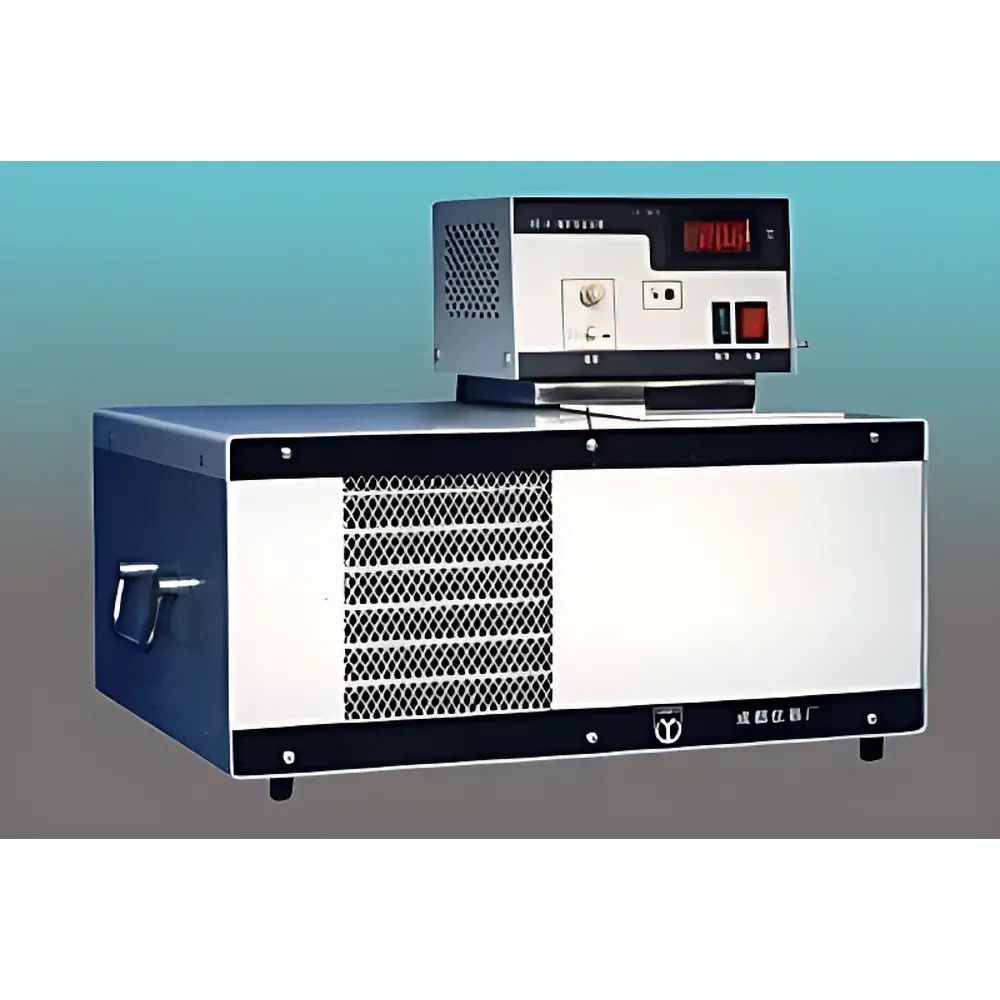
SCChengyi HS-4 Precision Refrigerated/Heating Circulating Bath
| Brand | SCChengyi |
|---|---|
| Origin | Sichuan, China |
| Model | HS-4 |
| Temperature Range | -15 to +95 °C |
| Temperature Stability | ±0.02 °C |
| Heating Power | 1 kW |
| Cooling Capacity | Integrated refrigeration system |
| Bath Volume | 7 L |
| Opening Dimensions | 148 × 149 mm |
| External Dimensions | 540 × 400 × 400 mm |
| Pump Flow Rate | 6 L/min |
| Internal/External Circulation | Yes |
| Weight | 36 kg |
| Power Supply | 220 V, 50–60 Hz |
Overview
The SCChengyi HS-4 Precision Refrigerated/Heating Circulating Bath is an engineered thermal management system designed for laboratory-scale temperature control of external devices and sample environments. Operating on a dual-mode thermoelectric and compressor-assisted refrigeration architecture combined with resistive heating elements, the HS-4 maintains precise setpoint temperatures across a broad operational range—from sub-zero cooling at –15 °C to high-stability heating up to +95 °C. Its closed-loop circulation capability supports both internal bath homogenization and external heat exchange via integrated pump-driven fluid delivery (6 L/min), enabling consistent thermal coupling with analytical instruments such as viscometers, spectrophotometers, calorimeters, and reaction modules. The unit’s ±0.02 °C temperature stability—validated under steady-state conditions per ISO 17025 traceable calibration protocols—meets the stringent repeatability requirements of QC laboratories conducting ASTM D2857 (viscosity), USP (aseptic processing support), or ISO 8573-1 (compressed air testing) thermal conditioning steps.
Key Features
- Integrated dual-mode thermal regulation: Compressor-based refrigeration paired with 1 kW resistive heating ensures rapid ramp rates and tight setpoint adherence across the full –15 to +95 °C range.
- High-stability PID control algorithm with adaptive tuning, minimizing overshoot and drift during extended operation (>24 h).
- Dual-circulation architecture: Independent internal recirculation maintains uniform bath temperature distribution; external porting enables connection to jacketed reactors, condensers, or sensor calibration fixtures.
- Stainless steel bath chamber (7 L capacity) with corrosion-resistant interior finish, compatible with water, ethanol/water mixtures, silicone oils, and low-viscosity heat transfer fluids.
- Front-panel digital interface with real-time display of setpoint, actual bath temperature, pump status, and system fault codes; configurable alarm thresholds for overtemperature, low-level, and flow interruption.
- Robust mechanical construction: Powder-coated steel chassis, vibration-damped mounting, and IP20-rated electrical enclosure compliant with IEC 61010-1 safety standards for laboratory equipment.
Sample Compatibility & Compliance
The HS-4 accommodates standard laboratory glassware (e.g., 100–1000 mL beakers, flasks, and immersion probes) within its 148 × 149 mm opening. Its temperature uniformity profile (±0.05 °C across central 50 mm zone, measured per ASTM E1137) supports applications requiring spatial thermal consistency. The unit conforms to CE marking requirements under the EU Machinery Directive 2006/42/EC and Low Voltage Directive 2014/35/EU. For regulated environments, its programmable logging function (via optional RS485/Modbus interface) supports 21 CFR Part 11-compliant data integrity when integrated with validated LIMS or ELN platforms. It is routinely deployed in GLP-compliant stability chambers, pharmaceutical dissolution apparatus baths (USP Apparatus I & II), and materials testing labs adhering to ISO 554 and ASTM E645 environmental conditioning standards.
Software & Data Management
While the HS-4 operates autonomously via its embedded controller, optional communication modules enable remote monitoring and parameter adjustment through industry-standard protocols. An RS485 interface supports Modbus RTU integration for centralized HVAC or lab automation systems (e.g., Siemens Desigo, Honeywell Experion). With third-party SCADA or LabVIEW drivers, users can log timestamped temperature and pump status data at user-defined intervals (1–60 s resolution), generating CSV-compatible audit trails. Firmware updates are performed via USB port using signed binary packages, ensuring firmware integrity and version traceability—a prerequisite for GMP process validation documentation.
Applications
- Thermal calibration of temperature-sensitive sensors (RTDs, thermistors, infrared detectors) against NIST-traceable references.
- Temperature-controlled enzymatic assays and cell culture incubation support where ambient fluctuations must be suppressed below ±0.1 °C.
- Cooling/heating of HPLC column ovens, GC injectors, and FTIR sampling accessories to minimize baseline drift and peak broadening.
- Accelerated stability testing per ICH Q1A(R3), including low-humidity thermal stress cycles when coupled with desiccant dry air manifolds.
- Viscometer temperature control per ASTM D445, where bath uniformity directly impacts kinematic viscosity reproducibility.
- Reaction calorimetry pre-conditioning of reagents and solvents prior to exothermic mixing in jacketed reactors.
FAQ
What fluids are compatible with the HS-4 bath chamber?
Deionized water, 30–50% aqueous ethylene glycol solutions, and silicone oils with flash points above 120 °C are approved. Avoid halogenated solvents, strong acids/bases, or fluids with vapor pressures exceeding 15 kPa at 95 °C.
Does the HS-4 support external temperature feedback control?
Yes—via optional PT100 input port, enabling cascade control where the bath regulates based on a probe placed in the external device rather than the bath fluid itself.
Is the unit suitable for continuous 24/7 operation in a certified cleanroom?
It meets ISO Class 8 particulate limits when operated with HEPA-filtered intake air and installed with vibration isolation mounts; however, its non-hermetic enclosure requires placement outside ISO Class 7 or stricter zones.
Can the pump flow rate be adjusted?
Flow is fixed at 6 L/min nominal; variable-speed pumping is not supported, but inline needle valves may be added to external loops for fine pressure regulation.
What maintenance intervals are recommended?
Biannual inspection of refrigerant charge, annual replacement of bath fluid (if used >6 months), and quarterly verification of temperature sensor accuracy using a calibrated reference thermometer per ISO/IEC 17025 procedures.



