
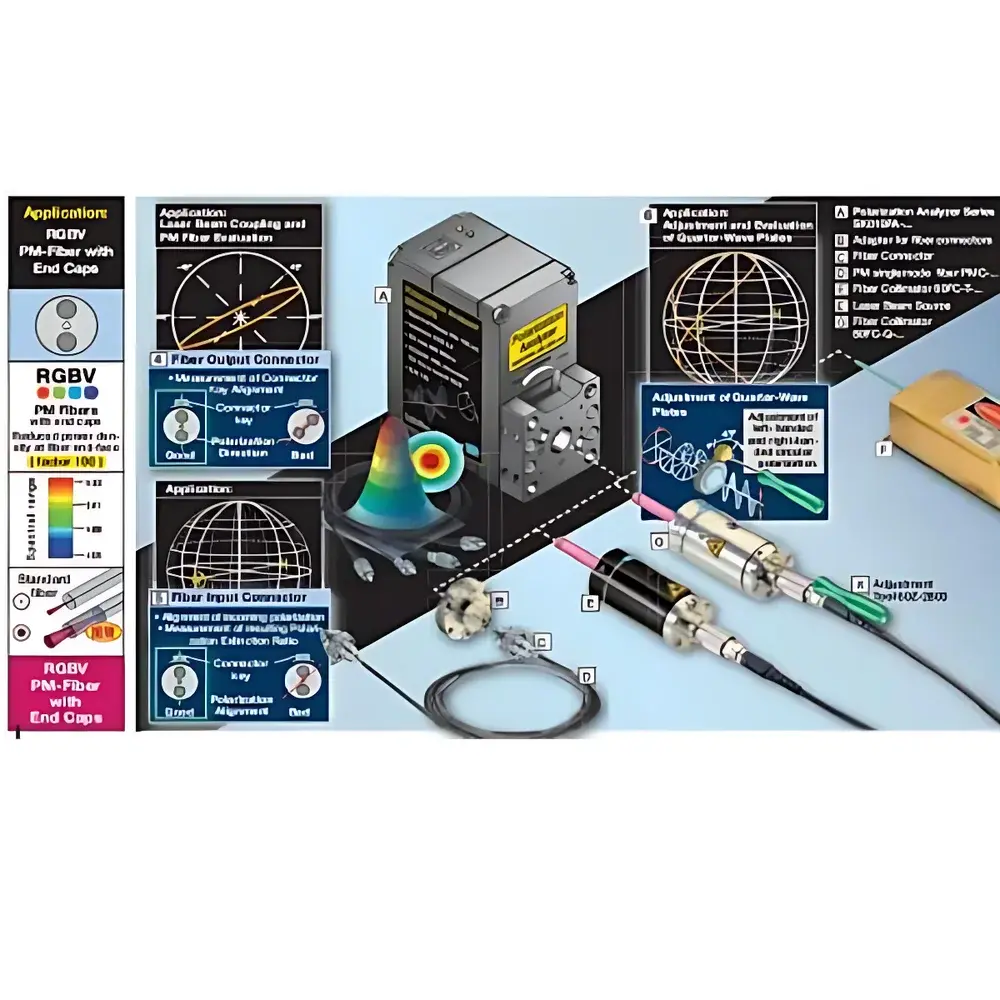
Schafter + Kirchhoff SK010PA Polarization Analyzer
| Brand | Schafter + Kirchhoff |
|---|---|
| Origin | Germany |
| Model | SK010PA |
| Interface | USB 2.0 (powered via USB) |
| Output | Real-time Stokes parameters (S₀–S₃), Degree of Polarization (DOP), Ellipticity, Azimuth |
| Display | Interactive Poincaré sphere visualization |
| Compliance | CE-marked, RoHS-compliant |
| Optical Input | Free-space beam or polarization-maintaining (PM) fiber-coupled sources |
| Calibration | Factory-calibrated with NIST-traceable reference standards |
Overview
The Schafter + Kirchhoff SK010PA Polarization Analyzer is a precision optical measurement instrument engineered for quantitative characterization of polarized light states in both free-space and polarization-maintaining (PM) fiber-coupled configurations. Based on the Mueller matrix formalism and calibrated Stokes vector decomposition, the SK010PA determines all four Stokes parameters (S₀, S₁, S₂, S₃) in real time, enabling full reconstruction of the incident polarization state—including degree of polarization (DOP), ellipticity angle, azimuth angle, and handedness. Its optical architecture integrates a motorized rotating waveplate, fixed polarizer, and low-noise silicon photodetector optimized for visible to near-infrared wavelengths (400–1100 nm). Designed for integration into R&D laboratories, laser system validation workflows, and fiber-optic component testing environments, the analyzer operates without external power supplies—drawing full functionality from its USB 2.0 interface.
Key Features
- Real-time acquisition of full Stokes vector (S₀–S₃) at up to 10 Hz update rate, with <0.5% relative uncertainty in DOP under stable illumination conditions
- Plug-and-play operation via USB 2.0 interface; no external power adapter or driver installation required beyond standard Windows HID class support
- Interactive Poincaré sphere display with dynamic trajectory plotting, enabling visual tracking of polarization drift, modulation, or instability over time
- Native compatibility with PM fiber inputs (FC/PC or FC/APC connectors) and free-space collimated beams (Ø ≤ 8 mm, divergence < 1.5 mrad)
- Factory calibration traceable to NIST-reference polarized sources; user-accessible recalibration routine supported through included software suite
- Rugged aluminum housing (120 × 80 × 35 mm) with thermal stabilization design ensuring <±0.02 rad/°C sensitivity drift across 15–35 °C ambient range
Sample Compatibility & Compliance
The SK010PA supports measurement of continuous-wave (CW) and quasi-CW laser sources, superluminescent diodes (SLDs), and filtered broadband lamps—provided spectral bandwidth remains ≤ 50 nm FWHM and average power does not exceed 5 mW at the detector plane. It is compatible with standard PM fibers (e.g., Panda, Bow-tie types) meeting IEC 61300-2-40 mechanical reliability specifications. The device conforms to EU Directive 2014/30/EU (EMC), 2011/65/EU (RoHS), and carries CE marking for use in laboratory and industrial settings. While not certified for clinical or GMP-regulated production environments, its measurement repeatability (<0.005 unit RMS in S₁/S₂/S₃ over 8-hour sessions) meets typical requirements for ISO/IEC 17025-accredited optical test labs performing method validation per ISO 11146-1 (laser beam parameters) and IEC 61290-10 (fiber amplifier polarization analysis).
Software & Data Management
The bundled SK-PolControl software (v3.2+, Windows 10/11 64-bit) provides a deterministic API for automated data logging, batch processing, and script-driven control via Python (COM interface) or LabVIEW (DLL wrapper). All raw Stokes data are stored in HDF5 format with embedded metadata—including timestamp (UTC), instrument serial number, calibration epoch, and environmental sensor readings (onboard temperature/humidity). Audit trails record every parameter change, calibration event, or export action—supporting GLP-aligned documentation practices. Export options include CSV (for Excel or MATLAB import), SVG (vector Poincaré plots), and XML (for integration into LIMS or MES platforms). Software updates are delivered via secure HTTPS channel with SHA-256 signature verification.
Applications
- Characterization of polarization-dependent loss (PDL) and polarization mode dispersion (PMD) in passive fiber components (isolators, circulators, WDM couplers)
- Verification of polarization extinction ratio (PER) in PM fiber pigtails and free-space polarization optics (waveplates, Glan-Taylor prisms)
- Monitoring polarization stability in ultrafast oscillator cavities and frequency-doubled laser systems
- Quantitative assessment of stress-induced birefringence in optical coatings, lenses, and fused silica substrates
- Teaching and demonstration of polarization optics fundamentals—including Malus’ law, Jones calculus, and Mueller matrix inversion
- Supporting development of polarization-encoded quantum communication hardware requiring sub-degree azimuth resolution
FAQ
Does the SK010PA support pulsed laser sources?
Yes—provided pulse repetition rates exceed 10 kHz and average power remains within the 5 mW limit. Single-shot polarization analysis is not supported due to its sequential waveplate rotation methodology.
Can it measure depolarized light accurately?
Yes—the instrument calculates degree of polarization (DOP = √(S₁²+S₂²+S₃²)/S₀) with validated accuracy down to DOP = 0.05, making it suitable for characterizing partially polarized sources such as LEDs or multimode VCSELs.
Is fiber alignment required before measurement?
For PM fiber inputs, rotational alignment of the slow/fast axis relative to the analyzer’s internal coordinate frame is required once during initial setup using the software’s guided alignment assistant; subsequent measurements retain this reference.
What is the minimum measurable power level?
The noise-equivalent power is 10 nW (at 633 nm, 10 Hz bandwidth), corresponding to a minimum detectable S₀ of ~0.002 arbitrary units in normalized Stokes space.
Does the device comply with FDA 21 CFR Part 11 for electronic records?
No—the SK010PA and its software are not validated for regulated pharmaceutical or medical device manufacturing; however, audit trail and export features may be leveraged in internally governed QA workflows where Part 11 compliance is not mandated by external regulators.




