
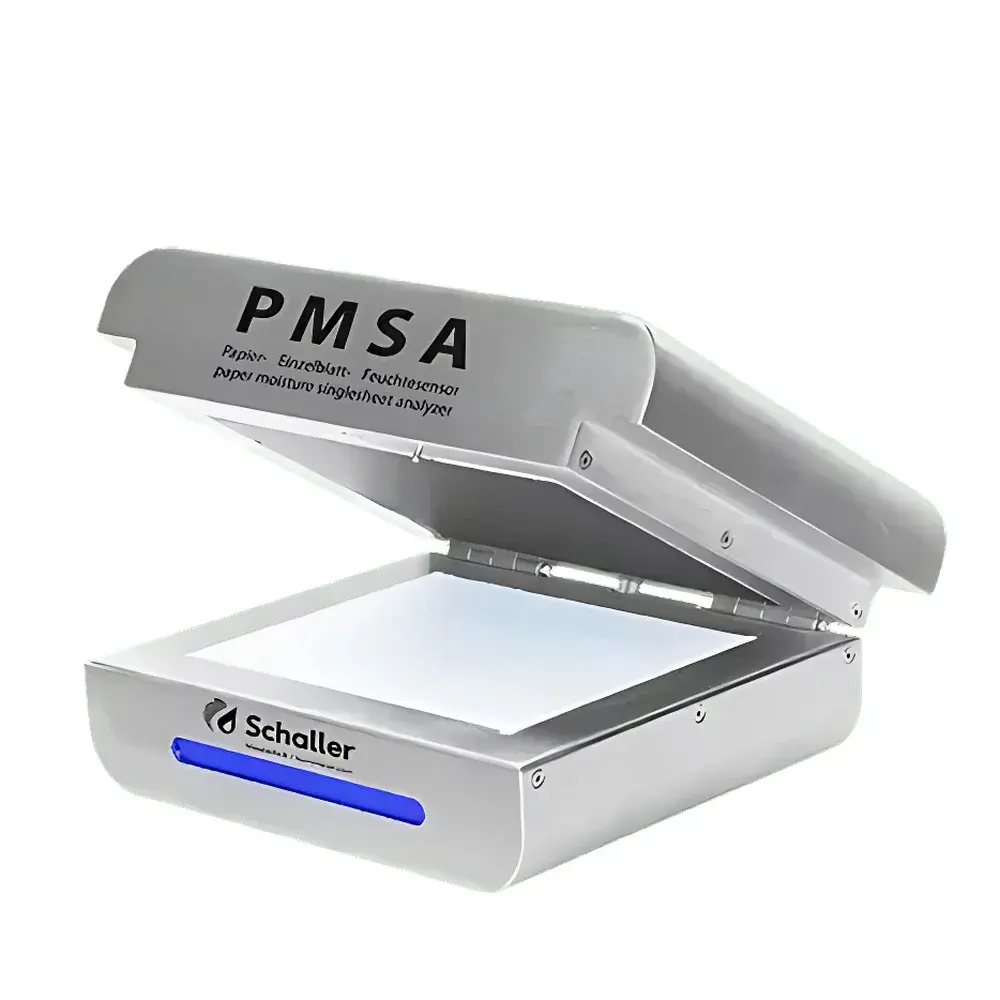
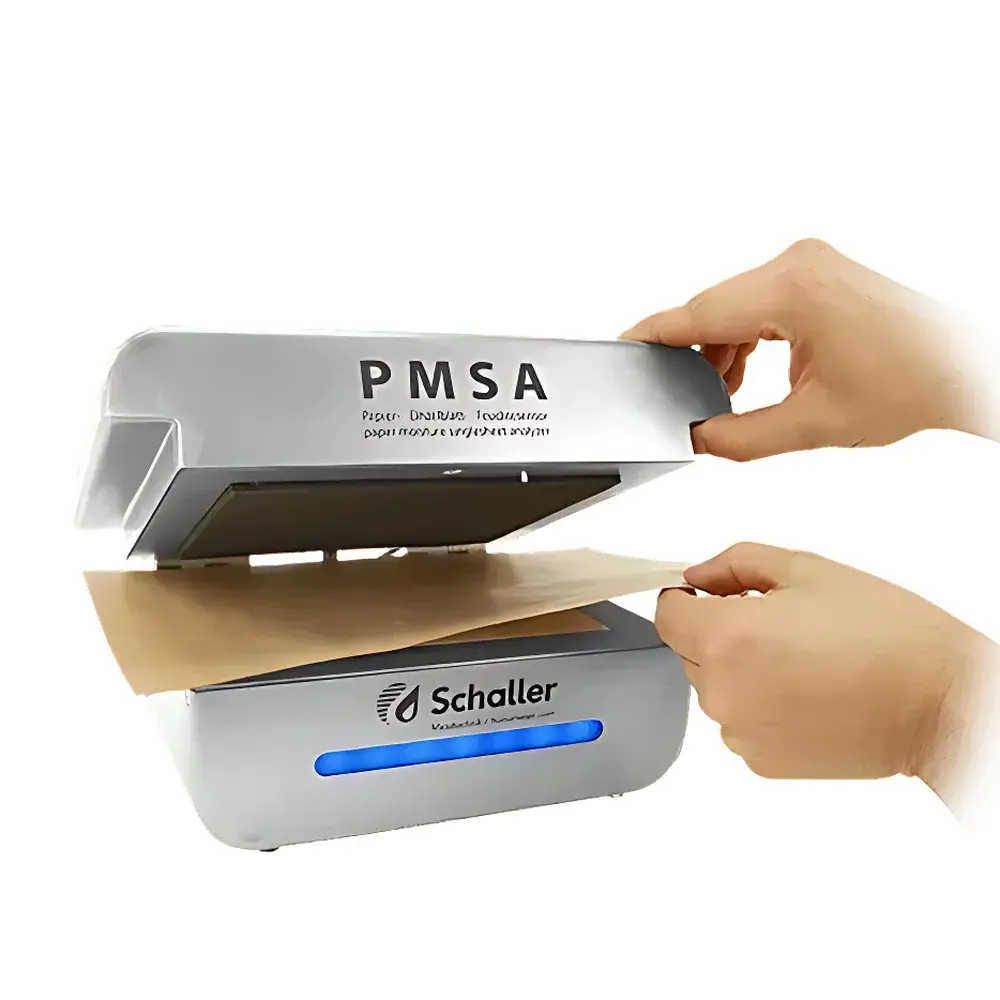
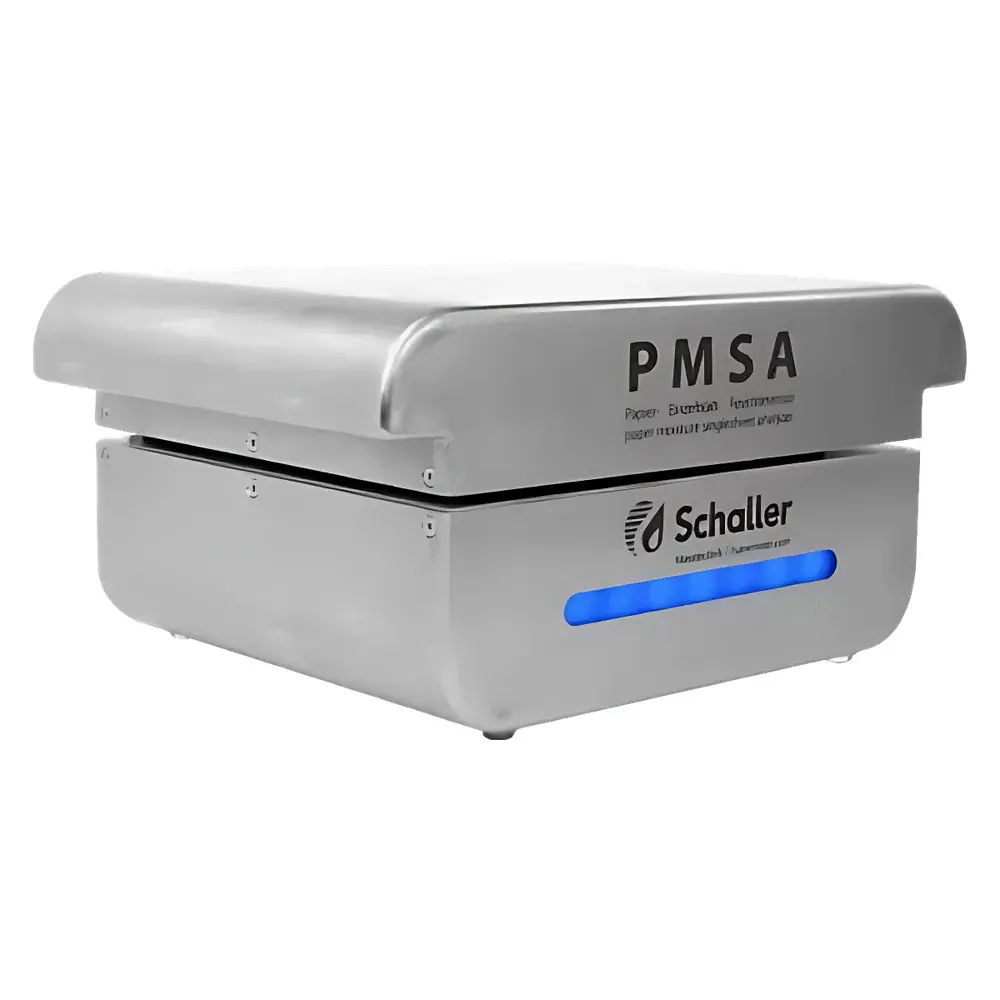
Schaller PMSA Paper Moisture Analyzer
| Brand | Schaller |
|---|---|
| Origin | Austria |
| Model | PMSA |
| Measurement Principle | Capacitive Dielectric Sensing with Integrated IR Temperature Compensation |
| Measurement Range | 1–20% w/w (moisture content, dry basis) |
| Basis Weight Range | 30–800 g/m² |
| Maximum Paper Thickness | 0.8 mm (custom options available) |
| Minimum Sample Size | 180 × 180 mm |
| Operating Temperature | 10–40 °C |
| Dimensions | 274 × 202 × 128 mm |
| Weight | 4.7 kg |
| Power Supply | 5 V DC via USB |
| Interface | USB Mini-B |
| Calibration | Automatic Pre-Measurement Sensor Self-Calibration |
| Software | Windows-based PC application for data visualization, multi-grade calibration, statistical reporting, and audit-ready export |
Overview
The Schaller PMSA Paper Moisture Analyzer is a laboratory-grade, non-destructive instrument engineered for rapid, traceable determination of absolute moisture content in single sheets of paper and board. Unlike gravimetric oven-drying methods (e.g., ISO 287, TAPPI T412), which require thermal drying, sample mass loss calculation, and 60+ minutes per test, the PMSA employs high-stability capacitive dielectric sensing—calibrated against reference standards—to quantify water concentration in seconds. The sensor measures changes in relative permittivity induced by bound and free water molecules within the cellulose matrix, while an integrated infrared pyrometer simultaneously records surface temperature to enable real-time dielectric compensation. This dual-sensor architecture ensures metrological integrity across varying ambient conditions and paper grades, supporting both R&D validation and routine QC workflows in pulp & paper mills, converting facilities, and certification laboratories.
Key Features
- Non-contact, non-destructive measurement: Preserves sample integrity for downstream testing or archival purposes.
- Capacitive dielectric sensing with automatic pre-measurement self-calibration—eliminates drift-related uncertainty and reduces operator dependency.
- Integrated IR temperature sensor (±0.5 °C accuracy) for dynamic dielectric compensation—critical for reproducibility across seasonal humidity and machine-room thermal gradients.
- Factory-traceable calibration using NIST-traceable reference materials; supports user-defined calibration curves for up to 20 paper grades (e.g., kraft linerboard, coated offset, tissue, filter paper).
- Rugged aluminum housing and thermally stabilized sensor head ensure long-term stability under continuous lab or production-floor operation.
- USB-powered operation (5 V DC) eliminates external power supplies—ideal for mobile lab carts or cleanroom-integrated setups.
Sample Compatibility & Compliance
The PMSA accommodates all commercially relevant paper types—including uncoated and coated freesheet, mechanical, recycled, specialty barrier, and packaging grades—within defined physical limits: basis weight (30–800 g/m²), thickness (≤0.8 mm standard; extended range available on request), and minimum planar dimension (180 × 180 mm). Its measurement protocol aligns with the fundamental principles of ISO 287 (paper moisture—determination by oven-drying) and ASTM D644 (standard test methods for moisture in paper and paperboard), though it delivers results without thermal alteration. Data output meets GLP/GMP documentation requirements: software timestamps every measurement, logs operator ID, calibration status, environmental temperature, and raw sensor values. Audit trails comply with FDA 21 CFR Part 11 when configured with user authentication and electronic signature modules.
Software & Data Management
The included Windows-compatible software provides a validated, intuitive interface for instrument control, calibration management, and statistical analysis. Users can define custom sample batches, assign project IDs, and generate PDF/CSV reports compliant with internal QA templates or external accreditation bodies (e.g., ISO/IEC 17025). Real-time graphs display moisture distribution across multiple measurements; trend analysis tools support SPC charting (X̄-R, Cpk) for process capability assessment. All raw data—including capacitance readings, IR temperature, and calculated %MC—are stored in encrypted SQLite databases with configurable backup intervals and role-based access permissions. Export functions support LIMS integration via ODBC drivers and HL7-compliant metadata tagging.
Applications
- On-line quality assurance: Rapid verification of moisture uniformity after calendering, coating, or drying sections—enabling immediate feedback loops for dryer control optimization.
- Raw material incoming inspection: Screening of pulp bales, recycled fiber lots, or imported reels against contractual moisture specifications (e.g., ≤8.5% for newsprint).
- Product release testing: Final QC sign-off prior to shipping—reducing reliance on destructive oven tests and accelerating throughput.
- Process development: Correlating moisture profiles with tensile strength, stiffness, and printability metrics during grade transitions or formulation trials.
- Regulatory compliance: Generating auditable moisture records for FSC®, PEFC™, or ISO 14001 environmental management system documentation.
FAQ
Is the PMSA suitable for measuring moisture in corrugated board or multi-ply laminates?
Yes—provided total thickness remains within specification and layers are tightly bonded. For composite structures with air gaps or foil barriers, empirical calibration against oven-dry reference is recommended.
Does the instrument require periodic recalibration by the manufacturer?
No. The built-in self-calibration routine maintains traceability between factory certifications. Annual verification against certified reference standards (e.g., Schaller SRM-Paper-01) is advised for ISO/IEC 17025 compliance.
Can the software be deployed on virtual machines or thin-client environments?
The application supports Windows 10/11 x64 in VMware Workstation and Microsoft Hyper-V environments, provided USB passthrough is enabled and driver signing policies are configured per enterprise IT policy.
What is the measurement uncertainty under typical lab conditions?
At 23 °C and 50% RH, expanded uncertainty (k=2) is ±0.25% MC for papers within 50–150 g/m² and 0.1–0.4 mm thickness, as verified per ISO/IEC 17025-accredited procedures.
How does the PMSA handle static charge interference common in high-speed converting lines?
The sensor electronics incorporate active electrostatic discharge (ESD) suppression and RF filtering—validated to IEC 61340-5-1—and include grounding clips for direct connection to plant earth potential.
Related Products




