Schaller RH2 Water Activity Analyzer
| Brand | Schaller |
|---|---|
| Origin | Austria |
| Model | RH2 |
| Water Activity Range | 0.03–0.99 aw |
| Resolution | 0.001 aw |
| Calibration Accuracy | ±0.01 aw (at 0.10–0.80 aw) |
| Temperature Range | Not specified (sensor-dependent) |
| Relative Humidity Range | Sensor-dependent |
| RH Resolution | 0.1 %RH |
| Temperature Resolution | 0.1 °C |
| Dew Point Range | −55 to +60 °C |
| Absolute Humidity Range | 0–130 g/m³ |
| Absolute Humidity Resolution | 0.1 g/m³ |
| Equilibrium Moisture Content (Wood) | 2–30 %, 0.1 % resolution |
| Equilibrium Moisture Content (Granules) | 0.1 % resolution |
| Data Storage Capacity | 10,000 measurements |
| Dimensions | 145 × 75 × 30 mm |
| Weight | 210 g (with batteries) |
| Power Supply | 4 × 1.5 V AA alkaline batteries |
| Display Languages | English, German, French, Spanish, Portuguese, Italian, Russian, Czech, Polish |
| Compliance | EN ISO 21807 |
Overview
The Schaller RH2 Water Activity Analyzer is a precision portable instrument engineered for rapid, reliable determination of water activity (aw) in food, pharmaceutical, and material science applications. Based on the fundamental thermodynamic principle that water activity equals the ratio of the vapor pressure of water in a sample to the vapor pressure of pure water at the same temperature, the RH2 employs high-stability capacitive humidity and integrated temperature sensors within a sealed measurement chamber or sample cup to quantify equilibrium relative humidity (ERH) — from which aw is directly derived (aw = ERH/100). Designed and manufactured in Austria, the RH2 adheres to the metrological requirements of EN ISO 21807, ensuring traceable, repeatable results essential for shelf-life prediction, microbial risk assessment, and formulation stability studies.
Key Features
- High-resolution aw measurement across full range (0.03–0.99 aw) with 0.001 aw resolution and ±0.01 aw calibration accuracy between 0.10–0.80 aw
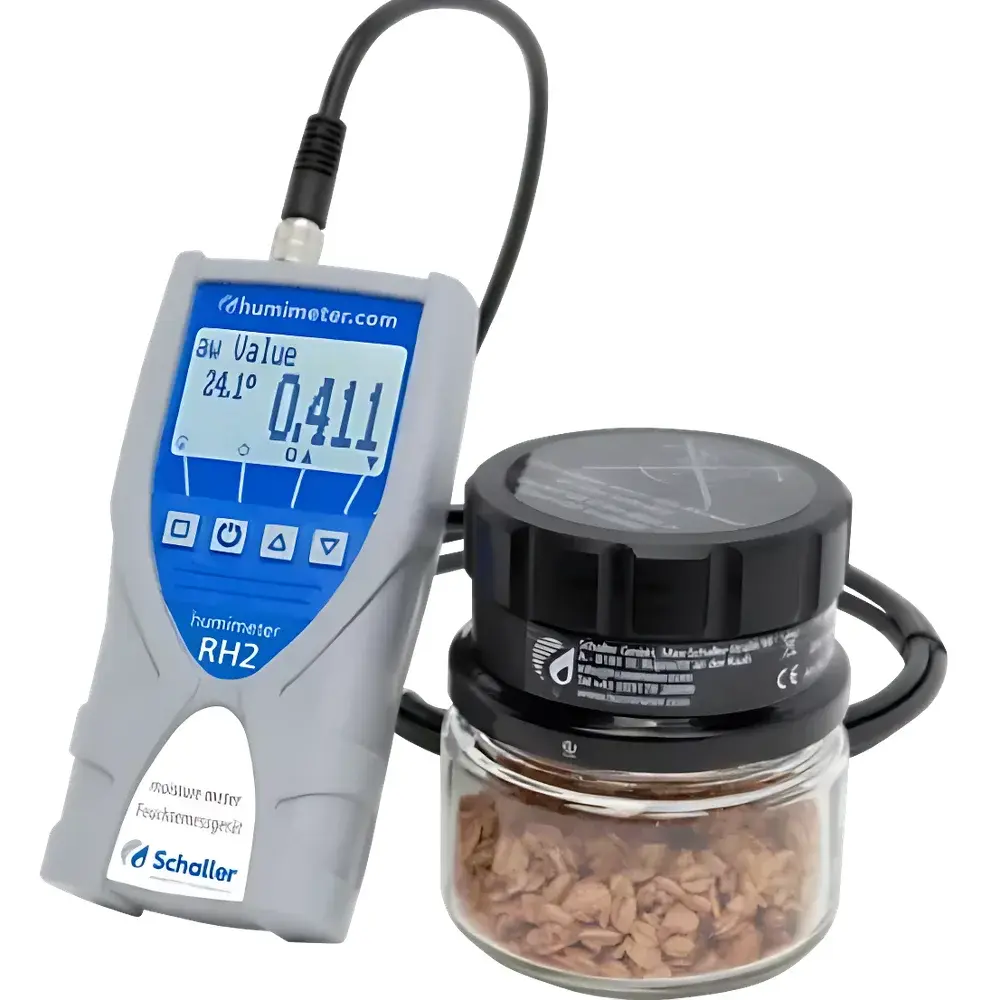
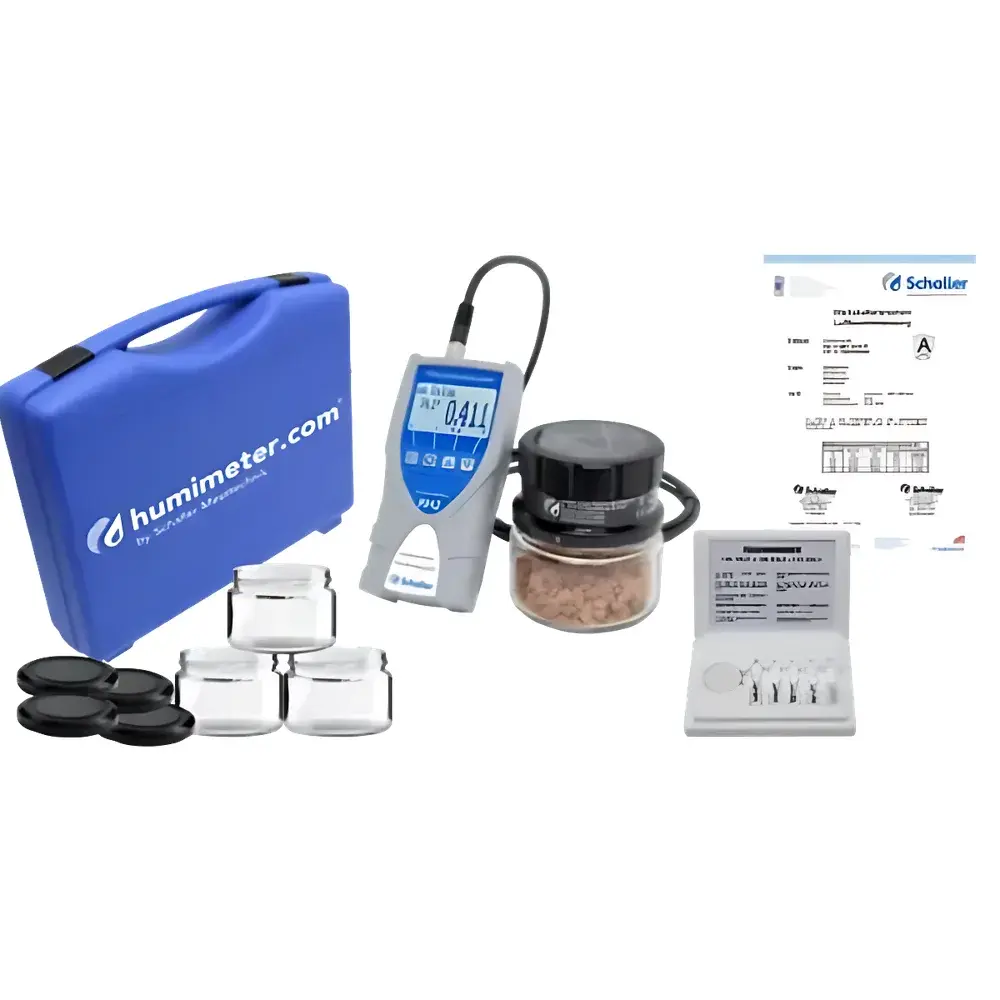
- Dual measurement configuration: interchangeable 186 mL and 245 mL measurement chambers for bulk samples; 25 mL sample cup for low-volume or heterogeneous materials
- Simultaneous real-time display of water activity (aw), relative humidity (%RH), absolute humidity (g/m³), dew point (°C), and equilibrium moisture content (EMC) for wood or granular matrices
- Long-term sensor stability enabled by factory-calibrated, drift-compensated capacitive humidity sensing elements and precision NTC temperature probes
- Onboard data logging with capacity for up to 10,000 timestamped measurements, supporting manual entry, auto-record mode, and value-lock functionality
- Compact handheld form factor (145 × 75 × 30 mm; 210 g with batteries) optimized for lab bench use, production line QC stations, and field deployment
- Multi-language interface supporting English, German, French, Spanish, Portuguese, Italian, Russian, Czech, and Polish — configurable without firmware update
Sample Compatibility & Compliance
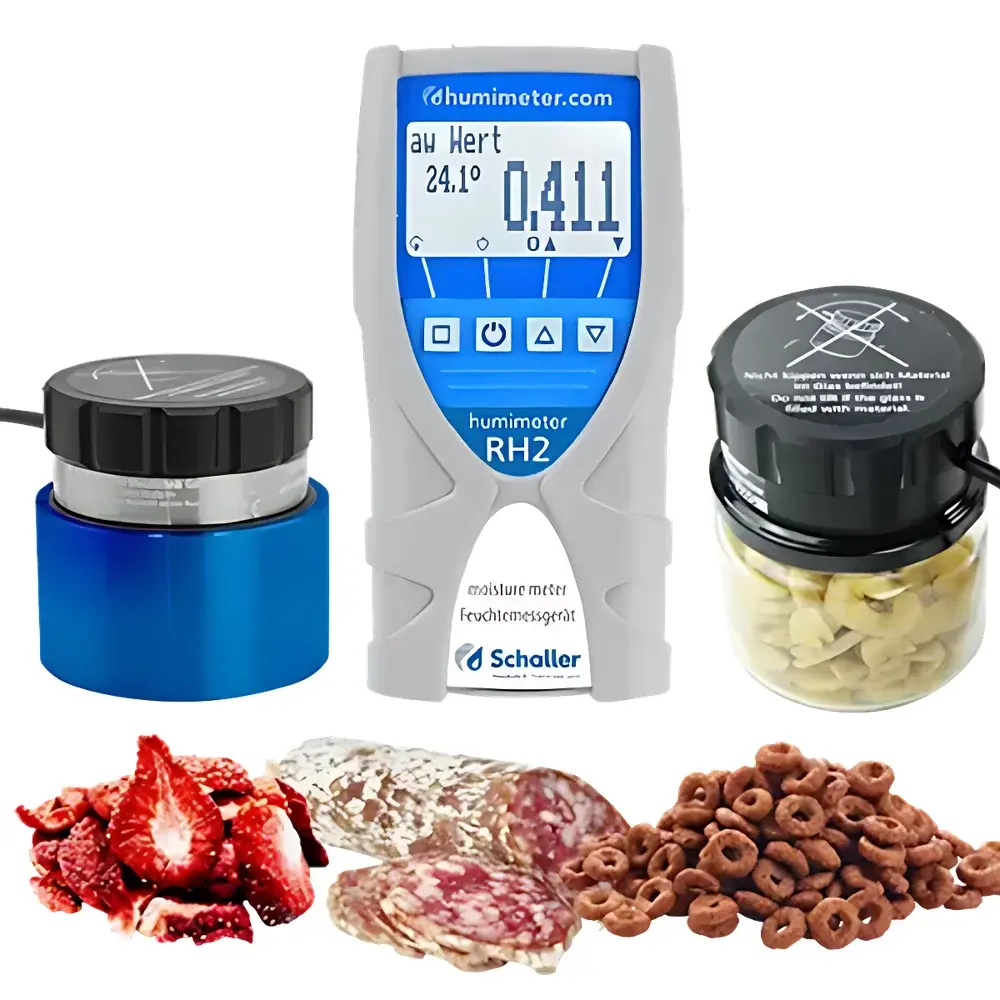
The RH2 accommodates diverse physical forms including viscous matrices (e.g., butter, fruit pastes), particulates (spices, dried herbs, granules), hygroscopic powders (xylitol, salt blends), polymers (PVC), and natural substrates (mushrooms, wood chips). Its modular chamber design ensures representative equilibration regardless of sample volume or surface-area-to-mass ratio. All measurements comply with EN ISO 21807 (“Foodstuffs — Determination of water activity”), providing auditable alignment with internationally recognized methodology. While not inherently 21 CFR Part 11 compliant out-of-the-box, the device supports GLP/GMP-aligned documentation practices through exportable CSV logs and user-defined measurement IDs — facilitating integration into validated quality management systems where electronic records are required.
Software & Data Management
Data retrieval is performed via USB connection using Schaller’s proprietary PC software (Windows-compatible), enabling batch export of measurement series, statistical summary generation (mean, SD, min/max), and time-series visualization. Each stored record includes date/time stamp, sensor ID, ambient temperature, chamber temperature, aw, %RH, dew point, and EMC values. The system supports audit-ready metadata tagging and allows users to assign sample identifiers and operator codes prior to measurement — critical for traceability in regulated environments. No cloud dependency or subscription model is involved; all data reside locally on-device until explicitly transferred.
Applications
The RH2 serves as a core tool in food safety and quality assurance programs, particularly for predicting microbial growth limits (e.g., inhibition of Staphylococcus aureus below aw 0.83, Aspergillus flavus below 0.78), optimizing drying processes, validating packaging barrier performance, and assessing ingredient compatibility in multi-phase products. It is routinely deployed in R&D labs developing shelf-stable confections, meat analogs, infant formula, and functional food powders. Beyond food, it supports moisture-sensitive material characterization in polymer manufacturing, herbal medicine standardization, and archival storage condition monitoring for cultural heritage institutions.
FAQ
What standards does the RH2 comply with?
The RH2 is designed and verified per EN ISO 21807 for water activity determination in foodstuffs.
Can the RH2 measure equilibrium moisture content (EMC) for non-wood materials?
EMC calculation is provided for wood and granular substances based on built-in isotherm models; custom isotherms require external correlation using exported aw and gravimetric moisture data.
Is sensor recalibration required in the field?
The RH2 features factory-traceable calibration; routine verification using certified salt standards (e.g., LiCl, MgCl₂) is recommended every 6–12 months depending on usage frequency and environmental exposure.
Does the device support automated reporting for regulatory submissions?
While the RH2 itself does not generate PDF reports, its structured CSV output integrates seamlessly with LIMS platforms and internal QA reporting templates used in FDA- or EFSA-regulated facilities.
How long does a typical measurement take?
Equilibration time varies by sample type and initial moisture gradient; most homogeneous foods stabilize within 3–8 minutes under controlled ambient conditions (20–25 °C).