
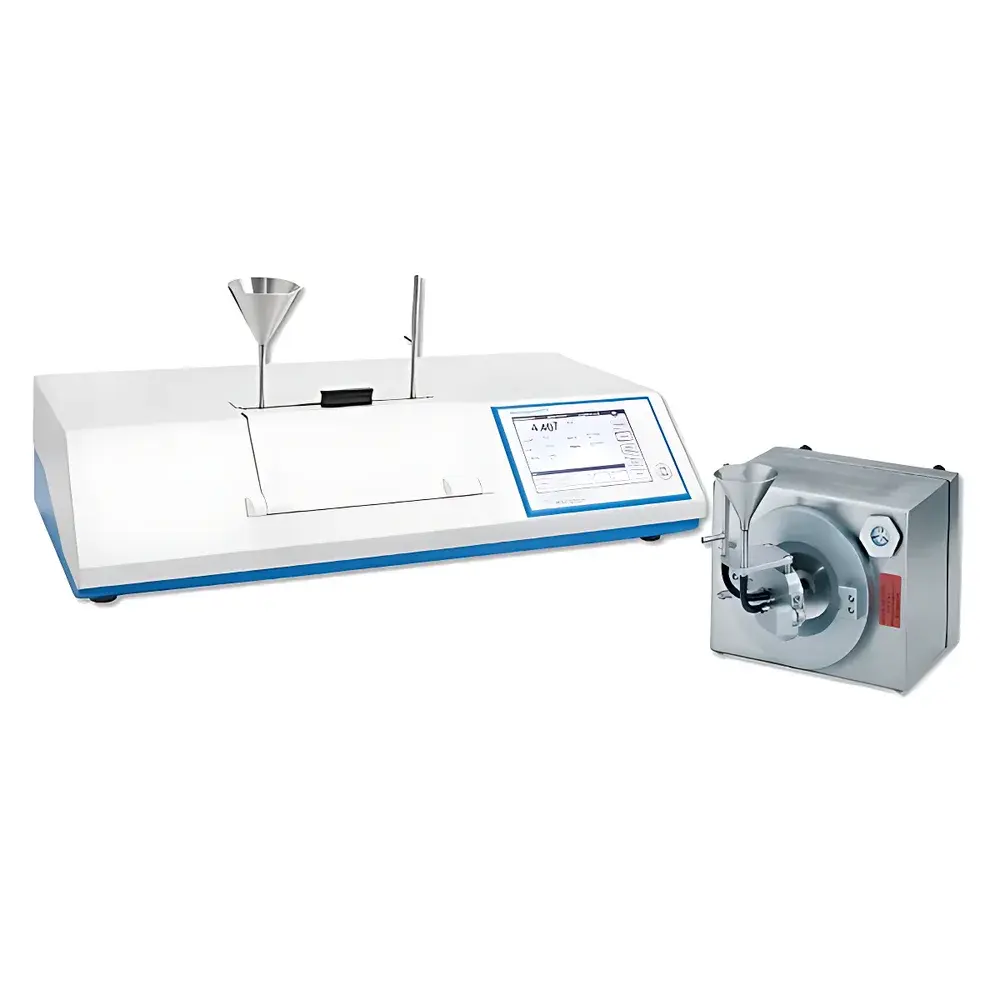
Schmidt + Haensch Auto-Purity Analyzer for Sucrose and Biopharmaceutical Applications
| Brand | Schmidt + Haensch |
|---|---|
| Origin | Germany |
| Configuration | Modular Standalone or PC-Linked Dual-Unit System |
| Compliance | ICUMSA Method GS4/3-12 (2021) |
| Measurement Principle | Simultaneous Polarimetry & Refractometry |
| Temperature Compensation | Integrated Peltier-Controlled Cell with ±0.02 °C Stability |
| Display Options | Touchscreen or LCD Keypad Interface |
| Data Output | Direct thermal printer interface |
| Software Integration | S+H PuritySuite v3.2 (FDA 21 CFR Part 11 compliant audit trail, GLP/GMP-ready) |
| Sample Handling | Compatible with Autofilt Z automatic filtration for turbid/dark samples |
| Optical Platform | Quartz-wedge polarimetry (Saccharomat series) or digital Faraday-modulated polarimetry (Polartronic M series) + ATR-based refractometry (ATR-B/F/R models) |
| Typical Applications | Raw juice, thin juice, thick juice, molasses, syrups, monoclonal antibody formulations, recombinant protein solutions |
Overview
The Schmidt + Haensch Auto-Purity Analyzer is a purpose-engineered dual-parameter optical instrument designed for high-accuracy purity determination in sucrose processing and biopharmaceutical formulation QC. It operates on the fundamental principle of concurrent polarimetric and refractometric measurement—leveraging the linear relationship between optical rotation (α), specific refraction increment (dn/dc), and concentration-dependent purity indices defined by the International Commission for Uniform Methods of Sugar Analysis (ICUMSA). Unlike single-mode analyzers, this system eliminates inter-instrument calibration drift by co-locating both measurement axes within a thermally stabilized optical path. The analyzer implements ICUMSA GS4/3-12 (2021) algorithms natively in firmware, enabling real-time calculation of purity (%) as defined for cane and beet sugar intermediates—including correction for invert sugar interference and temperature-dependent dispersion effects. Its architecture supports both fully autonomous operation and synchronized dual-unit PC-based analysis, making it suitable for ISO 17025-accredited laboratories and FDA-regulated biomanufacturing environments requiring traceable, auditable data generation.
Key Features
- Modular dual-sensor platform: Integrates either Saccharomat quartz-wedge polarimeters (models 101/103/202) or Polartronic M digital Faraday-effect polarimeters (models 100/101/202) with PURE-S ATR refractometer heads (ATR-B/F/R variants)
- Self-contained computation engine: Onboard ICUMSA-compliant purity calculation without dependency on external PCs; results displayed in real time on optional touchscreen or LCD keypad interface
- Automated thermal compensation: Peltier-regulated sample cell maintains ±0.02 °C stability across 15–40 °C operating range; integrated Pt100 sensor enables dynamic correction per ICUMSA Annex B.3
- Direct thermal print output: RS-232 or USB-connected receipt printer generates timestamped, GMP-aligned hardcopy reports with operator ID, batch ID, and measurement metadata
- NIR-compatible workflow extension: Optional integration with Autofilt Z automated filtration module for particulate-laden or optically dense samples (e.g., unclarified beet juice, aggregated mAb formulations)
- FDA 21 CFR Part 11 readiness: Firmware-level electronic signature support, role-based access control, and immutable audit trail logging via S+H PuritySuite v3.2 software
Sample Compatibility & Compliance
The Auto-Purity Analyzer accommodates liquid-phase samples ranging from clarified sucrose solutions (0–95 Brix) to viscous, colored intermediates such as thick juice (65–85 Brix) and molasses (75–88 Brix), as well as therapeutic protein formulations containing excipients like sucrose, trehalose, or mannitol. Its ATR-refractometry head tolerates absorbance up to OD350 = 2.8 without signal saturation, while NIR-polarimetry variants extend dynamic range for turbid biologics. All configurations comply with ICUMSA GS4/3-12 methodology for sugar purity and are validated per ASTM E2915-22 for optical instrument performance verification. For pharmaceutical applications, the system meets USP <1058> Analytical Instrument Qualification requirements and supports IQ/OQ/PQ documentation packages aligned with EU Annex 11 and ICH Q5C guidelines.
Software & Data Management
S+H PuritySuite v3.2 provides centralized configuration, method management, and data reconciliation for multi-instrument deployments. It enforces ALCOA+ data integrity principles through encrypted SQLite database storage, automated backup scheduling, and granular user permission tiers (Administrator, Analyst, Reviewer). Electronic records include full raw polarimetric waveforms, refractometric spectral scans (400–1000 nm), and intermediate calculation logs—each digitally signed and time-stamped via NIST-traceable hardware clock. Batch export supports CSV, PDF/A-2, and XML formats compatible with LIMS integration (e.g., LabWare, Thermo Fisher SampleManager). Audit trails are immutable and exportable for regulatory inspection under FDA 21 CFR Part 11 Subpart C.
Applications
- Sugar refinery QC: Real-time purity monitoring of raw juice, carbonation filtrate, evaporator feed, and final syrup streams
- Biopharmaceutical release testing: Quantitative assessment of excipient purity (e.g., sucrose in lyophilized mAb formulations) per ICH Q5C stability protocols
- Contract manufacturing organizations (CMOs): Cross-site method transfer validation using standardized ICUMSA traceable reference materials
- Academic research labs: Kinetic studies of enzymatic sucrose inversion under controlled temperature gradients
- Regulatory compliance labs: Generation of auditable data packages for EMA scientific advice procedures and PMDA pre-submission consultations
FAQ
Does the Auto-Purity Analyzer require external calibration standards for daily use?
No—built-in factory-calibrated quartz control plates and NIST-traceable sucrose reference solutions enable automated verification per ICUMSA GS2/3-10. Daily system suitability checks are performed internally without user intervention.
Can the instrument differentiate between sucrose and other optically active carbohydrates in complex matrices?
Yes—when operated with Polartronic M series polarimeters and spectral ATR refractometers, multivariate calibration models (PLS regression) can resolve overlapping contributions from glucose, fructose, and maltose based on wavelength-resolved refractive index dispersion profiles.
Is remote diagnostics supported for global service contracts?
Yes—optional S+H RemoteLink module enables encrypted TLS 1.3 tunneling for secure firmware updates, log retrieval, and real-time sensor health monitoring via ISO/IEC 27001-certified infrastructure.






